Department of Pharmacy and Pharmaceutical Sciences, St. Jude Children's Research Hospital, Memphis, TN, USA.
Graduate Program in Pharmaceutical Sciences, College of Pharmacy, University of Tennessee Health Science Center, Memphis, TN, USA.
Nat Commun. 2024 Apr 29;15(1):3642. doi: 10.1038/s41467-024-48029-2.
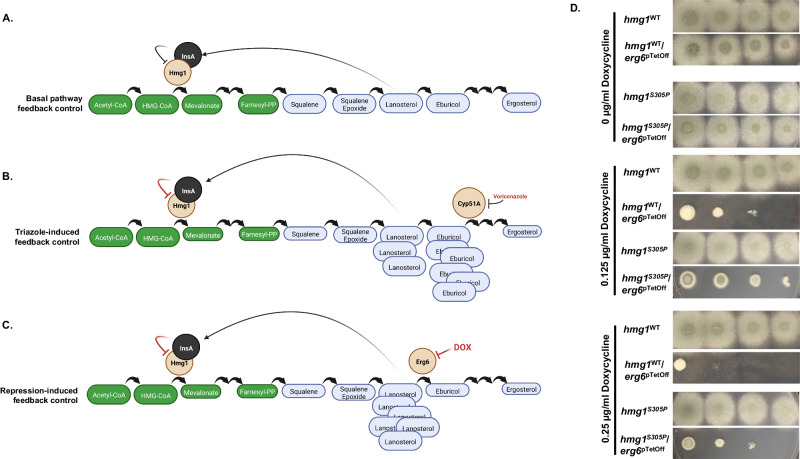
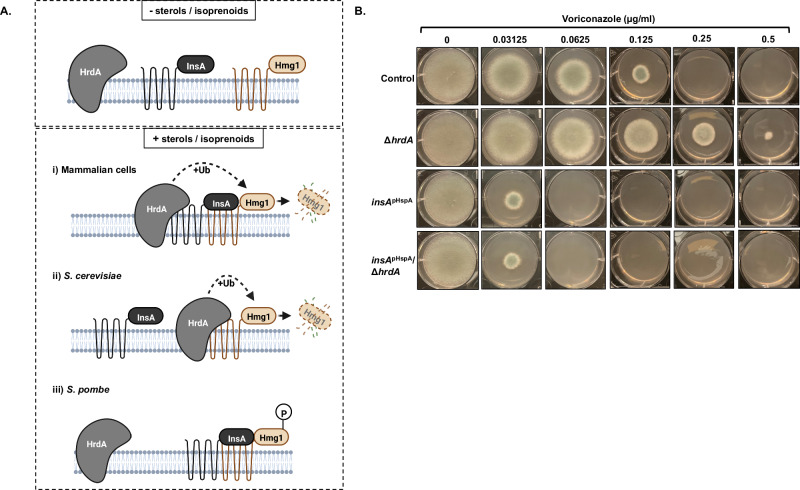
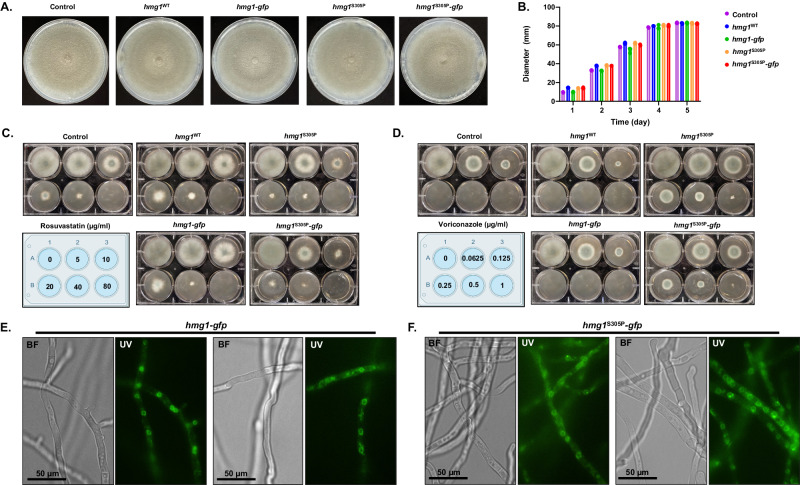
Triazole antifungals function as ergosterol biosynthesis inhibitors and are frontline therapy for invasive fungal infections, such as invasive aspergillosis. The primary mechanism of action of triazoles is through the specific inhibition of a cytochrome P450 14-α-sterol demethylase enzyme, Cyp51A/B, resulting in depletion of cellular ergosterol. Here, we uncover a clinically relevant secondary mechanism of action for triazoles within the ergosterol biosynthesis pathway. We provide evidence that triazole-mediated inhibition of Cyp51A/B activity generates sterol intermediate perturbations that are likely decoded by the sterol sensing functions of HMG-CoA reductase and Insulin-Induced Gene orthologs as increased pathway activity. This, in turn, results in negative feedback regulation of HMG-CoA reductase, the rate-limiting step of sterol biosynthesis. We also provide evidence that HMG-CoA reductase sterol sensing domain mutations previously identified as generating resistance in clinical isolates of Aspergillus fumigatus partially disrupt this triazole-induced feedback. Therefore, our data point to a secondary mechanism of action for the triazoles: induction of HMG-CoA reductase negative feedback for downregulation of ergosterol biosynthesis pathway activity. Abrogation of this feedback through acquired mutations in the HMG-CoA reductase sterol sensing domain diminishes triazole antifungal activity against fungal pathogens and underpins HMG-CoA reductase-mediated resistance.
三唑类抗真菌药物作为麦角固醇生物合成抑制剂,是治疗侵袭性真菌感染(如侵袭性曲霉菌病)的一线药物。三唑类药物的主要作用机制是通过特异性抑制细胞色素 P450 14-α-固醇去甲基酶 Cyp51A/B,导致细胞内麦角固醇耗竭。在这里,我们揭示了麦角固醇生物合成途径中三唑类药物的一种临床相关的次要作用机制。我们提供的证据表明,三唑类药物抑制 Cyp51A/B 活性会产生固醇中间产物的扰动,这些扰动可能被 HMG-CoA 还原酶和胰岛素诱导基因同源物的固醇感应功能解码为增加途径活性。这反过来又导致了麦角固醇生物合成限速步骤 HMG-CoA 还原酶的负反馈调节。我们还提供的证据表明,先前在烟曲霉临床分离株中发现的导致耐药性的 HMG-CoA 还原酶固醇感应结构域突变,部分破坏了这种三唑类药物诱导的反馈。因此,我们的数据指出了三唑类药物的另一种作用机制:诱导 HMG-CoA 还原酶的负反馈,下调麦角固醇生物合成途径的活性。通过在 HMG-CoA 还原酶固醇感应结构域中获得的突变来阻断这种反馈,会降低三唑类抗真菌药物对真菌病原体的活性,并支持 HMG-CoA 还原酶介导的耐药性。