Moura Lívia de Lima, Neto Mercedes, Souza-Santos Reinaldo
Escola Nacional de Saúde Pública Sergio Arouca (ENSP) Programa de Pós-Graduação em Epidemiologia em Saúde Pública Rio de Janeiro (RJ) Brasil Escola Nacional de Saúde Pública Sergio Arouca (ENSP), Programa de Pós-Graduação em Epidemiologia em Saúde Pública, Rio de Janeiro (RJ), Brasil.
Universidade do Estado do Rio de Janeiro (UERJ) Departamento de Enfermagem de Saúde Pública Rio de Janeiro (RJ) Brasil Universidade do Estado do Rio de Janeiro (UERJ), Departamento de Enfermagem de Saúde Pública, Rio de Janeiro (RJ), Brasil.
Rev Panam Salud Publica. 2024 Apr 29;48:e34. doi: 10.26633/RPSP.2024.34. eCollection 2024.
To evaluate immunization coverage and dropout rates of the measles, mumps, and rubella vaccine across Brazilian regions.
This ecological study employing a space-time approach used data from the National Immunization Program (PNI) and the Live Births Information System (SINASC). We estimated the annual variation (2014 to 2021) in immunization coverage and dropout rate of the measles, mumps, and rubella vaccine in children aged 12 and 15 months in the 5 570 Brazilian municipalities. Statistical analysis was conducted for the municipalities contained in each Brazilian region using the space-time scan technique, considering the Poisson probabilistic model and the hypothesis that municipalities with lower immunization coverage or high dropout rates would form space-time clusters.
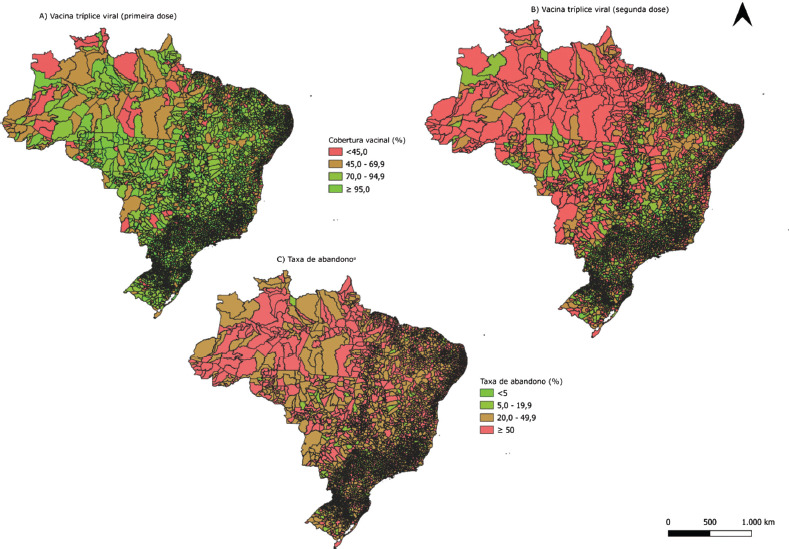
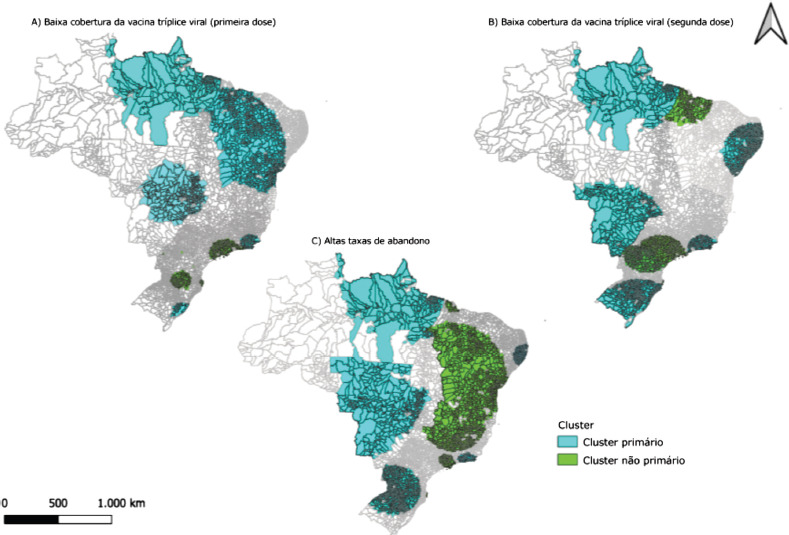
From 2014 to 2021, 38.3% and 12.9% of municipalities achieved a coverage ≥ 95.0% in the first and second doses respectively; 53.6% of municipalities had a high dropout rate (20.0% to 49.9%) and 37.2% had a very high dropout rate. The Northeast region had primary clusters for low coverage of the first (2018 to 2021) and second vaccine doses (2020 to 2021) with higher relative risks (RR) compared to other primary clusters. The RR for high dropout rate was elevated in all Brazilian regions (1.57 to 26.23).
In some Brazilian regions, the dropout rate has been high since 2014, signaling a risk of measles resurgence. In turn, space-time analysis indicated lower vaccination coverage in 2020, suggesting the influence of the COVID-19 pandemic.
评估巴西各地区麻疹、腮腺炎和风疹疫苗的免疫覆盖率及疫苗接种中断率。
本生态研究采用时空分析法,使用了国家免疫规划(PNI)和活产信息系统(SINASC)的数据。我们估算了巴西5570个市中12至15个月龄儿童麻疹、腮腺炎和风疹疫苗免疫覆盖率及疫苗接种中断率的年度变化(2014年至2021年)。使用时空扫描技术对巴西各地区的市进行统计分析,考虑泊松概率模型以及免疫覆盖率较低或疫苗接种中断率较高的市会形成时空聚集的假设。
2014年至2021年,分别有38.3%和12.9%的市第一剂和第二剂疫苗的覆盖率≥95.0%;53.6%的市疫苗接种中断率较高(20.0%至49.9%),37.2%的市疫苗接种中断率非常高。东北地区存在第一剂(2018年至2021年)和第二剂疫苗(2020年至2021年)覆盖率低的主要聚集区,与其他主要聚集区相比相对风险更高。巴西所有地区疫苗接种中断率较高的相对风险均有所升高(1.57至26.23)。
自2014年以来,巴西一些地区的疫苗接种中断率一直很高,这预示着麻疹疫情有卷土重来的风险。反过来,时空分析表明2020年疫苗接种覆盖率较低,这表明了新冠疫情的影响。