Alves Yan Mathias, Berra Thaís Zamboni, Tavares Reginaldo Bazon Vaz, Zini Nathalia, Ferreira Quézia Rosa, Andrade Licia Kellen de Almeida, Tártaro Ariela Fehr, Pelodan Maria Eduarda Pagano, Vigato Beatriz Fornaziero, Silveira Beatriz Kuroda, Assumpção Ana Luiza Brasileiro Nato Marques, Popolin Marcela Antunes Paschoal, Curvo Patricia Abrahão, Protti-Zanatta Simone, Serrano-Gallardo Maria Del Pilar, Arcêncio Ricardo Alexandre, Palha Pedro Fredemir, Ballestero Jaqueline Garcia de Almeida
Department of Maternal-Infant and Public Health Nursing, Ribeirão Preto College of Nursing, University of São Paulo, Ribeirão Preto 14040-902, São Paulo, Brazil.
Nursing Department, Federal University of Tocantins, Palmas 77001-090, Tocantins, Brazil.
Vaccines (Basel). 2024 Dec 20;12(12):1434. doi: 10.3390/vaccines12121434.
Vaccines are a significant public health achievement, which are crucial for child survival and disease control globally. In Brazil, the National Immunization Program (PNI) manages vaccination schedules, including essential vaccines like BCG and Hepatitis B, administered at birth. Despite achieving over 95% coverage for years, vaccination rates have declined since 2016, a trend exacerbated by the COVID-19 pandemic. This study aims to analyze spatial and temporal trends in BCG and Hepatitis B vaccination coverage at birth, identify areas with spatial variation in these trends, classify the identified trends, and investigate the pandemic's impact on vaccination adherence.
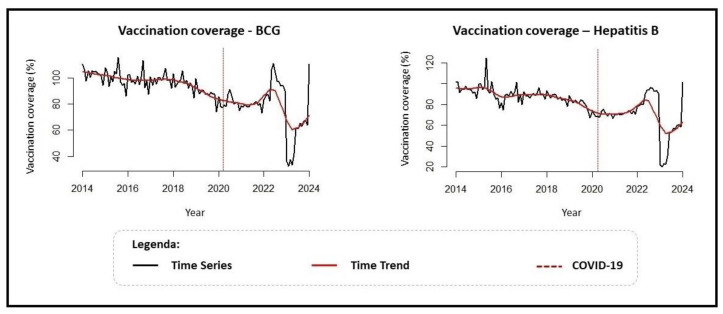
This is an ecological study with real-world data from Brazil, focusing on vaccination coverage from 2014 to 2023. Utilizing the Spatial Variation in Temporal Trends (SVTT) technique, the study identifies municipalities' vaccination trends. It also employs time series analysis and Interrupted Time Series methods to evaluate the pandemic's impact on vaccination rates, using data from the PNI and the Information System on Live Births (SINASC).
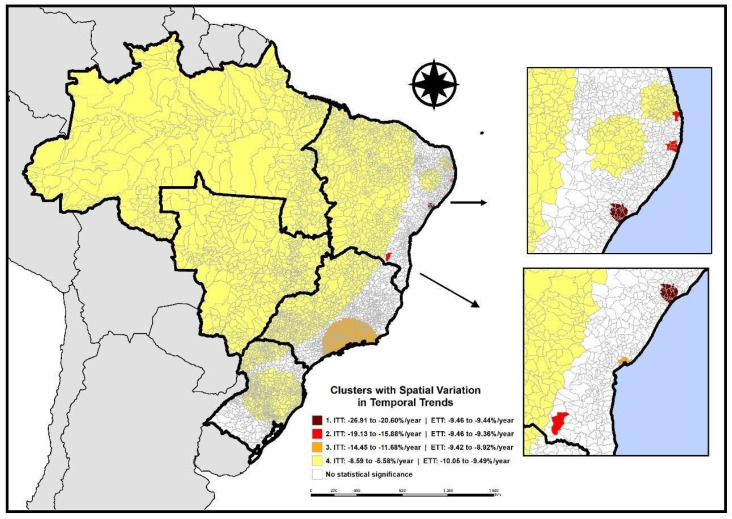
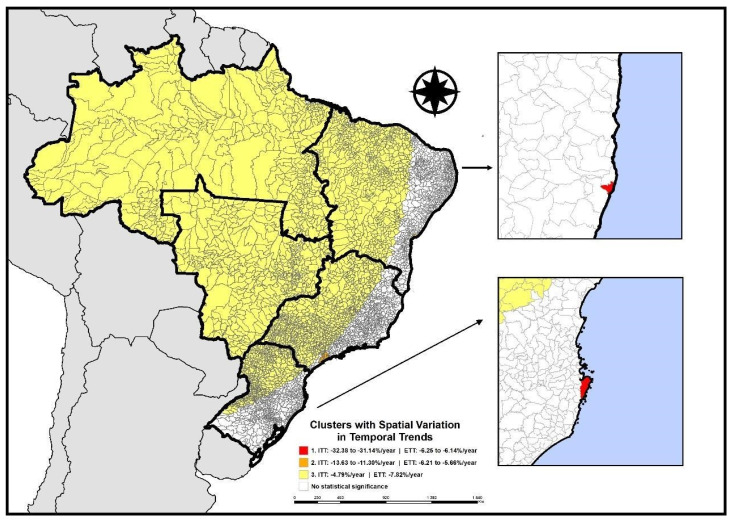
Between January 2014 and December 2023, Brazil administered 25,902,207 doses of the BCG vaccine to children at birth, with 3911 municipalities (70.24%) showing declining trends, particularly in Florianópolis. Similarly, 22,962,434 doses of the Hepatitis B vaccine were administered, with 3284 municipalities also experiencing declines.
It is crucial that public health policies be reevaluated to address regional disparities in vaccination coverage, particularly in more vulnerable areas. Focused interventions, such as awareness campaigns, improved access to vaccination services, and strengthened monitoring, are fundamental to reversing this trend.
疫苗是一项重大的公共卫生成就,对全球儿童生存和疾病控制至关重要。在巴西,国家免疫规划(PNI)管理疫苗接种计划,包括出生时接种的卡介苗和乙肝疫苗等基本疫苗。尽管多年来覆盖率超过95%,但自2016年以来疫苗接种率有所下降,新冠疫情加剧了这一趋势。本研究旨在分析出生时卡介苗和乙肝疫苗接种覆盖率的空间和时间趋势,确定这些趋势存在空间差异的地区,对确定的趋势进行分类,并调查疫情对疫苗接种依从性的影响。
这是一项利用巴西真实世界数据的生态学研究,重点关注2014年至2023年的疫苗接种覆盖率。该研究利用时间趋势空间变异(SVTT)技术确定各市的疫苗接种趋势。它还采用时间序列分析和中断时间序列方法,利用国家免疫规划和活产信息系统(SINASC)的数据评估疫情对疫苗接种率的影响。
2014年1月至2023年12月期间,巴西共为出生儿童接种了25,902,207剂卡介苗,3911个市(70.24%)呈现下降趋势,在弗洛里亚诺波利斯尤为明显。同样,共接种了22,962,434剂乙肝疫苗,3284个市也出现了下降。
重新评估公共卫生政策以解决疫苗接种覆盖率的地区差异至关重要,特别是在更脆弱的地区。有针对性的干预措施,如提高认识运动、改善疫苗接种服务的可及性和加强监测,是扭转这一趋势的基础。