Department of Population Health Sciences, Duke University School of Medicine, Durham, North Carolina.
Center of Innovation to Accelerate Discovery and Practice Transformation, Durham Veterans Affairs Medical Center, Durham, North Carolina.
JAMA Netw Open. 2024 Apr 1;7(4):e248732. doi: 10.1001/jamanetworkopen.2024.8732.
Individuals with dialysis-dependent kidney failure have numerous risk factors for medication-related adverse events, including receipt of care by multiple clinicians and initiation of some QT-prolonging medications with known risk of torsades de pointes (TdP), which is associated with higher risk of sudden cardiac death. Little is known about the prescription and dispensation patterns of QT-prolonging medications among people receiving dialysis, hindering efforts to reduce drug-related harm from these and other medications in this high-risk population.
To examine prescription and dispensation patterns of QT-prolonging medications with known TdP risk and selected interacting medications prescribed to individuals receiving hemodialysis.
DESIGN, SETTING, AND PARTICIPANTS: This cross-sectional study included patients 60 years or older who were enrolled in Medicare Parts A, B, and D receiving in-center hemodialysis from January 1 to December 31, 2019. Analyses were conducted from October 20, 2022, to June 16, 2023.
New-user prescriptions for the 7 most frequently filled QT-prolonging medications characterized by the timing of the new prescription relative to acute care encounters, the type of prescribing clinician and pharmacy that dispensed the medication, and concomitant use of selected medications known to interact with the 7 most frequently filled QT-prolonging medications with known TdP risk.
The main outcomes were the frequencies of the most commonly filled and new-use episodes of QT-prolonging medications; the timing of medication fills relative to acute care events; prescribers and dispensing pharmacy characteristics for new use of medications; and the frequency and types of new-use episodes with concurrent use of potentially interacting medications.
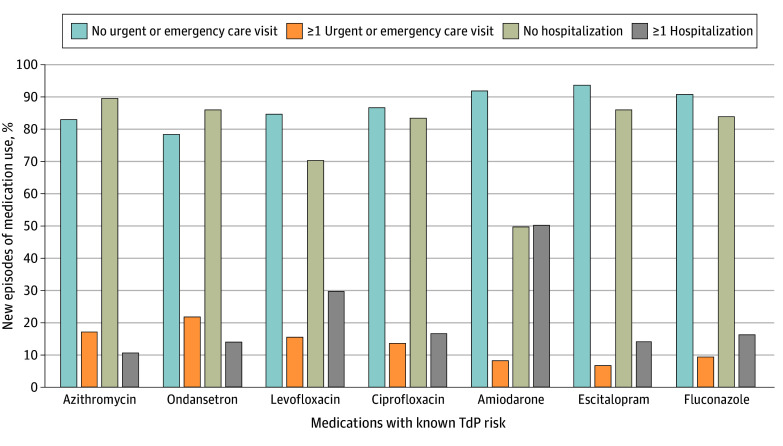
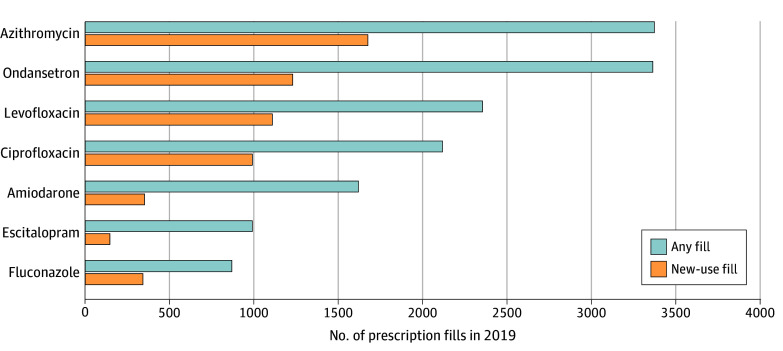
Of 20 761 individuals receiving hemodialysis in 2019 (mean [SD] age, 74 [7] years; 51.1% male), 10 992 (52.9%) filled a study drug prescription. Approximately 80% (from 78.6% for odansetron to 93.9% for escitalopram) of study drug new-use prescriptions occurred outside of an acute care event. Between 36.8% and 61.0% of individual prescriptions originated from general medicine clinicians. Between 16.4% and 26.2% of these prescriptions occurred with the use of another QT-prolonging medication. Most potentially interacting drugs were prescribed by different clinicians (46.3%-65.5%).
In this cross-sectional study, QT-prolonging medications for individuals with dialysis-dependent kidney failure were commonly prescribed by nonnephrology clinicians and from nonacute settings. Prescriptions for potentially interacting medications often originated from different prescribers. Strategies aimed at minimizing high-risk medication-prescribing practices in the population undergoing dialysis are needed.
透析依赖型肾衰竭患者存在许多与药物相关的不良事件的风险因素,包括接受多名临床医生的治疗和开始使用一些已知具有尖端扭转型室性心动过速(TdP)风险的延长 QT 间期药物,这与更高的心脏性猝死风险相关。对于接受透析的人群中,延长 QT 间期药物的处方和配药模式知之甚少,这阻碍了降低这些和其他高危人群中药物相关危害的努力。
检查具有已知 TdP 风险的延长 QT 间期药物和选定的与这些药物相互作用的药物在接受血液透析的个体中的处方和配药模式。
设计、设置和参与者:这项横断面研究纳入了 2019 年 1 月 1 日至 12 月 31 日期间参加医疗保险 A、B 和 D 部分并接受中心血液透析的 60 岁及以上患者。分析于 2022 年 10 月 20 日至 2023 年 6 月 16 日进行。
根据新处方与急性护理事件的时间关系、开具药物的临床医生和药房的类型以及与已知具有 TdP 风险的 7 种最常使用的延长 QT 间期药物相互作用的选定药物的同时使用,对 7 种最常使用的延长 QT 间期药物的新用户处方进行评估。
主要结局是最常使用和新使用延长 QT 间期药物的频率;药物配药与急性护理事件的时间关系;新使用药物的处方医生和配药药房特征;以及同时使用潜在相互作用药物的新使用药物的频率和类型。
在 2019 年接受血液透析的 20761 名患者中(平均[标准差]年龄 74[7]岁;51.1%为男性),10992 名(52.9%)患者开出了研究药物处方。大约 80%(从奥氮平的 78.6%到依地普仑的 93.9%)的研究药物新处方发生在急性护理事件之外。约 36.8%至 61.0%的个体处方来自普通内科医生。其中约 16.4%至 26.2%的处方与另一种延长 QT 间期药物同时使用。大多数潜在相互作用药物由不同的医生开具(46.3%-65.5%)。
在这项横断面研究中,透析依赖型肾衰竭患者的延长 QT 间期药物通常由非肾病学医生开具,并在非急性环境下开具。潜在相互作用药物的处方通常来自不同的医生。需要制定策略,尽量减少透析人群中高危药物的处方。