Xu Yi-Ran, Zhao Jinglu, Huang Hsi-Yuan, Lin Yang-Chi-Dung, Lee Tzong-Yi, Huang Hsien-Da, Yang Yi, Wang Yong-Fei
Warshel Institute for Computational Biology, The Chinese University of Hong Kong, Shenzhen, Guangdong, China.
School of Medicine, The Chinese University of Hong Kong, Shenzhen, Guangdong, China.
Front Nutr. 2024 Apr 16;11:1366435. doi: 10.3389/fnut.2024.1366435. eCollection 2024.
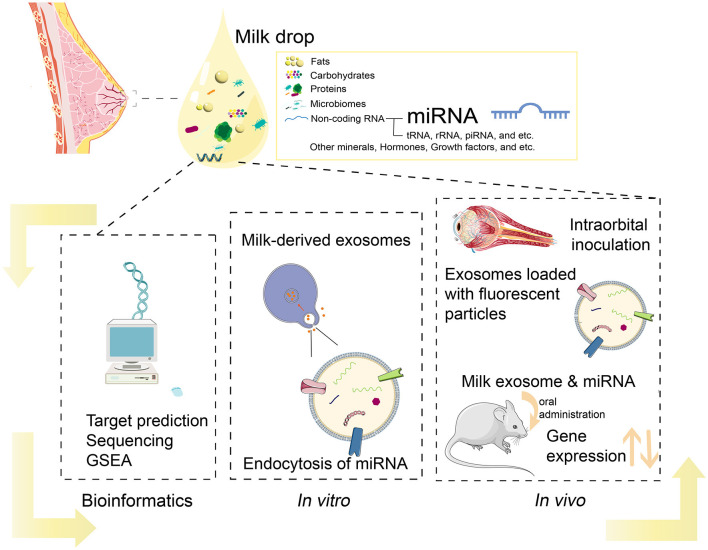
Breast milk (BM) is a primary biofluid that plays a crucial role in infant development and the regulation of the immune system. As a class of rich biomolecules in BM, microRNAs (miRNAs) are regarded as active factors contributing to infant growth and development. Surprisingly, these molecules exhibit resilience in harsh conditions, providing an opportunity for infants to absorb them. In addition, many studies have shown that miRNAs in breast milk, when absorbed into the gastrointestinal system, can act as a class of functional regulators to effectively regulate gene expression. Understanding the absorption pattern of BM miRNA may facilitate the creation of formula with a more optimal miRNA balance and pave the way for novel drug delivery techniques. In this review, we initially present evidence of BM miRNA absorption. Subsequently, we compile studies that integrate both and findings to illustrate the bioavailability and biodistribution of BM miRNAs post-absorption. In addition, we evaluate the strengths and weaknesses of previous studies and discuss potential variables contributing to discrepancies in their outcomes. This literature review indicates that miRNAs can be absorbed and act as regulatory agents.
母乳是一种主要的生物流体,在婴儿发育和免疫系统调节中起着至关重要的作用。作为母乳中一类丰富的生物分子,微小RNA(miRNAs)被视为有助于婴儿生长发育的活性因子。令人惊讶的是,这些分子在恶劣条件下具有弹性,为婴儿吸收它们提供了机会。此外,许多研究表明,母乳中的miRNAs被吸收到胃肠道系统后,可作为一类功能调节剂有效调节基因表达。了解母乳miRNA的吸收模式可能有助于创建具有更优化miRNA平衡的配方奶粉,并为新型药物递送技术铺平道路。在这篇综述中,我们首先展示母乳miRNA吸收的证据。随后,我们汇总了结合体内和体外研究结果的研究,以阐明母乳miRNAs吸收后的生物利用度和生物分布。此外,我们评估了以往研究的优缺点,并讨论了导致其结果存在差异的潜在变量。这篇文献综述表明,miRNAs可以被吸收并作为调节因子发挥作用。