Department of Nursing, Ya'an Vocational College, Ya'an, Sichuan, China.
Int J Biol Sci. 2012;8(1):118-23. doi: 10.7150/ijbs.8.118. Epub 2011 Nov 29.
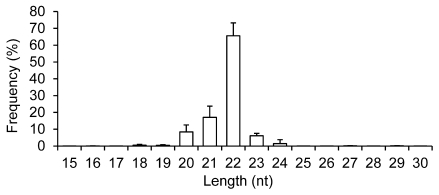
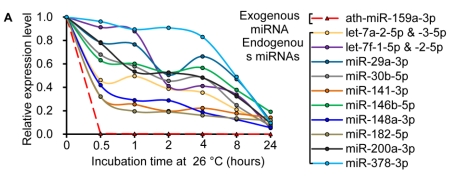
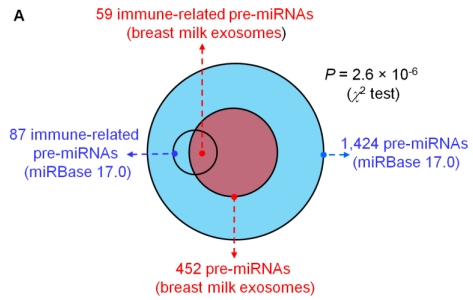
Breast milk is a complex liquid rich in immunological components that affect the development of the infant's immune system. Exosomes are membranous vesicles of endocytic origin that are found in various body fluids and that can mediate intercellular communication. MicroRNAs (miRNAs), a well-defined group of non-coding small RNAs, are packaged inside exosomes in human breast milk. Here, we identified 602 unique miRNAs originating from 452 miRNA precursors (pre-miRNAs) in human breast milk exosomes using deep sequencing technology. We found that, out of 87 well-characterized immune-related pre-miRNAs, 59 (67.82%) are presented and enriched in breast milk exosomes (P < 10(-16), χ(2) test). In addition, compared with exogenous synthetic miRNAs, these endogenous immune-related miRNAs are more resistant to relatively harsh conditions. It is, therefore, tempting to speculate that these exosomal miRNAs are transferred from the mother's milk to the infant via the digestive tract, and that they play a critical role in the development of the infant immune system.
母乳是一种富含影响婴儿免疫系统发育的免疫成分的复杂液体。外泌体是一种起源于内吞作用的膜性囊泡,存在于各种体液中,能够介导细胞间的通讯。微小 RNA(miRNA)是一类定义明确的非编码小 RNA,在人乳外泌体中以内含体的形式存在。在这里,我们使用深度测序技术在人乳外泌体中鉴定出 602 个独特的源自 452 个 miRNA 前体(pre-miRNA)的 miRNA。我们发现,在 87 个具有良好特征的免疫相关 pre-miRNA 中,59 个(67.82%)在外泌体中呈现并富集(P<10(-16),卡方检验)。此外,与外源性合成 miRNA 相比,这些内源性免疫相关 miRNA 对相对恶劣的条件更具抵抗力。因此,人们推测这些外泌体 miRNA 是通过消化道从母亲的乳汁传递给婴儿的,并且在婴儿免疫系统的发育中发挥着关键作用。