Department of Psychology, University of Milano-Bicocca, Piazza dell'Ateneo Nuovo, 1, 20126, Milan, Italy.
Mind and Behavior Technological Center, University of Milano-Bicocca, Milan, Italy.
Sci Rep. 2024 May 1;14(1):10011. doi: 10.1038/s41598-024-59570-x.
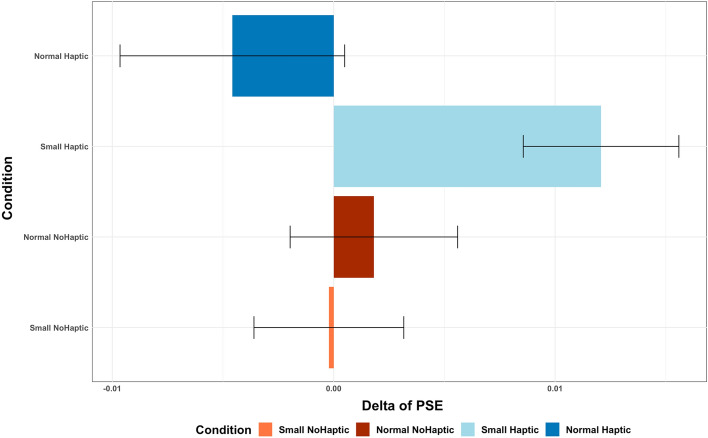
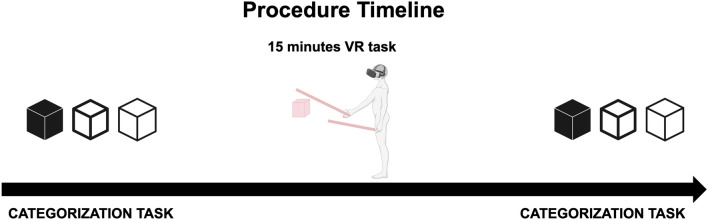
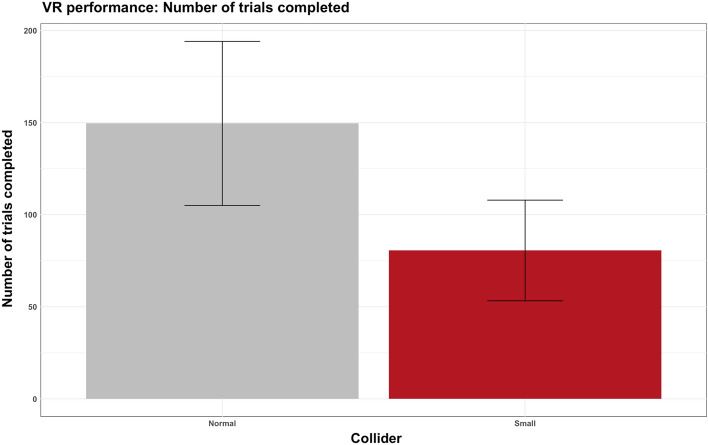
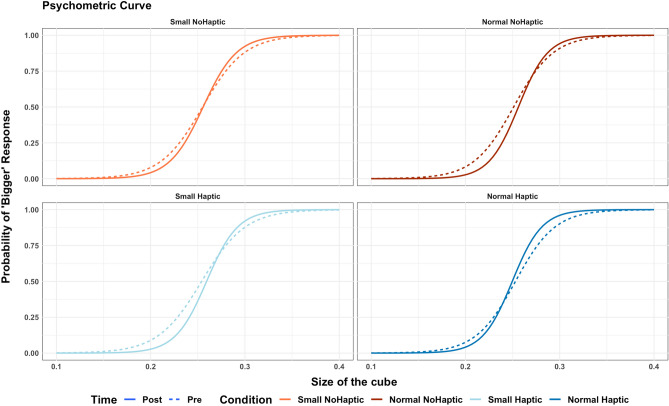
Interacting with the environment often requires the integration of visual and haptic information. Notably, perceiving external objects depends on how our brain binds sensory inputs into a unitary experience. The feedback provided by objects when we interact (through our movements) with them might then influence our perception. In VR, the interaction with an object can be dissociated by the size of the object itself by means of 'colliders' (interactive spaces surrounding the objects). The present study investigates possible after-effects in size discrimination for virtual objects after exposure to a prolonged interaction characterized by visual and haptic incongruencies. A total of 96 participants participated in this virtual reality study. Participants were distributed into four groups, in which they were required to perform a size discrimination task between two cubes before and after 15 min of a visuomotor task involving the interaction with the same virtual cubes. Each group interacted with a different cube where the visual (normal vs. small collider) and the virtual cube's haptic (vibration vs. no vibration) features were manipulated. The quality of interaction (number of touches and trials performed) was used as a dependent variable to investigate the performance in the visuomotor task. To measure bias in size perception, we compared changes in point of subjective equality (PSE) before and after the task in the four groups. The results showed that a small visual collider decreased manipulation performance, regardless of the presence or not of the haptic signal. However, change in PSE was found only in the group exposed to the small visual collider with haptic feedback, leading to increased perception of the cube size. This after-effect was absent in the only visual incongruency condition, suggesting that haptic information and multisensory integration played a crucial role in inducing perceptual changes. The results are discussed considering the recent findings in visual-haptic integration during multisensory information processing in real and virtual environments.
与环境交互通常需要整合视觉和触觉信息。值得注意的是,外部物体的感知取决于我们的大脑如何将感官输入整合为一个单一的体验。当我们(通过运动)与物体相互作用时,物体提供的反馈可能会影响我们的感知。在 VR 中,通过“碰撞器”(围绕物体的交互空间)可以将物体本身的大小与物体的交互分开。本研究调查了在长时间的视觉和触觉不一致的交互后,暴露于虚拟物体的大小辨别后效。共有 96 名参与者参与了这项虚拟现实研究。参与者被分为四组,在进行 15 分钟的视觉运动任务(涉及与相同的虚拟立方体交互)之前和之后,他们需要在两个立方体之间执行大小辨别任务。每组与一个不同的立方体交互,其中视觉(正常与小碰撞器)和虚拟立方体的触觉(振动与无振动)特征被操纵。交互质量(触摸次数和执行的试验次数)用作因变量,以研究视觉运动任务中的性能。为了测量大小感知的偏差,我们在四个组中比较了任务前后 PSE(主观相等点)的变化。结果表明,小的视觉碰撞器会降低操作性能,无论是否存在触觉信号。然而,仅在暴露于具有触觉反馈的小视觉碰撞器的组中发现 PSE 的变化,导致对立方体大小的感知增加。在仅存在视觉不一致的情况下,这种后效不存在,这表明触觉信息和多感觉整合在诱导感知变化方面起着至关重要的作用。考虑到在真实和虚拟环境中多感觉信息处理过程中视觉-触觉整合的最新发现,对结果进行了讨论。