Paris-Lodron-University of Salzburg, Department of Psychology, Centre for Cognitive Neuroscience, Salzburg, Austria.
Department of Otorhinolaryngology, Head and Neck Surgery, Paracelsus Medical University Salzburg, 5020, Salzburg, Austria.
Nat Commun. 2024 May 1;15(1):3692. doi: 10.1038/s41467-024-48126-2.
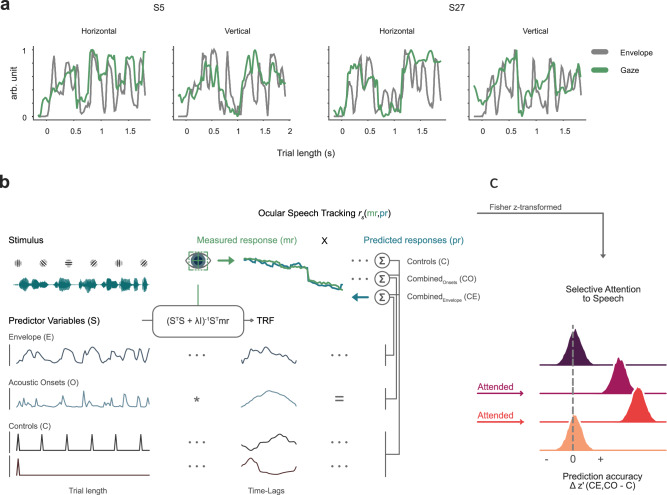
Over the last decades, cognitive neuroscience has identified a distributed set of brain regions that are critical for attention. Strong anatomical overlap with brain regions critical for oculomotor processes suggests a joint network for attention and eye movements. However, the role of this shared network in complex, naturalistic environments remains understudied. Here, we investigated eye movements in relation to (un)attended sentences of natural speech. Combining simultaneously recorded eye tracking and magnetoencephalographic data with temporal response functions, we show that gaze tracks attended speech, a phenomenon we termed ocular speech tracking. Ocular speech tracking even differentiates a target from a distractor in a multi-speaker context and is further related to intelligibility. Moreover, we provide evidence for its contribution to neural differences in speech processing, emphasizing the necessity to consider oculomotor activity in future research and in the interpretation of neural differences in auditory cognition.
在过去的几十年中,认知神经科学已经确定了一组对注意力至关重要的分布式大脑区域。与眼球运动过程关键区域的强烈解剖重叠表明注意力和眼球运动的共同网络。然而,这个共享网络在复杂的自然环境中的作用仍未得到充分研究。在这里,我们研究了与自然言语中的(未)关注句子有关的眼球运动。我们结合同时记录的眼动追踪和脑磁图数据以及时响应函数,表明注视跟踪关注的言语,我们将其称为眼球言语跟踪。眼球言语跟踪甚至可以区分多说话人环境中的目标和干扰项,并且与可理解性进一步相关。此外,我们提供了证据表明它对言语处理中的神经差异有贡献,强调了在未来的研究中以及在听觉认知的神经差异的解释中考虑眼球运动活动的必要性。