
癌症特异性健康效用值:对肺癌患者中欧洲癌症研究与治疗组织QLU-C10D核心测量属性的评估——来自四项多中心LUX-Lung试验的数据,采用六个国家的关税标准
Cancer-Specific Health Utilities: Evaluation of Core Measurement Properties of the EORTC QLU-C10D in Lung Cancer Patients-Data from Four Multicentre LUX-Lung Trials, Applying Six Country Tariffs.
作者信息
Pilz Micha J, Seyringer Simone, Al-Naesan Imad, King Madeleine T, Bottomley Andrew, Norman Richard, Schlosser Lisa, Hell Tobias, Gamper Eva Maria
机构信息
University Hospital of Psychiatry II, Medical University of Innsbruck, Innsbruck, Austria.
Department of Nuclear Medicine, Medical University of Innsbruck, 6020, Innsbruck, Austria.
出版信息
Pharmacoecon Open. 2024 Jul;8(4):627-640. doi: 10.1007/s41669-024-00484-9. Epub 2024 May 2.
BACKGROUND
Cost-utility analysis generally requires valid preference-based measures (PBMs) to assess the utility of patient health. While generic PBMs are widely used, disease-specific PBMs may capture additional aspects of health relevant for certain patient populations. This study investigates the construct and concurrent criterion validity of the cancer-specific European Organisation for Research and Treatment of Cancer (EORTC) Quality of Life Utility-Core 10 dimensions (QLU-C10D) in non-small-cell lung cancer patients.
METHODS
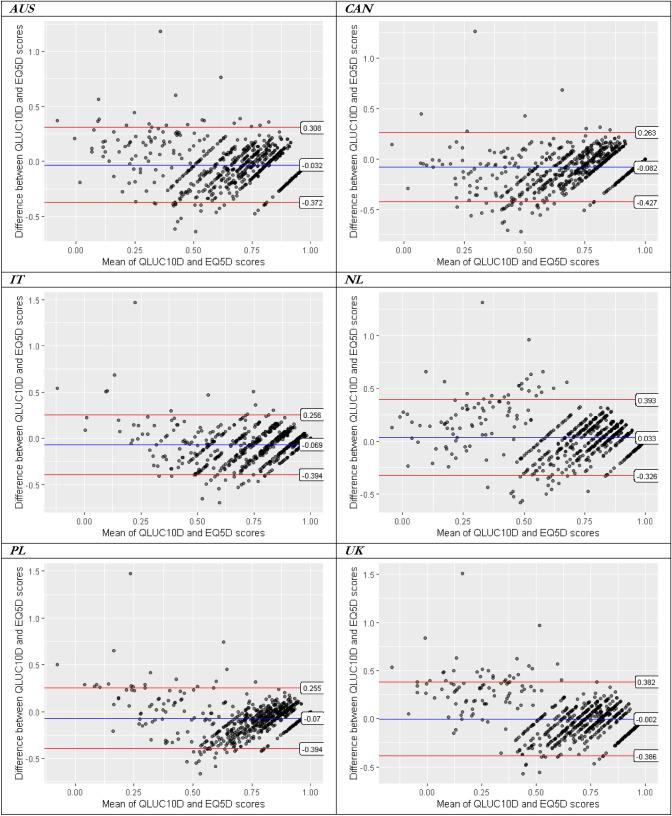
We retrospectively analysed data from four multicentre LUX-Lung trials, all of which had administered the EORTC Quality of Life Questionnaire (QLQ-C30) and the EQ-5D-3L. We applied six country-specific value sets (Australia, Canada, Italy, the Netherlands, Poland, and the United Kingdom) to both instruments. Criterion validity was assessed via correlations between the instruments' utility scores. Correlations of divergent and convergent domains and Bland-Altman plots investigated construct validity. Floor and ceiling effects were assessed.
RESULTS
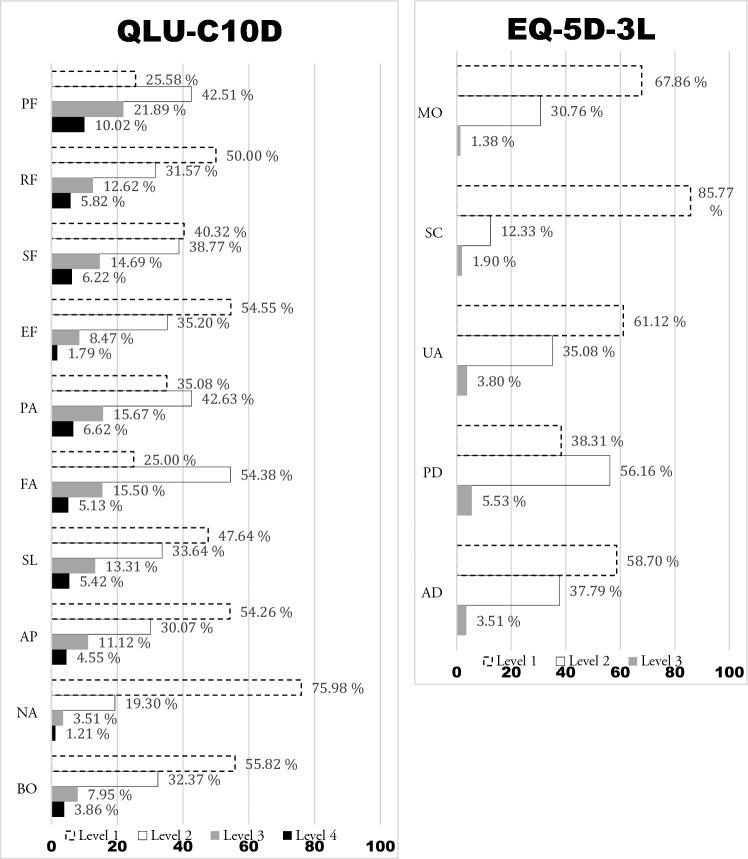
The comparison of the EORTC QLU-C10D and EQ-5D-3L produced homogenous results for five of the six country tariffs. High correlations of utilities (r > 0.7) were found for all country tariffs except for the Netherlands. Moderate to high correlations of converging domain pairs (r from 0.472 to 0.718) were found with few exceptions, such as the Social Functioning-Usual Activities domain pair (max. r = 0.376). For all but the Dutch tariff, the EORTC QLU-C10D produced consistently lower utility values compared to the EQ-5D-3L (x̄ difference from - 0.082 to 0.033). Floor and ceiling effects were consistently lower for the EORTC QLU-C10D (max. 4.67% for utilities).
CONCLUSIONS
The six country tariffs showed good psychometric properties for the EORTC QLU-C10D in lung cancer patients. Criterion and construct validity was established. The QLU-C10D showed superior measurement precision towards the upper and lower end of the scale compared to the EQ-5D-3L, which is important when cost-utility analysis seeks to measure health change across the severity spectrum.
背景
成本效用分析通常需要基于有效的偏好测量方法(PBMs)来评估患者健康的效用。虽然通用的PBMs被广泛使用,但特定疾病的PBMs可能会捕捉到与某些患者群体相关的健康的其他方面。本研究调查了癌症特异性的欧洲癌症研究与治疗组织(EORTC)生活质量效用核心10维度(QLU-C10D)在非小细胞肺癌患者中的结构效度和同时效度。
方法
我们回顾性分析了四项多中心LUX-Lung试验的数据,所有试验都实施了EORTC生活质量问卷(QLQ-C30)和EQ-5D-3L。我们将六个国家特定的价值集(澳大利亚、加拿大、意大利、荷兰、波兰和英国)应用于这两种工具。通过工具的效用得分之间的相关性评估效度。通过发散和收敛领域的相关性以及Bland-Altman图来研究结构效度。评估地板效应和天花板效应。
结果
在六个国家关税中的五个中,EORTC QLU-C10D和EQ-5D-3L的比较产生了同质的结果。除荷兰外,所有国家关税的效用相关性都很高(r>0.7)。除少数例外,如社会功能-日常活动领域对(最大r=0.376),收敛领域对的相关性从中等到高(r从0.472到0.718)。除荷兰关税外,与EQ-5D-3L相比,EORTC QLU-C10D产生的效用值始终较低(x̄差异从-0.082到0.033)。EORTC QLU-C10D的地板效应和天花板效应始终较低(效用最大为4.67%)。
结论
六个国家关税显示出EORTC QLU-C10D在肺癌患者中具有良好的心理测量特性。建立了效度和结构效度。与EQ-5D-3L相比,QLU-C10D在量表的上端和下端显示出更高的测量精度,这在成本效用分析试图测量整个严重程度范围内的健康变化时很重要。
 Zotero 插件