Tans Anouk, Struyf Thomas, Geboers Rune, Smeets Toon, Asselbergh Yorick, Declerck Emmanuel, Bloemen Luca, van den Bruel Ann
Department of Public Health and Primary Care, KU Leuven, Leuven, Belgium
Department of Public Health and Primary Care, KU Leuven, Leuven, Belgium.
BJGP Open. 2024 Oct 29;8(3). doi: 10.3399/BJGPO.2023.0245. Print 2024 Oct.
Acute abdominal pain is a common complaint, caused by a variety of conditions, ranging from acutely life-threatening to benign and self-limiting, with symptom overlap complicating diagnosis. Signs and symptoms may be valuable when assessing a patient to guide clinical work.
Summarising evidence on the accuracy of signs and symptoms for diagnosing serious illness in adults with acute abdominal pain in an ambulatory care setting.
DESIGN & SETTING: We performed a systematic review, searching for prospective diagnostic accuracy studies that included adults presenting with acute abdominal pain to an ambulatory care setting.
Six databases and guideline registers were searched, using a comprehensive search strategy. We assessed the risk of bias, and calculated descriptive statistics and measures of diagnostic accuracy. Results were pooled when at least four studies were available.
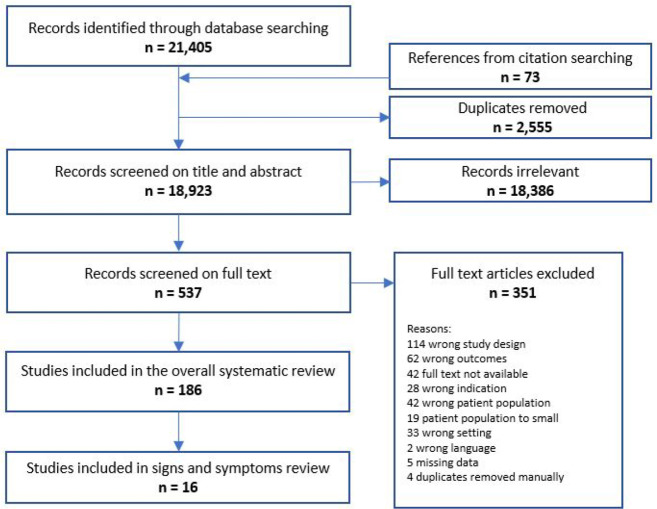
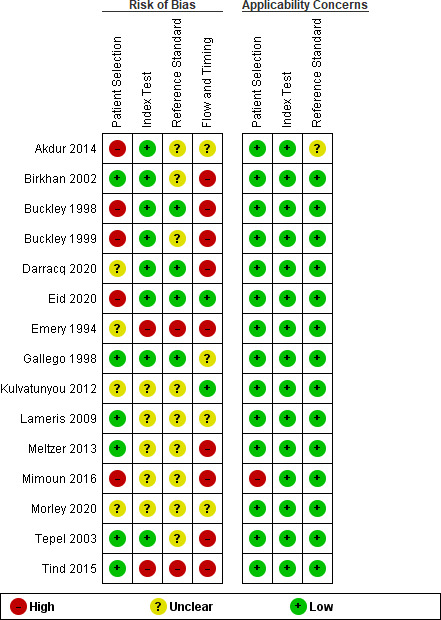
Out of 18 923 unique studies, 16 studies with moderate to high-risk bias were included. Fourteen clinical features met our criteria, including systolic blood pressure <100 mmHg (positive likelihood ratio [LR+]7.01), shock index >0.85, uterine cervical motion tenderness (LR+5.62 and negative likelihood ratio [LR-]8.60), and a self-assessment questionnaire score >70 (LR+12.20) or <25 (LR-0.19). Clinical diagnosis made by the clinician had the best rule-in ability (LR+24.6).
We identified 14 signs and symptoms that can influence the likelihood of a serious illness, including pain characteristics, systemic signs, gynaecological signs, and clinician's overall assessment. The risk of bias was moderate to high, leading to uncertainty and preventing us from making firm conclusions. This highlights the need for better research in this setting.
急性腹痛是一种常见的主诉,由多种情况引起,从急性危及生命到良性和自限性疾病不等,症状重叠使诊断复杂化。体征和症状在评估患者以指导临床工作时可能很有价值。
总结在门诊环境中,成人急性腹痛患者体征和症状诊断严重疾病准确性的证据。
我们进行了一项系统评价,检索前瞻性诊断准确性研究,这些研究纳入了因急性腹痛到门诊就诊的成人。
使用全面的检索策略检索六个数据库和指南登记册。我们评估了偏倚风险,并计算了描述性统计量和诊断准确性指标。当至少有四项研究可用时,对结果进行合并。
在18923项独特的研究中,纳入了16项中高风险偏倚的研究。14项临床特征符合我们的标准,包括收缩压<100 mmHg(阳性似然比[LR+]7.01)、休克指数>0.85、宫颈举痛(LR+5.62和阴性似然比[LR-]8.60)以及自我评估问卷评分>70(LR+12.20)或<25(LR-0.19)。临床医生做出的临床诊断具有最佳的纳入能力(LR+24.6)。
我们确定了14种可影响严重疾病可能性的体征和症状,包括疼痛特征、全身体征、妇科体征和临床医生的总体评估。偏倚风险为中度至高度,导致存在不确定性,使我们无法得出确切结论。这凸显了在此环境下开展更好研究的必要性。