Western Heights, The Mint Nairobi, M and E Advisory Group, Nairobi, Kenya.
Centre for Health Services Studies, University of Kent, Canterbury, UK.
BMJ Open. 2024 May 2;14(5):e082011. doi: 10.1136/bmjopen-2023-082011.
Kenya still faces the challenge of mothers and neonates dying from preventable pregnancy-related complications. The free maternity policy (FMP), implemented in 2013 and expanded in 2017 (Linda Mama Policy (LMP)), sought to address this challenge. This study examines the quality of care (QoC) across the continuum of maternal care under the LMP in Kenya.
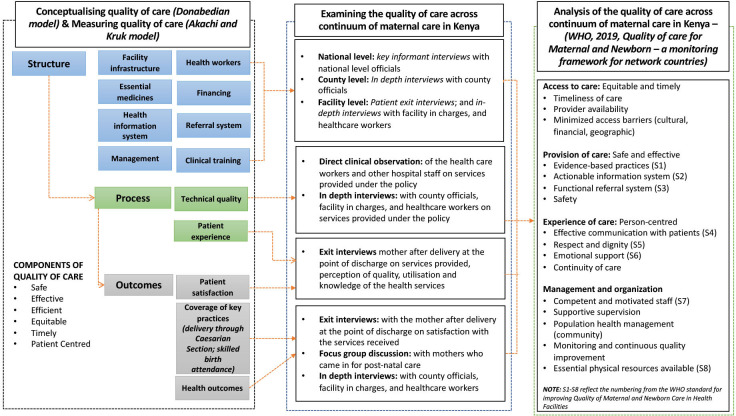
We conducted a convergent parallel mixed-methods study across multiple levels of the Kenyan health system, involving key informant interviews with national stakeholders (n=15), in-depth interviews with county officials and healthcare workers (HCWs) (n=21), exit interview survey with mothers (n=553) who utilised the LMP delivery services, and focus group discussions (n=9) with mothers who returned for postnatal visits (at 6, 10 and 14 weeks). Quantitative data were analysed descriptively, while qualitative data were analysed thematically. All the data were triangulated at the analysis and discussion stage using a framework approach guided by the QoC for maternal and newborns.
The results showed that the expanded FMP enhanced maternal care access: geographical, financial and service utilisation. However, the facilities and HCWs bore the brunt of the increased workload and burnout. There was a longer waiting time for the initial visit by the pregnant women because of the enhanced antenatal care package of the LMP. The availability and standards of equipment, supplies and infrastructure still posed challenges. Nurses were multitasking and motivated despite the human resources challenge. Mothers were happy to have received care information; however, there were challenges regarding respect and dignity they received (inadequate food, over-crowding, bed-sharing and lack of privacy), and they experienced physical, verbal and emotional abuse and a lack of attention/care.
Addressing the negative aspects of QoC while strengthening the positives is necessary to achieve the Universal Health Coverage goals through better quality service for every woman.
肯尼亚仍面临产妇和新生儿因可预防的与妊娠相关的并发症而死亡的挑战。2013 年实施的免费产妇政策(FMP),并于 2017 年扩大(琳达妈妈政策(LMP)),旨在解决这一挑战。本研究检查了肯尼亚 LMP 下孕产妇保健连续体的护理质量(QoC)。
我们在肯尼亚卫生系统的多个层面上进行了一项收敛平行混合方法研究,涉及与国家利益相关者(n=15)的关键人物访谈、与县官员和医疗保健工作者(HCWs)(n=21)的深入访谈、利用 LMP 分娩服务的产妇(n=553)的退出访谈调查,以及与返回接受产后访视(第 6、10 和 14 周)的母亲进行的焦点小组讨论(n=9)。定量数据进行描述性分析,定性数据进行主题分析。在分析和讨论阶段,使用以孕产妇和新生儿护理质量为指导的框架方法对所有数据进行三角剖分。
结果表明,扩大的 FMP 增加了获得产妇保健的机会:地理、财务和服务的利用。然而,设施和 HCWs 承担了增加工作量和倦怠的重担。由于 LMP 增强的产前保健套餐,孕妇的初次就诊等待时间更长。设备、用品和基础设施的可用性和标准仍然存在挑战。尽管面临人力资源挑战,护士还是承担了多项任务并保持积极性。母亲很高兴接受了护理信息;然而,她们在获得的尊重和尊严方面面临挑战(食物不足、过度拥挤、同床共枕和缺乏隐私),并遭受身体、言语和情感虐待以及缺乏关注/护理。
在加强积极方面的同时解决 QoC 的负面方面,对于通过为每一位女性提供更好的服务质量实现全民健康覆盖目标是必要的。