Ophthalmology Department, First Affiliated Hospital of Fujian Medical University, No. 20, Chazhong Road, Taijiang District, 350004, Fuzhou, Fujian, China.
Department of Neurosurgery, Shengli Clinical Medical College of Fujian Medical University, 516 Jinrong South Road, 350001, Fuzhou, China.
BMC Ophthalmol. 2024 May 2;24(1):204. doi: 10.1186/s12886-024-03441-6.
Uveal melanoma (UVM) is a malignant intraocular tumor in adults. Targeting genes related to oxidative phosphorylation (OXPHOS) may play a role in anti-tumor therapy. However, the clinical significance of oxidative phosphorylation in UVM is unclear.
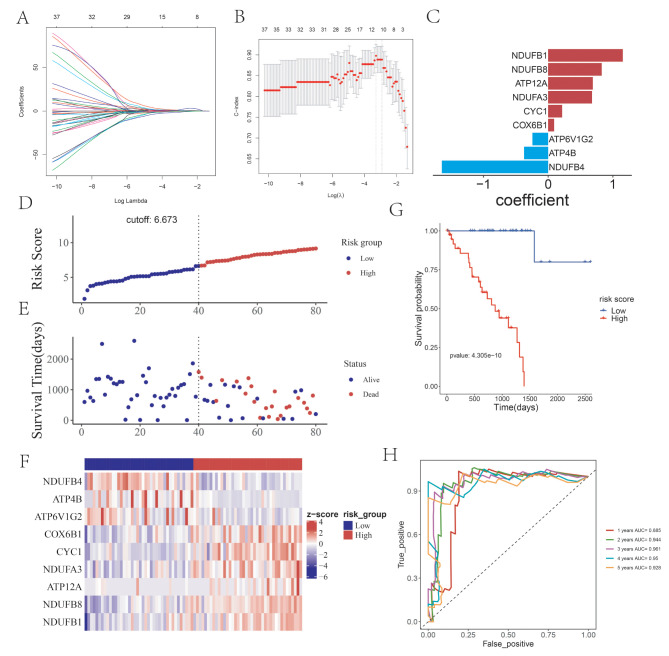
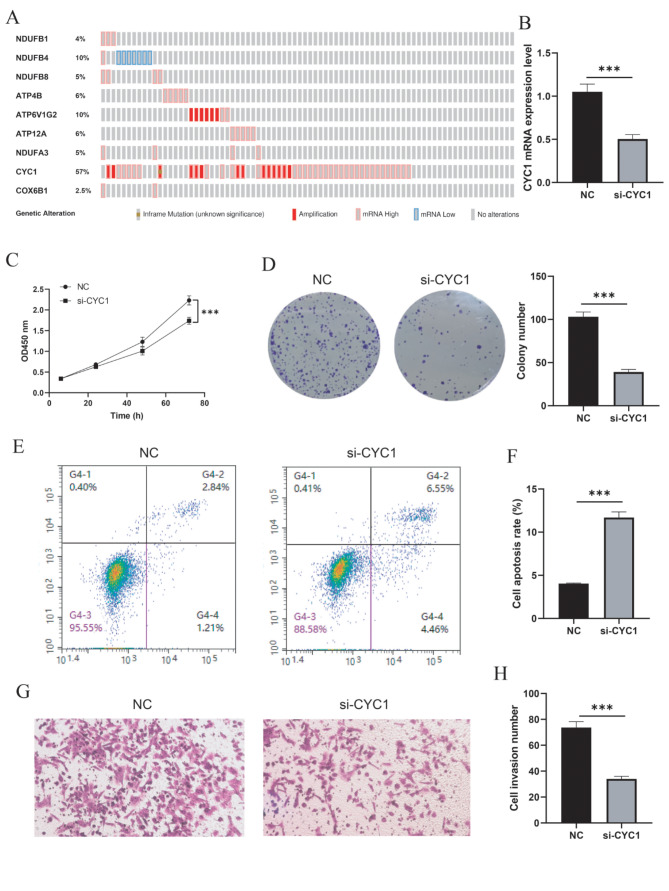
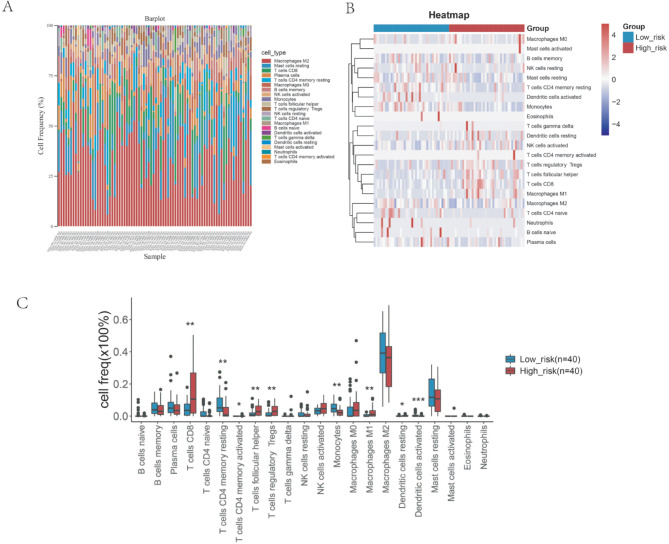
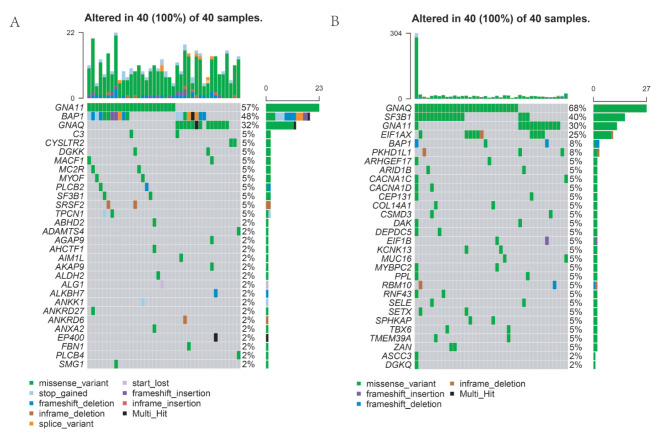
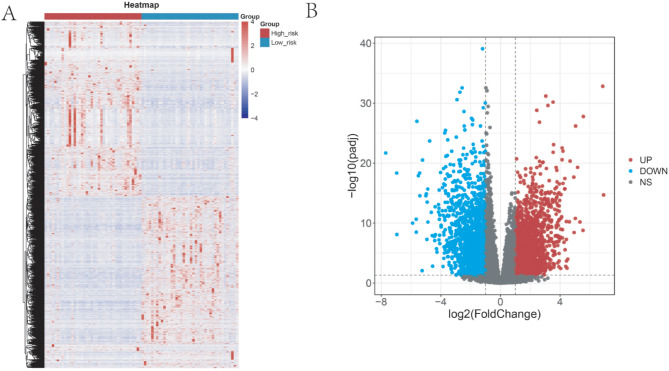
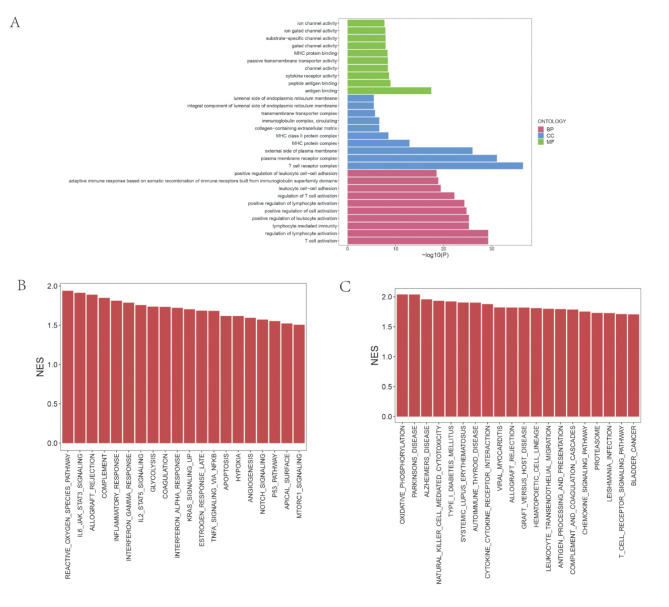
The 134 OXPHOS-related genes were obtained from the KEGG pathway, the TCGA UVM dataset contained 80 samples, served as the training set, while GSE22138 and GSE39717 was used as the validation set. LASSO regression was carried out to identify OXPHOS-related prognostic genes. The coefficients obtained from Cox multivariate regression analysis were used to calculate a risk score, which facilitated the construction of a prognostic model. Kaplan-Meier survival analysis, logrank test and ROC curve using the time "timeROC" package were conducted. The immune cell frequency in low- and high-risk group was analyzed through Cibersort tool. The specific genomic alterations were analyzed by "maftools" R package. The differential expressed genes between low- or high-risk group were analyzed and performed Gene Ontology (GO) and GSEA. Finally, we verified the function of CYC1 in UVM by gene silencing in vitro.
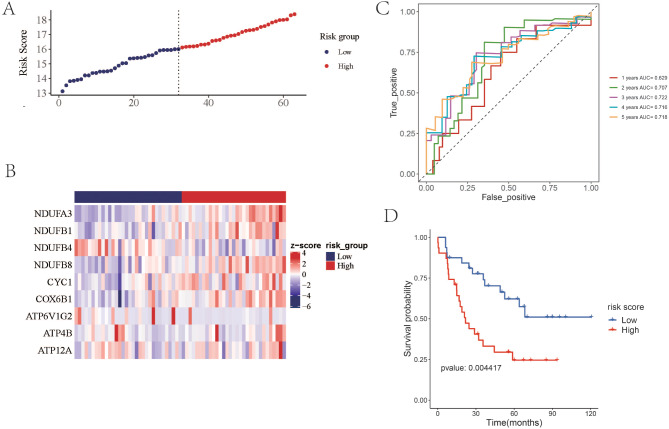
A total of 9 OXPHOS-related prognostic genes were identified, including NDUFB1, NDUFB8, ATP12A, NDUFA3, CYC1, COX6B1, ATP6V1G2, ATP4B and NDUFB4. The UVM prognostic risk model was constructed based on the 9 OXPHOS-related prognostic genes. The prognosis of patients in the high-risk group was poorer than low-risk group. Besides, the ROC curve demonstrated that the area under the curve of the model for predicting the 1 to 5-year survival rate of UVM patients were all more than 0.88. External validation in GSE22138 and GSE39717 dataset revealed that these 9 genes could also be utilized to evaluate and predict the overall survival of patients with UVM. The risk score levels related to immune cell frequency and specific genomic alterations. The DEGs between the low- and high- risk group were enriched in tumor OXPHOS and immune related pathway. In vitro experiments, CYC1 silencing significantly inhibited UVM cell proliferation and invasion, induced cell apoptosis.
In sum, a prognostic risk score model based on oxidative phosphorylation-related genes in UVM was developed to enhance understanding of the disease. This prognostic risk score model may help to find potential therapeutic targets for UVM patients. CYC1 acts as an oncogene role in UVM.
葡萄膜黑色素瘤(UVM)是一种发生于成年人的眼内恶性肿瘤。靶向氧化磷酸化(OXPHOS)相关基因可能在抗肿瘤治疗中发挥作用。然而,OXPHOS 在 UVM 中的临床意义尚不清楚。
从 KEGG 途径中获得 134 个 OXPHOS 相关基因,TCGA UVM 数据集包含 80 个样本,作为训练集,GSE22138 和 GSE39717 用作验证集。使用 LASSO 回归鉴定 OXPHOS 相关预后基因。通过 Cox 多变量回归分析获得的系数用于计算风险评分,从而构建预后模型。通过“timeROC”包进行 Kaplan-Meier 生存分析、对数秩检验和 ROC 曲线分析。通过 Cibersort 工具分析低风险和高风险组的免疫细胞频率。使用“maftools”R 包分析特定的基因组改变。分析低风险或高风险组之间的差异表达基因,并进行基因本体(GO)和 GSEA 分析。最后,通过体外基因沉默验证 CYC1 在 UVM 中的功能。
共鉴定出 9 个 OXPHOS 相关预后基因,包括 NDUFB1、NDUFB8、ATP12A、NDUFA3、CYC1、COX6B1、ATP6V1G2、ATP4B 和 NDUFB4。基于这 9 个 OXPHOS 相关预后基因构建了 UVM 预后风险模型。高风险组患者的预后较对照组差。此外,ROC 曲线表明,该模型预测 UVM 患者 1 至 5 年生存率的曲线下面积均大于 0.88。在 GSE22138 和 GSE39717 数据集的外部验证中,这 9 个基因也可用于评估和预测 UVM 患者的总生存率。风险评分水平与免疫细胞频率和特定基因组改变相关。低风险和高风险组之间的差异表达基因富集在肿瘤 OXPHOS 和免疫相关途径中。体外实验表明,CYC1 沉默显著抑制 UVM 细胞的增殖和侵袭,诱导细胞凋亡。
总之,本研究构建了基于 UVM 氧化磷酸化相关基因的预后风险评分模型,以增强对疾病的认识。该预后风险评分模型可能有助于为 UVM 患者找到潜在的治疗靶点。CYC1 在 UVM 中发挥癌基因作用。