Nepal Santosh, Neupane Nilhari, Koirala Sanju, Lautze Jonathan, Shrestha Ram Narayan, Bhatt Dinesh, Shrestha Nirman, Adhikari Manju, Kaini Santosh, Karki Shanta, Yangkhurung Jigyasha Rai, Gnawali Kapil, Singh Pradhan Ananta Man, Timsina Krishna, Pradhananga Saurav, Khadka Manohara
International Water Management Institute, Nepal Office, Kathmandu, Nepal.
International Water Management Institute, South Africa Office, Pretoria, South Africa.
Heliyon. 2024 Apr 10;10(9):e29407. doi: 10.1016/j.heliyon.2024.e29407. eCollection 2024 May 15.
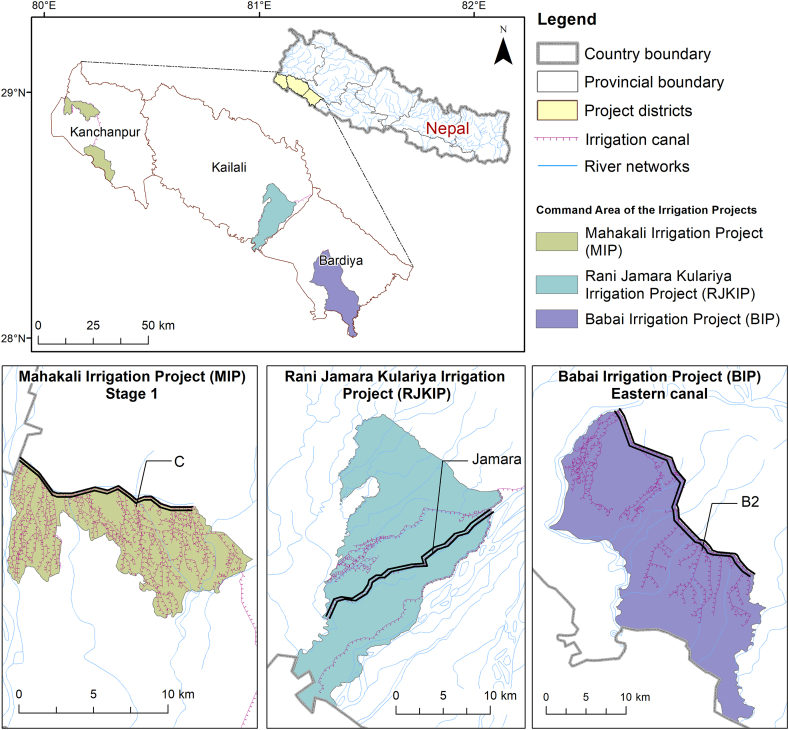
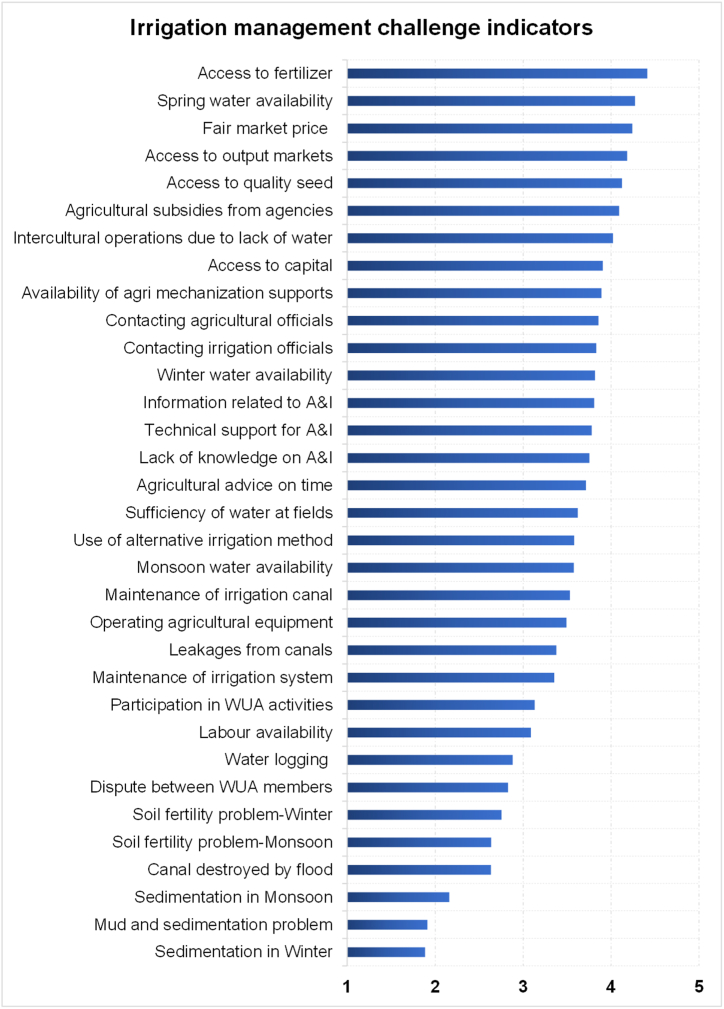
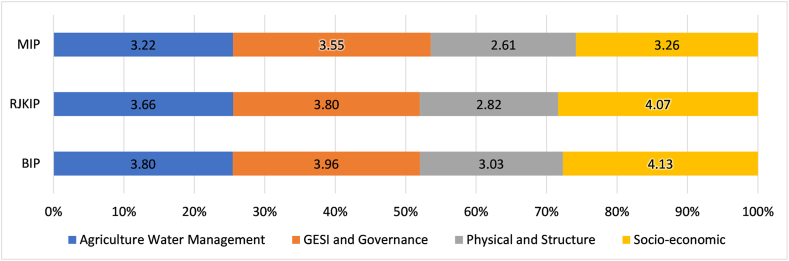
Agriculture plays a critical role in ensuring food and nutrition security, livelihood, and rural employment in Nepal. Despite substantial investments and institutional reforms, irrigation projects have faced consistently low performance. While existing studies have shed light on technical aspects of irrigation performance, they often focus on specific themes rather than holistic evaluations of sustainability. This research systematically assesses barriers and challenges to effective irrigation water management in Nepal by assessing and ranking the challenges faced by three irrigation systems in western Nepal: Mahakali, Rani Jamara Kulariya, and Babai. To investigate these challenges, we collected data from 449 households, which provided insights into 33 indicators representing key barriers to effective irrigation and agricultural management. The identified challenges were categorized into four broad thematic areas: physical and structural, agricultural and water, socioeconomic and market, and gender and governance. A comprehensive evaluation was conducted to compare these challenges among the three irrigation schemes, different thematic areas, and various locations within each scheme (namely, the head, mid, and tail sections of the system). The findings revealed that timely access and availability of fertilizers, spring water availability and fair market prices of agricultural products are the most significant challenges. The Babai irrigation system faced the most substantial challenges among the three systems, particularly in the mid section. These findings emphasize the interconnectedness of these challenges, highlighting the need for a holistic approach to planning, implementation, and management. Integrated strategies are essential to address socioeconomic, market, and endogenous farming issues, ensuring reliable irrigation water availability for sustainable agricultural production.
农业在确保尼泊尔的粮食和营养安全、生计及农村就业方面发挥着关键作用。尽管进行了大量投资和体制改革,但灌溉项目的绩效一直很低。虽然现有研究揭示了灌溉绩效的技术方面,但它们往往侧重于特定主题,而非对可持续性进行全面评估。本研究通过评估和排名尼泊尔西部三个灌溉系统——马哈卡利、拉尼·贾马拉·库拉里亚和巴拜所面临的挑战,系统地评估了尼泊尔有效灌溉水资源管理的障碍和挑战。为调查这些挑战,我们收集了449户家庭的数据,这些数据提供了有关代表有效灌溉和农业管理关键障碍的33项指标的见解。所确定的挑战分为四大主题领域:物理和结构、农业和水、社会经济和市场以及性别和治理。我们进行了全面评估,以比较这三个灌溉计划、不同主题领域以及每个计划内不同地点(即系统的首部、中部和尾部)之间的这些挑战。研究结果表明,化肥的及时获取和供应、泉水供应以及农产品的公平市场价格是最重大的挑战。在这三个系统中,巴拜灌溉系统面临的挑战最为严峻,尤其是在中部地区。这些研究结果强调了这些挑战的相互关联性,突出了在规划、实施和管理中采取整体方法的必要性。综合战略对于解决社会经济、市场和内生农业问题至关重要,以确保可靠的灌溉用水供应,实现可持续农业生产。