Gairhe Samaya, Timsina Krishna Prasad, Ghimire Yuga Nath, Lamichhane Jeevan, Subedi Subash, Shrestha Jiban
Nepal Agricultural Research Council, Singhdurbar Plaza, Kathmandu, Nepal.
National Agricultural Policy Research Centre, Khumaltar, Lalitpur, Nepal.
Heliyon. 2021 Apr 16;7(4):e06775. doi: 10.1016/j.heliyon.2021.e06775. eCollection 2021 Apr.
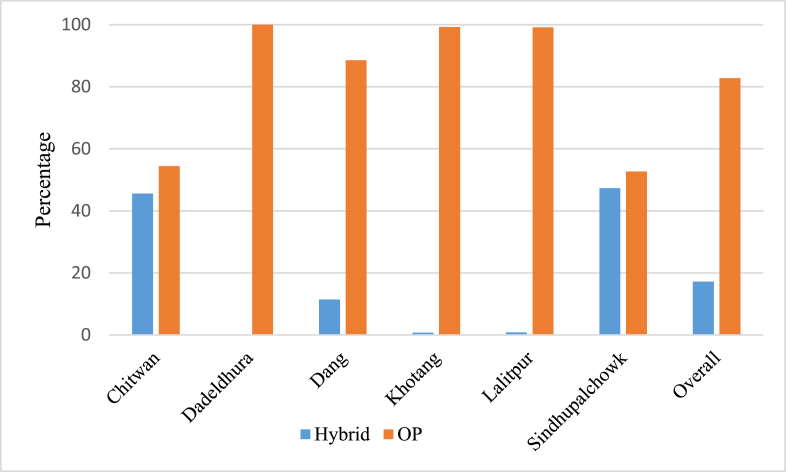
This study analyses the gaps and issues in the production and distribution system of maize seed in Nepal. A total of 682 households were surveyed in 2017 by employing multistage random sampling with probability proportionate to size by representing different (tarai and hill) agro-ecological zones. Twelve focus group discussions (FGDs) and four key informant interviews (KII) were also carried out. Results showed that the old varieties like Rampur Composite and Manakamana-3 are still popular in the farmers' fields. The cost of seed production was about 48% and the profit of the producer was 18% of the consumer price. The share of wholesalers was 15% of the consumer price whereas it was 19% for retailer/agro-vet. The average total cost of production was found to be $1392/ha and gross income was $1925/ha with the 1.38 average B: C ratio; it is, therefore, a lucrative enterprise. Out of a total of 27 released varieties, only 12 varieties have been used in seed production. Results revealed that 83% of the farmers cultivate open-pollinated maize varieties whereas 17% of them cultivate hybrid maize varieties. Seventy-five per cent of seed was from a formal source. The maize productivity, hybrid maize area, and seed replacement were below the targets set in Nepals' National Seed Vision, a policy document of the government. Focus on the production of nucleus and breeder seed by Government research farms and use of these seeds by private seed companies and community seed producing groups to produce next generation foundation seeds are urgently required. Equally important is enabling private and community-based organizations to produce hybrid seeds of the crop.
本研究分析了尼泊尔玉米种子生产与分销系统中的差距和问题。2017年,通过采用与规模成比例的概率抽样的多阶段随机抽样方法,代表不同(特莱和平原)农业生态区,共对682户家庭进行了调查。还开展了12次焦点小组讨论(FGD)和4次关键 informant访谈(KII)。结果表明,像兰布尔复合种和马纳卡马纳 - 3这样的老品种在农民田间仍然很受欢迎。种子生产成本约为消费者价格的48%,生产者利润为消费者价格的18%。批发商的份额为消费者价格的15%,而零售商/农业兽医的份额为19%。生产的平均总成本为1392美元/公顷,总收入为1925美元/公顷,平均B:C比为1.38;因此,这是一个有利可图的企业。在总共27个已发布的品种中,只有12个品种用于种子生产。结果显示,83%的农民种植开放授粉玉米品种,而17%的农民种植杂交玉米品种。75%的种子来自正规渠道。玉米生产力、杂交玉米种植面积和种子更换率均低于尼泊尔政府政策文件《国家种子愿景》设定的目标。迫切需要政府研究农场专注于原种和育种种子的生产,并让私营种子公司和社区种子生产团体使用这些种子来生产下一代基础种子。同样重要的是要使私营和社区组织能够生产该作物的杂交种子。