Cappabianca Dan, Pham Dan, Forsberg Matthew H, Bugel Madison, Tommasi Anna, Lauer Anthony, Vidugiriene Jolanta, Hrdlicka Brookelyn, McHale Alexandria, Sodji Quaovi H, Skala Melissa C, Capitini Christian M, Saha Krishanu
Wisconsin Institute for Discovery, University of Wisconsin-Madison, Madison, WI 53715, USA.
Department of Biomedical Engineering, University of Wisconsin-Madison, Madison, WI 53715, USA.
Mol Ther Methods Clin Dev. 2024 Apr 10;32(2):101249. doi: 10.1016/j.omtm.2024.101249. eCollection 2024 Jun 13.
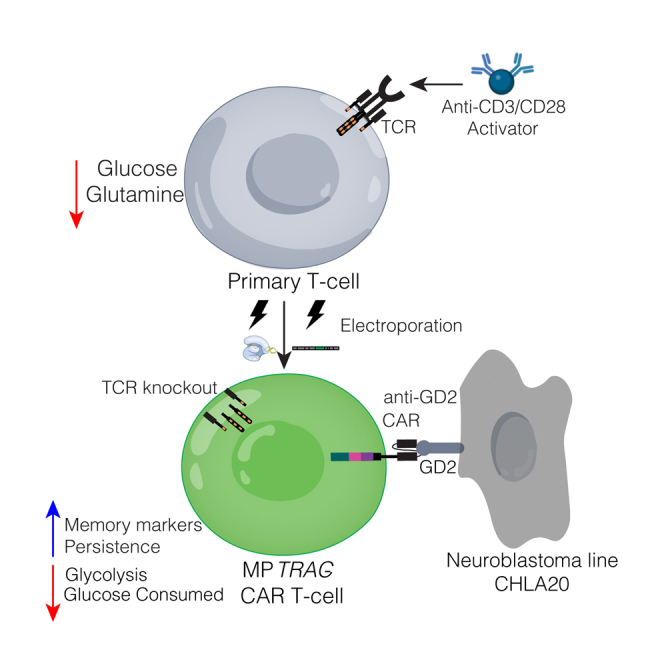
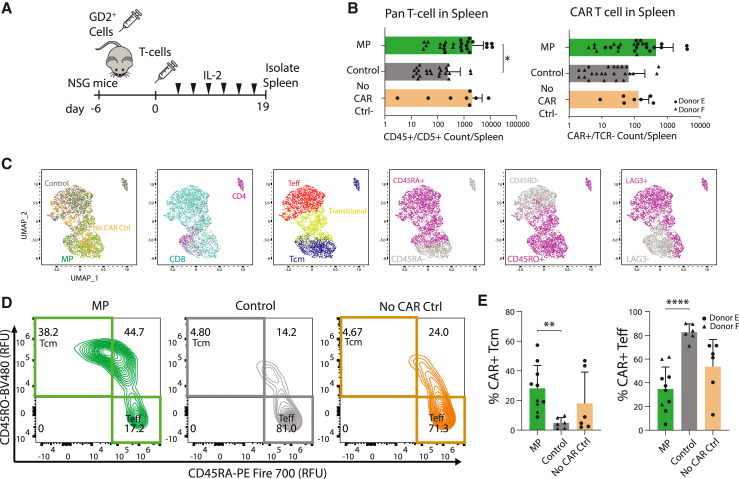
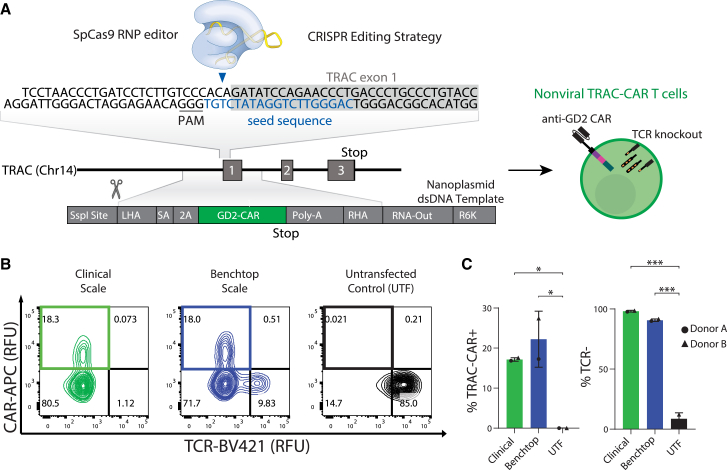
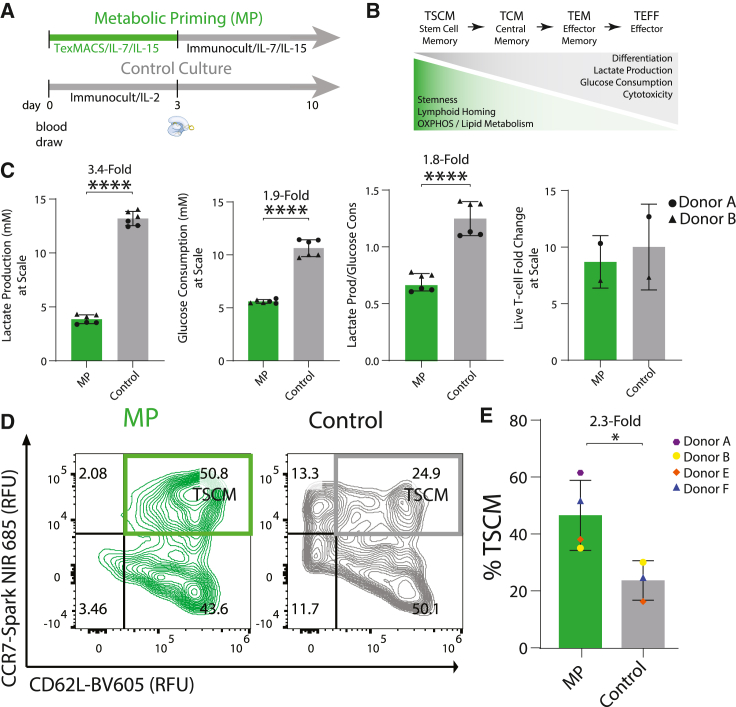
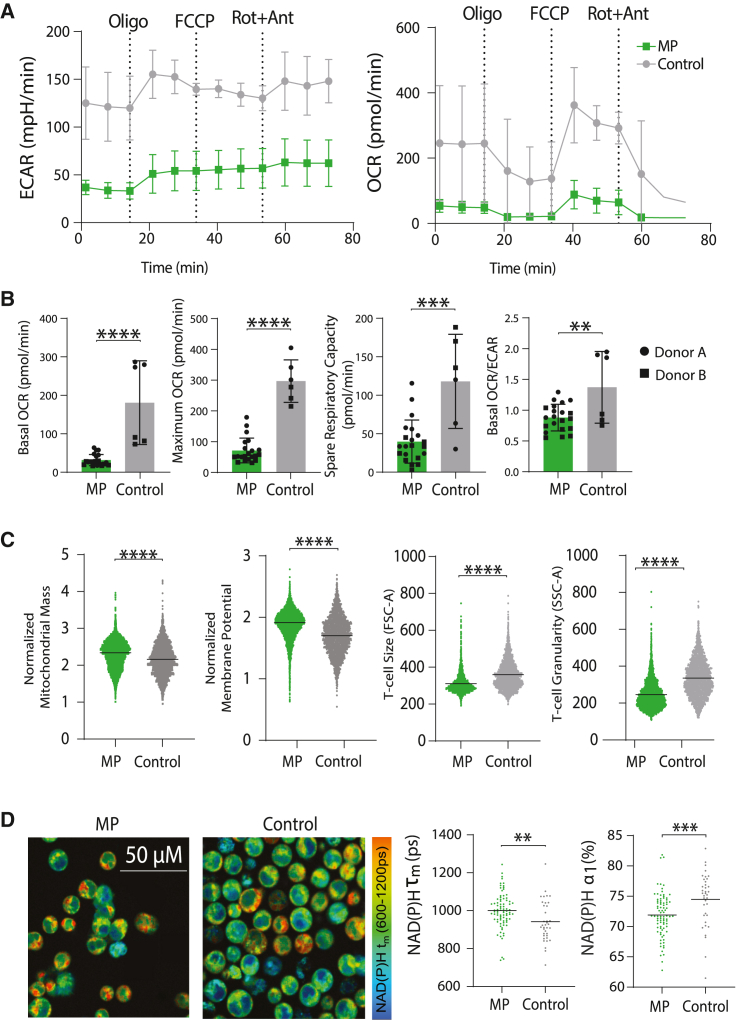
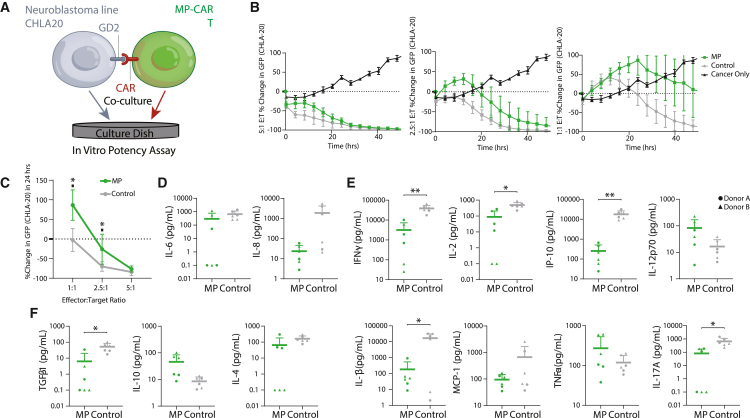
Manufacturing chimeric antigen receptor (CAR) T cell therapies is complex, with limited understanding of how medium composition impacts T cell phenotypes. CRISPR-Cas9 ribonucleoproteins can precisely insert a CAR sequence while disrupting the endogenous T cell receptor alpha constant () gene resulting in -CAR T cells with an enriched stem cell memory T cell population, a process that could be further optimized through modifications to the medium composition. In this study we generated anti-GD2 -CAR T cells using "metabolic priming" (MP), where the cells were activated in glucose/glutamine-low medium and then expanded in glucose/glutamine-high medium. T cell products were evaluated using spectral flow cytometry, metabolic assays, cytokine production, cytotoxicity assays , and potency against human GD2+ xenograft neuroblastoma models . Compared with standard -CAR T cells, MP -CAR T cells showed less glycolysis, higher CCR7/CD62L expression, more bound NAD(P)H activity, and reduced IFN-γ, IL-2, IP-10, IL-1β, IL-17, and TGF-β production at the end of manufacturing , with increased central memory CAR T cells and better persistence observed . MP with medium during CAR T cell biomanufacturing can minimize glycolysis and enrich memory phenotypes , which could lead to better responses against solid tumors .
嵌合抗原受体(CAR)T细胞疗法的生产过程复杂,人们对培养基成分如何影响T细胞表型的了解有限。CRISPR-Cas9核糖核蛋白可以精确插入CAR序列,同时破坏内源性T细胞受体α恒定区()基因,从而产生富含干细胞记忆T细胞群体的-CAR T细胞,这一过程可通过调整培养基成分进一步优化。在本研究中,我们使用“代谢预激”(MP)方法生成了抗GD2 -CAR T细胞,即先在低葡萄糖/谷氨酰胺培养基中激活细胞,然后在高葡萄糖/谷氨酰胺培养基中进行扩增。使用光谱流式细胞术、代谢分析、细胞因子产生分析、细胞毒性分析以及针对人GD2+异种移植神经母细胞瘤模型的效力评估等方法对T细胞产品进行了评估。与标准-CAR T细胞相比,MP -CAR T细胞在生产末期表现出较少的糖酵解、较高的CCR7/CD62L表达、更多的结合NAD(P)H活性,以及降低的IFN-γ、IL-2、IP-10、IL-1β、IL-17和TGF-β产生,同时观察到中枢记忆CAR T细胞增加且持久性更好。在CAR T细胞生物制造过程中采用MP培养基可使糖酵解最小化并富集记忆表型,这可能会导致对实体瘤产生更好的反应。