Taneja Karan, He Xiaolong, He QiZhi, Chen Jiun-Shyan
Department of Structural Engineering, University of California San Diego, La Jolla, CA USA.
ANSYS Inc., Livermore, CA USA.
Comput Mech. 2024;73(5):1125-1145. doi: 10.1007/s00466-023-02403-x. Epub 2023 Oct 20.
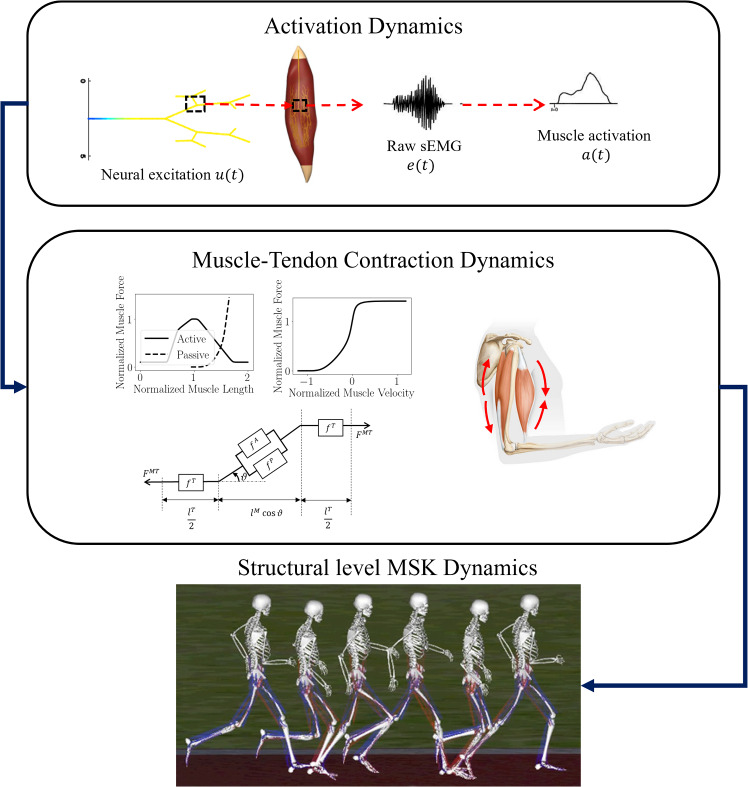
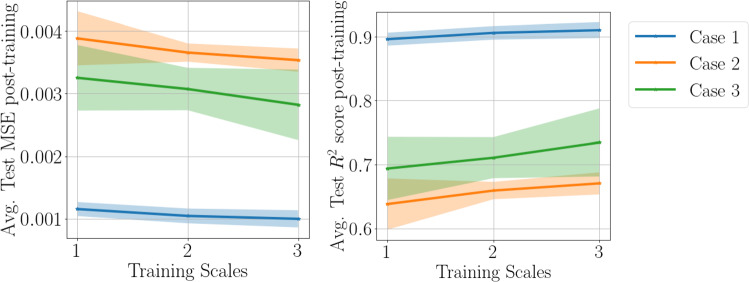
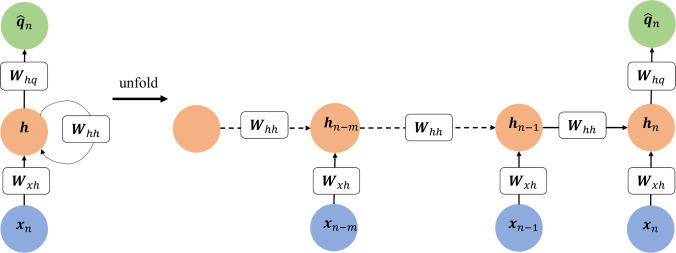
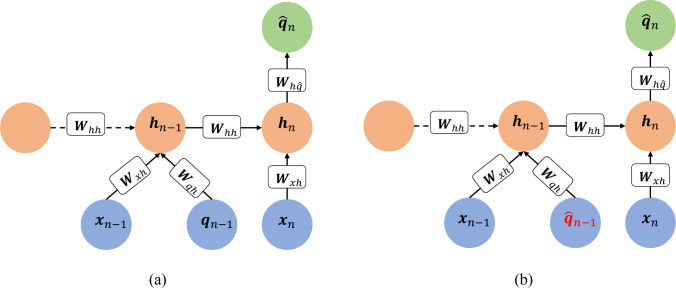
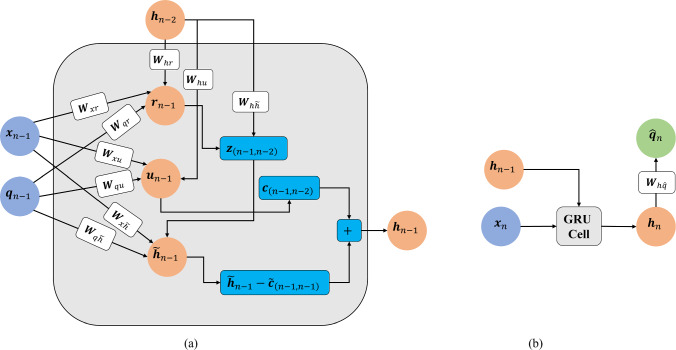
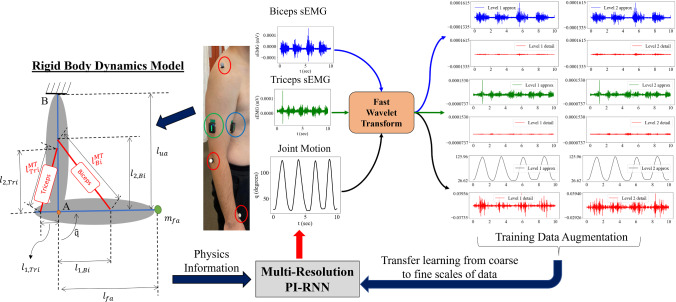
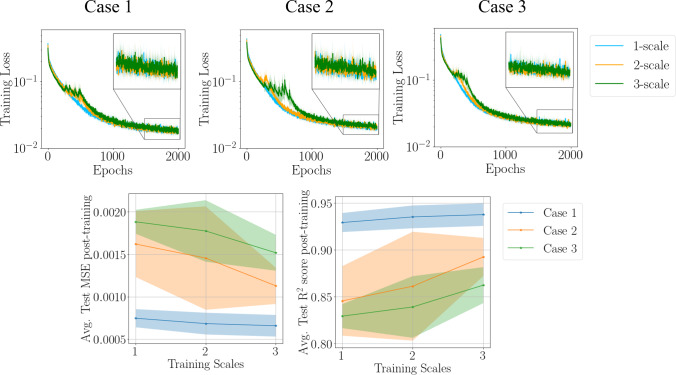
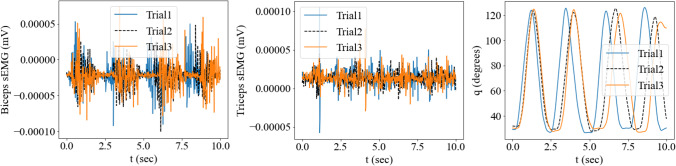
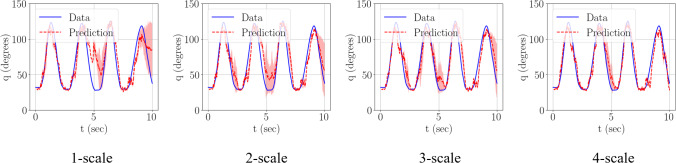
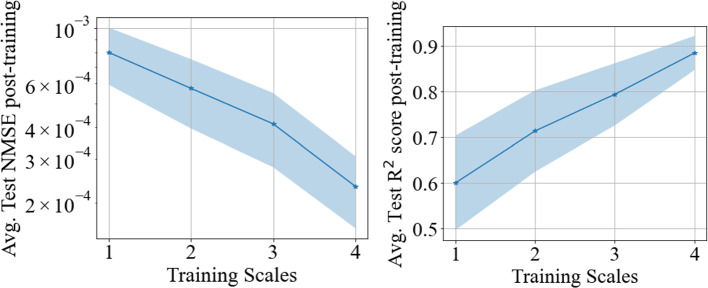
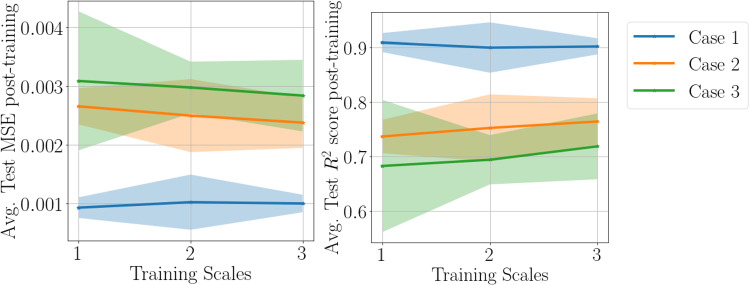
This work presents a multi-resolution physics-informed recurrent neural network (MR PI-RNN), for simultaneous prediction of musculoskeletal (MSK) motion and parameter identification of the MSK systems. The MSK application was selected as the model problem due to its challenging nature in mapping the high-frequency surface electromyography (sEMG) signals to the low-frequency body joint motion controlled by the MSK and muscle contraction dynamics. The proposed method utilizes the fast wavelet transform to decompose the mixed frequency input sEMG and output joint motion signals into nested multi-resolution signals. The prediction model is subsequently trained on coarser-scale input-output signals using a gated recurrent unit (GRU), and then the trained parameters are transferred to the next level of training with finer-scale signals. These training processes are repeated recursively under a transfer-learning fashion until the full-scale training (i.e., with unfiltered signals) is achieved, while satisfying the underlying dynamic equilibrium. Numerical examples on recorded subject data demonstrate the effectiveness of the proposed framework in generating a physics-informed forward-dynamics surrogate, which yields higher accuracy in motion predictions of elbow flexion-extension of an MSK system compared to the case with single-scale training. The framework is also capable of identifying muscle parameters that are physiologically consistent with the subject's kinematics data.
这项工作提出了一种多分辨率物理信息递归神经网络(MR PI-RNN),用于同时预测肌肉骨骼(MSK)运动和MSK系统的参数识别。由于将高频表面肌电图(sEMG)信号映射到由MSK和肌肉收缩动力学控制的低频身体关节运动具有挑战性,因此选择MSK应用作为模型问题。所提出的方法利用快速小波变换将混合频率输入sEMG和输出关节运动信号分解为嵌套的多分辨率信号。随后,使用门控递归单元(GRU)在较粗尺度的输入-输出信号上训练预测模型,然后将训练好的参数转移到使用更精细尺度信号的下一级训练中。这些训练过程以迁移学习的方式递归重复,直到实现全尺度训练(即使用未滤波信号),同时满足潜在的动态平衡。对记录的受试者数据进行的数值示例证明了所提出框架在生成物理信息前向动力学代理方面的有效性,与单尺度训练的情况相比,该代理在MSK系统肘部屈伸运动预测中具有更高的准确性。该框架还能够识别与受试者运动学数据在生理上一致的肌肉参数。