Alber Mark, Buganza Tepole Adrian, Cannon William R, De Suvranu, Dura-Bernal Salvador, Garikipati Krishna, Karniadakis George, Lytton William W, Perdikaris Paris, Petzold Linda, Kuhl Ellen
1Department of Mathematics, University of California, Riverside, CA USA.
2Department of Mechanical Engineering, Purdue University, West Lafayette, USA.
NPJ Digit Med. 2019 Nov 25;2:115. doi: 10.1038/s41746-019-0193-y. eCollection 2019.
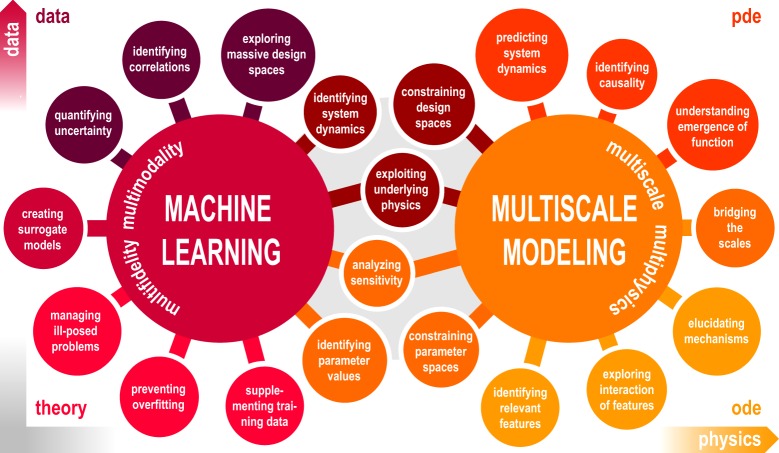
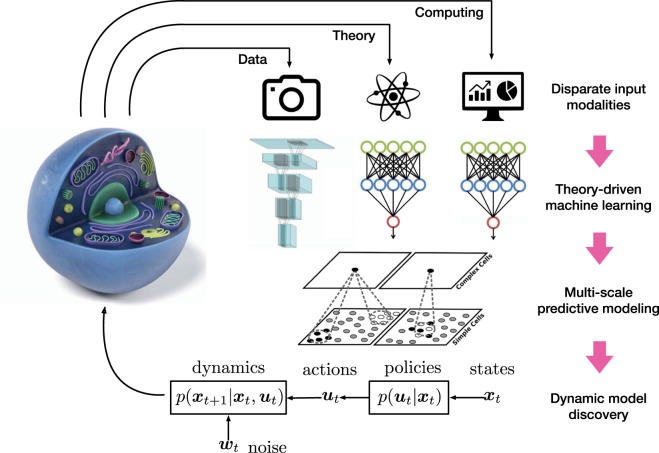
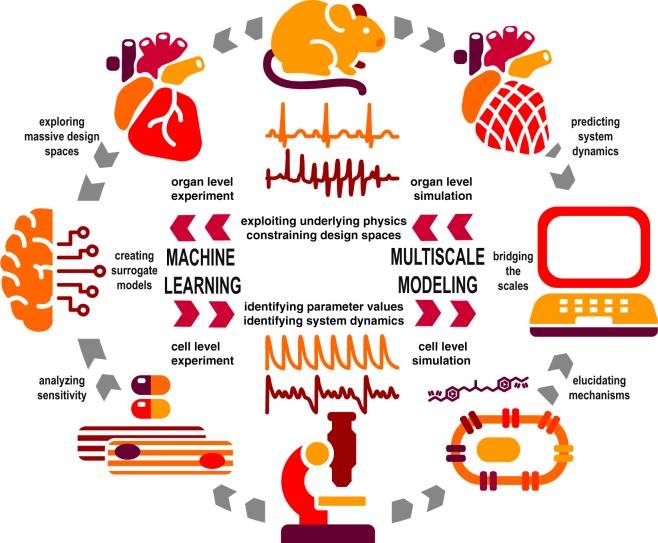
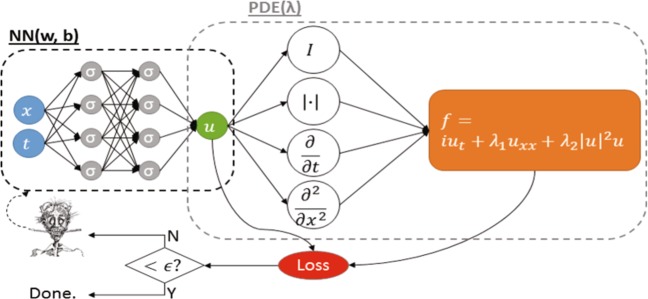
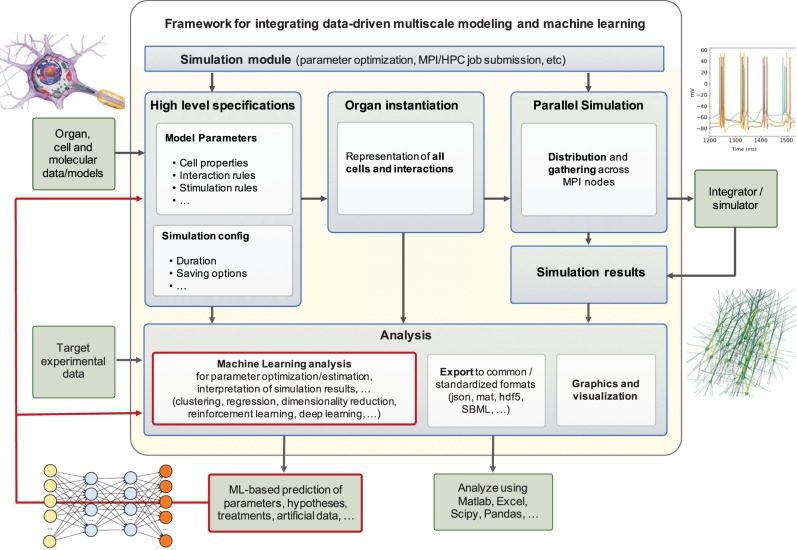
Fueled by breakthrough technology developments, the biological, biomedical, and behavioral sciences are now collecting more data than ever before. There is a critical need for time- and cost-efficient strategies to analyze and interpret these data to advance human health. The recent rise of machine learning as a powerful technique to integrate multimodality, multifidelity data, and reveal correlations between intertwined phenomena presents a special opportunity in this regard. However, machine learning alone ignores the fundamental laws of physics and can result in ill-posed problems or non-physical solutions. Multiscale modeling is a successful strategy to integrate multiscale, multiphysics data and uncover mechanisms that explain the emergence of function. However, multiscale modeling alone often fails to efficiently combine large datasets from different sources and different levels of resolution. Here we demonstrate that machine learning and multiscale modeling can naturally complement each other to create robust predictive models that integrate the underlying physics to manage ill-posed problems and explore massive design spaces. We review the current literature, highlight applications and opportunities, address open questions, and discuss potential challenges and limitations in four overarching topical areas: ordinary differential equations, partial differential equations, data-driven approaches, and theory-driven approaches. Towards these goals, we leverage expertise in applied mathematics, computer science, computational biology, biophysics, biomechanics, engineering mechanics, experimentation, and medicine. Our multidisciplinary perspective suggests that integrating machine learning and multiscale modeling can provide new insights into disease mechanisms, help identify new targets and treatment strategies, and inform decision making for the benefit of human health.
在突破性技术发展的推动下,生物学、生物医学和行为科学目前正在收集比以往任何时候都更多的数据。迫切需要采用节省时间和成本的策略来分析和解释这些数据,以促进人类健康。机器学习作为一种强大的技术,用于整合多模态、多保真度数据并揭示相互交织现象之间的相关性,最近的兴起在这方面提供了一个特殊的机会。然而,仅靠机器学习会忽略物理的基本定律,并可能导致不适定问题或非物理解决方案。多尺度建模是一种成功的策略,用于整合多尺度、多物理数据并揭示解释功能出现的机制。然而,仅靠多尺度建模往往无法有效地组合来自不同来源和不同分辨率水平的大型数据集。在这里,我们证明机器学习和多尺度建模可以自然地相互补充,以创建强大的预测模型,这些模型整合了基础物理知识,以处理不适定问题并探索大量的设计空间。我们回顾了当前的文献,突出了应用和机会,解决了开放性问题,并在四个总体主题领域讨论了潜在的挑战和局限性:常微分方程、偏微分方程、数据驱动方法和理论驱动方法。为了实现这些目标,我们利用了应用数学、计算机科学、计算生物学、生物物理学、生物力学、工程力学、实验和医学等领域的专业知识。我们的多学科视角表明,整合机器学习和多尺度建模可以为疾病机制提供新的见解,有助于识别新的靶点和治疗策略,并为人类健康的利益提供决策依据。