Laboratory for Chemistry and Life Science, Tokyo Institute of Technology, Yokohama 226-8501, Japan.
ACS Appl Mater Interfaces. 2024 May 15;16(19):25236-25245. doi: 10.1021/acsami.4c01401. Epub 2024 May 3.
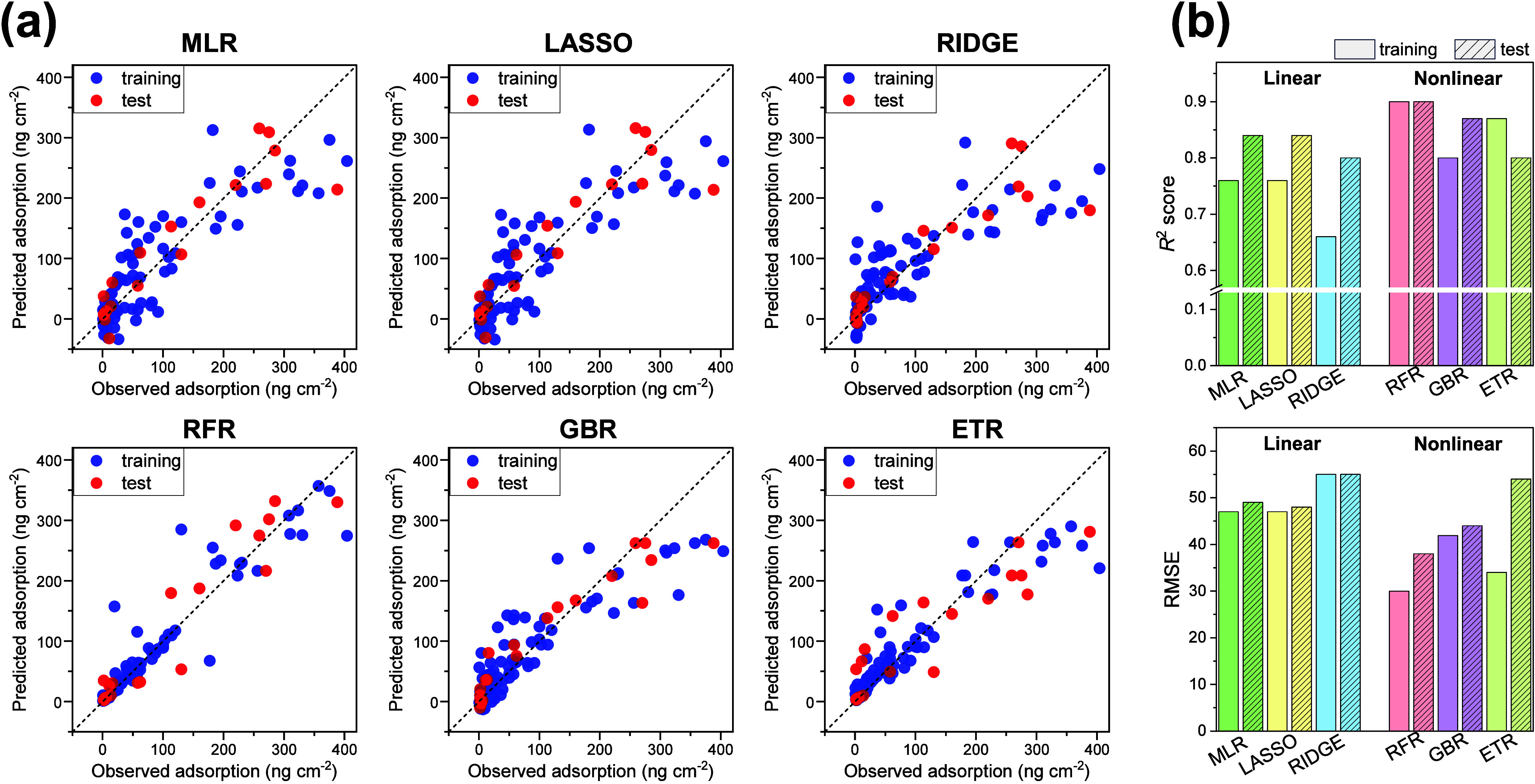
Constructing antifouling surfaces is a crucial technique for optimizing the performance of devices such as water treatment membranes and medical devices in practical environments. These surfaces are achieved by modification with hydrophilic polymers. Notably, zwitterionic (ZI) polymers have attracted considerable interest because of their ability to form a robust hydration layer and inhibit the adsorption of foulants. However, the importance of the molecular weight and density of the ZI polymer on the antifouling property is partially understood, and the surface design still retains an empirical flavor. Herein, we individually assessed the influence of the molecular weight and density of the ZI polymer on protein adsorption through machine learning. The results corroborated that protein adsorption is more strongly influenced by density than by molecular weight. Furthermore, the distribution of predicted protein adsorption against molecular weight and polymer density enabled us to determine conditions that enhanced (or weaken) antifouling. The relevance of this prediction method was also demonstrated by estimating the protein adsorption over a wide range of ionic strengths. Overall, this machine-learning-based approach is expected to contribute as a tool for the optimized functionalization of materials, extending beyond the applications of ZI polymer brushes.
构建抗污表面是优化水处理膜和医疗器械等设备在实际环境中性能的关键技术。这些表面可以通过亲水性聚合物的修饰来实现。值得注意的是,两性离子(ZI)聚合物因其能够形成稳定的水化层并抑制污染物的吸附而引起了相当大的关注。然而,ZI 聚合物的分子量和密度对其抗污性能的重要性部分被理解,表面设计仍然具有经验性。在这里,我们通过机器学习分别评估了 ZI 聚合物的分子量和密度对蛋白质吸附的影响。结果证实,蛋白质吸附受密度的影响比分子量更大。此外,针对分子量和聚合物密度的预测蛋白质吸附分布使我们能够确定增强(或削弱)抗污的条件。通过在较宽的离子强度范围内估计蛋白质吸附,还证明了这种预测方法的相关性。总的来说,这种基于机器学习的方法有望成为优化材料功能化的工具,其应用范围超出 ZI 聚合物刷的应用。