Neurology Service, Marqués de Valdecilla University Hospital, Santander, Spain.
Institute for Research Marqués de Valdecilla (IDIVAL), Santander, Spain.
J Parkinsons Dis. 2024;14(4):797-808. doi: 10.3233/JPD-230416.
Video-oculography constitutes a highly-sensitive method of characterizing ocular movements, which could detect subtle premotor changes and contribute to the early diagnosis of Parkinson's disease (PD).
To investigate potential oculomotor differences between idiopathic PD (iPD) and PD associated with the G2019S variant of LRRK2 (L2PD), as well as to evaluate oculomotor function in asymptomatic carriers of the G2019S variant of LRRK2.
The study enrolled 129 subjects: 30 PD (16 iPD, 14 L2PD), 23 asymptomatic carriers, 13 non-carrier relatives of L2PD patients, and 63 unrelated HCs. The video-oculographic evaluation included fixation, prosaccade, antisaccade, and memory saccade tests.
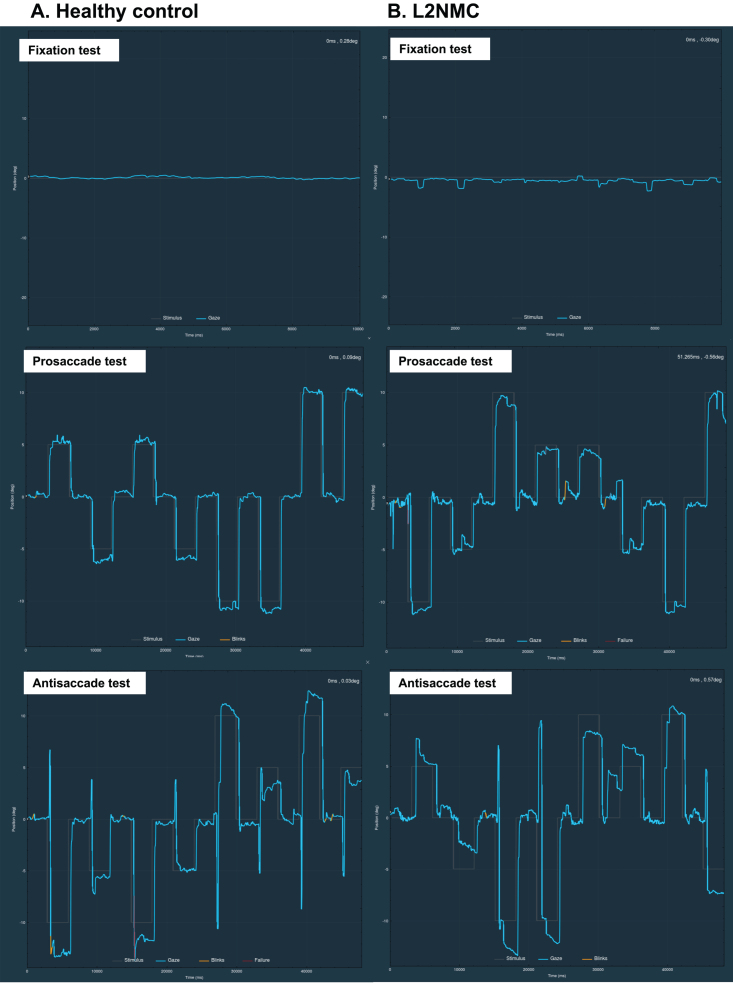
We did not find significant differences between iPD and L2PD. Compared to controls, PD patients displayed widespread oculomotor deficits including larger microsaccades, hypometric vertical prosaccades, increased latencies in all tests, and lower percentages of successful antisaccades and memory saccades. Non-carrier relatives showed oculomotor changes with parkinsonian features, such as fixation instability and hypometric vertical saccades. Asymptomatic carriers shared multiple similarities with PD, including signs of unstable fixation and hypometric vertical prosaccades; however, they were able to reach percentages of successful antisaccade and memory saccades similar to controls, although at the expense of longer latencies. Classification accuracy of significant oculomotor parameters to differentiate asymptomatic carriers from HCs ranged from 0.68 to 0.74, with BCEA, a marker of global fixation instability, being the parameter with the greatest classification accuracy.
iPD and LRRK2-G2019S PD patients do not seem to display a differential oculomotor profile. Several oculomotor changes in asymptomatic carriers of LRRK2 mutations could be considered premotor biomarkers.
视频眼动描记术是一种高度敏感的眼部运动特征描述方法,可检测到细微的运动前变化,并有助于帕金森病(PD)的早期诊断。
探讨特发性 PD(iPD)与 LRRK2 基因 G2019S 变异相关 PD(L2PD)之间潜在的眼动差异,并评估 LRRK2 基因 G2019S 变异的无症状携带者的眼动功能。
该研究纳入了 129 名受试者:30 名 PD(16 名 iPD,14 名 L2PD),23 名无症状携带者,13 名 L2PD 患者的非携带者亲属,以及 63 名无关的健康对照者。视频眼动描记术评估包括注视、正扫视、反扫视和记忆扫视测试。
我们未发现 iPD 与 L2PD 之间存在显著差异。与对照组相比,PD 患者表现出广泛的眼动缺陷,包括更大的微扫视、垂直扫视幅度减小、所有测试的潜伏期增加,以及成功反扫视和记忆扫视的百分比降低。非携带者亲属表现出具有帕金森特征的眼动变化,例如注视不稳定和垂直扫视幅度减小。无症状携带者与 PD 有多个相似之处,包括不稳定注视和垂直扫视幅度减小的迹象;然而,他们能够达到与对照组相似的成功反扫视和记忆扫视的百分比,尽管代价是更长的潜伏期。区分无症状携带者和健康对照者的有意义的眼动参数的分类准确性范围为 0.68 至 0.74,其中 BCEA,一种整体注视不稳定的标志物,是具有最大分类准确性的参数。
iPD 和 LRRK2-G2019S PD 患者似乎没有表现出不同的眼动特征。LRRK2 突变的无症状携带者的几种眼动变化可被视为运动前生物标志物。