Nonaka Saori, Odaka Masaaki, Takada Akemi, Senoo Yuki, Sawano Toyoaki, Ozaki Akihiko, Murakami Michio, Yoshida Makoto, Uchi Yuna, Onoda Katsuko, Oikawa Tomoyoshi, Tsubokura Masaharu
Department of Radiation Health Management, Fukushima Medical University School of Medicine, Fukushima, Japan.
Research Center for Community Health, Minamisoma Municipal General Hospital, Fukushima, Japan.
Medicine (Baltimore). 2024 May 3;103(18):e37942. doi: 10.1097/MD.0000000000037942.
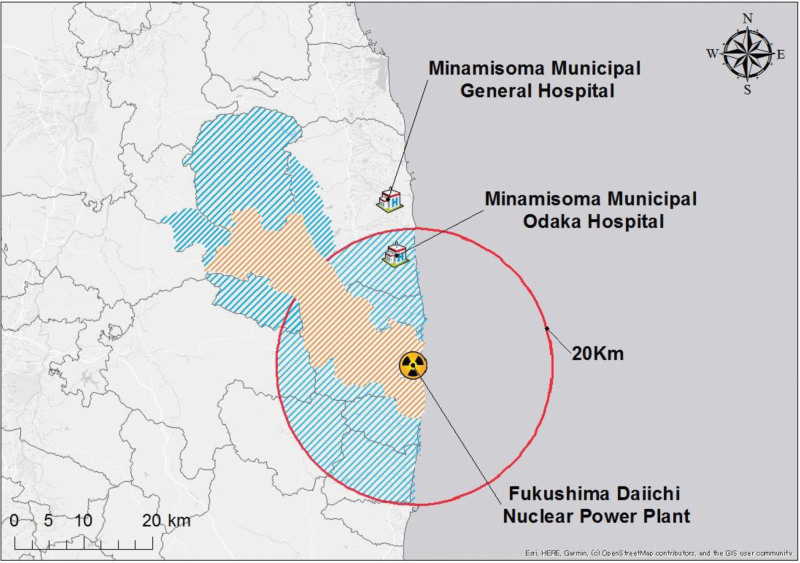
Radiation disasters pose distinctive medical challenges, requiring diverse care approaches. Beyond radiation exposure assessment, addressing health impacts due to lifestyle changes, especially among vulnerable populations, is vital. Evacuation orders issued in radiation-affected areas introduce unique healthcare dynamics, with their duration significantly influencing the recovery process. Understanding evolving patient demographics and medical needs after lifting evacuation orders is crucial for post-disaster care planning. Minamisoma Municipal Odaka Hospital, located 13 to 20 km from Fukushima Daiichi Nuclear power plant in a post-evacuation zone, was greatly affected by the Great East Japan Earthquake and subsequent radiation disaster. Data were retrospectively collected from patient records, including age, gender, visit date, diagnoses, and addresses. Patient records from April 2014 to March 2020 were analyzed, comparing data before and after the July 2016 evacuation order lift. Data was categorized into pre and post-evacuation order lifting periods, using International Classification of Diseases, Tenth Edition codes, to identify the top diseases. Statistical analyses, including χ-square tests, assessed changes in disease distributions. Population data for Odaka Ward and Minamisoma City fluctuated after lifting evacuation orders. As of March 11, 2011, Odaka Ward had 12,842 residents (27.8% aged 65+ years), dropping to 8406 registered residents and 2732 actual residents by April 30, 2018 (49.7%). Minamisoma City also saw declines, with registered residents decreasing from 71,561 (25.9%) to 61,049 (34.1%). The study analyzed 11,100 patients, mostly older patients (75.1%), between 2014 and 2020. Post-lifting, monthly patient numbers surged from an average of 55.2 to 213.5, with female patients increasing from 33.8% to 51.7%. Disease patterns shifted, with musculoskeletal cases declining from 23.8% to 13.0%, psychiatric disorders increasing from 9.3% to 15.4%, and trauma-related cases decreasing from 14.3% to 3.9%. Hypertension (57.1%) and dyslipidemia (29.2%) prevailed post-lifting. Urgent cases decreased from 1.3% to 0.1%. This study emphasizes the importance of primary care in post-evacuation zones, addressing diverse medical needs, including trauma, noncommunicable diseases, and psychiatric disorders. Changing patient demographics require adaptable healthcare strategies and resource allocation to meet growing demands. Establishing a comprehensive health maintenance system tailored to these areas' unique challenges is crucial for future disaster recovery efforts.
辐射灾难带来了独特的医学挑战,需要采取多样的护理方法。除了辐射暴露评估外,应对因生活方式改变而产生的健康影响至关重要,尤其是在弱势群体中。在受辐射影响地区发布的疏散命令引入了独特的医疗动态,其持续时间对恢复过程有重大影响。了解疏散命令解除后不断变化的患者人口统计学特征和医疗需求对于灾后护理规划至关重要。南相马市小高医院位于距福岛第一核电站13至20公里的疏散后区域,受到东日本大地震及随后的辐射灾难的严重影响。数据是从患者记录中回顾性收集的,包括年龄、性别、就诊日期、诊断和地址。分析了2014年4月至2020年3月期间的患者记录,比较了2016年7月疏散命令解除前后的数据。使用国际疾病分类第十版编码将数据分为疏散命令解除前后两个时期,以确定主要疾病。包括卡方检验在内的统计分析评估了疾病分布的变化。疏散命令解除后,小高町和南相马市的人口数据出现波动。截至2011年3月11日,小高町有12842名居民(65岁及以上人口占27.8%),到2018年4月30日,登记居民降至8406人,实际居民降至2732人(占49.7%)。南相马市也出现了下降,登记居民从71561人(占25.9%)降至61049人(占34.1%)。该研究分析了2014年至2020年期间的11100名患者,其中大多数是老年患者(占75.1%)。疏散命令解除后,每月患者数量从平均55.2人激增至213.5人,女性患者从33.8%增至51.7%。疾病模式发生了变化,肌肉骨骼疾病病例从23.8%降至13.0%,精神障碍病例从9.3%增至15.4%,创伤相关病例从14.3%降至3.9%。疏散命令解除后,高血压(占57.1%)和血脂异常(占29.2%)最为常见。紧急病例从1.3%降至0.1%。这项研究强调了疏散后区域初级护理的重要性,要满足包括创伤、非传染性疾病和精神障碍在内的各种医疗需求。不断变化的患者人口统计学特征需要适应性强的医疗策略和资源分配,以满足不断增长的需求。建立一个针对这些地区独特挑战的全面健康维护系统对于未来的灾难恢复工作至关重要。