Jeon Donghwan, Hill Ethan, Moseman Jena E, McNeel Douglas G
Cancer Biology, University of Wisconsin-Madison, Madison, Wisconsin, USA.
Medicine, University of Wisconsin-Madison, Madison, Wisconsin, USA.
J Immunother Cancer. 2024 May 3;12(5):e008799. doi: 10.1136/jitc-2024-008799.
T cell checkpoint receptors are expressed when T cells are activated, and modulation of the expression or signaling of these receptors can alter the function of T cells and their antitumor efficacy. We previously found that T cells activated with cognate antigen had increases in the expression of PD-1, and this was attenuated in the presence of multiple toll-like receptor (TLR) agonists, notably TLR3 plus TLR9. In the current report, we sought to investigate whether combining TLR agonists with immune checkpoint blockade can further augment vaccine-mediated T cell antitumor immunity in murine tumor models.
TLR agonists (TLR3 plus TLR9) and immune checkpoint inhibitors (antibodies targeting PD-1, CTLA-4, LAG-3, TIM-3 or VISTA) were combined and delivered with vaccines or vaccine-activated CD8+T cells to E.G7-OVA or MyC-CaP tumor-bearing mice. Tumors were assessed for growth and then collected and analyzed by flow cytometry.
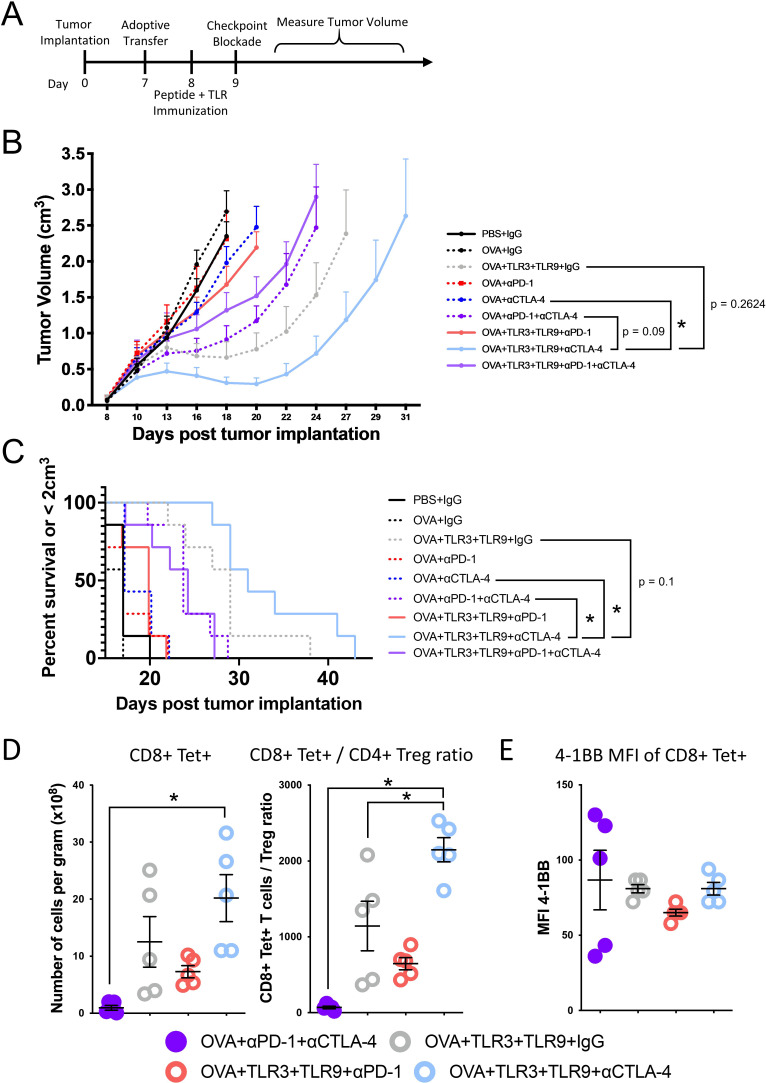
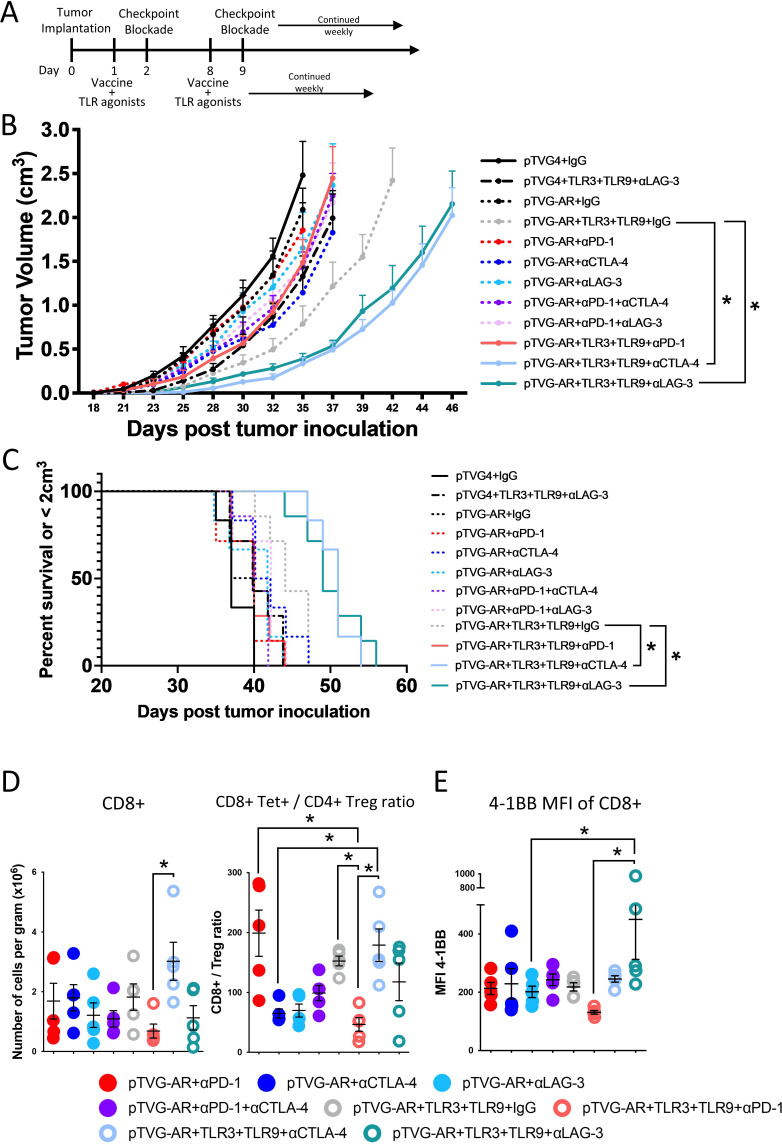
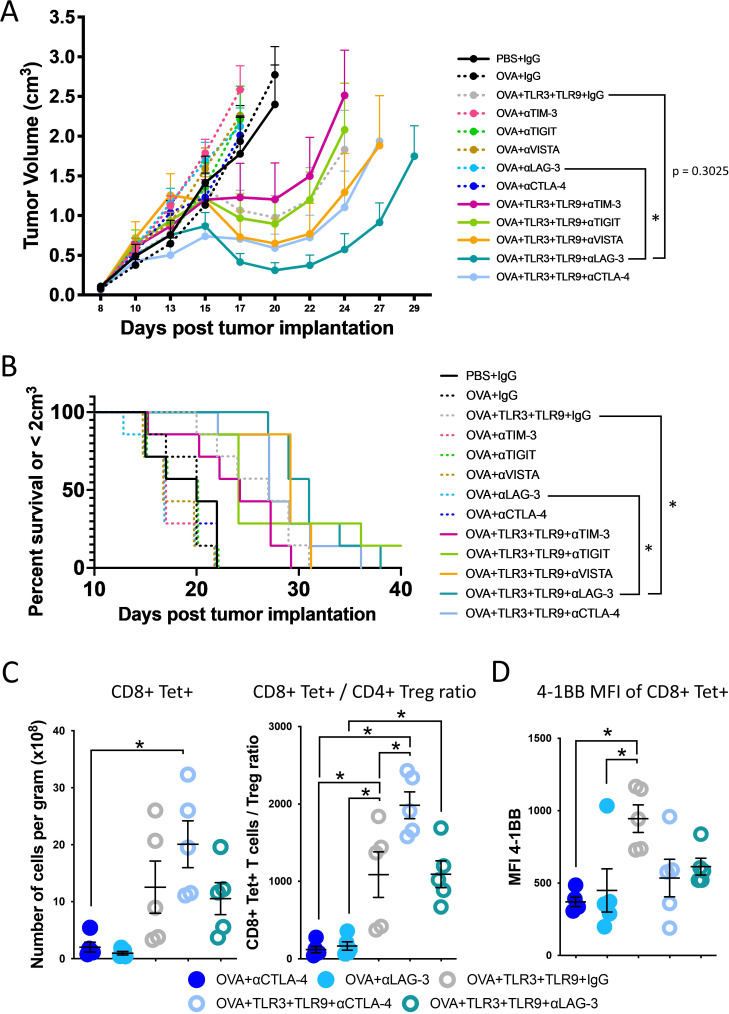
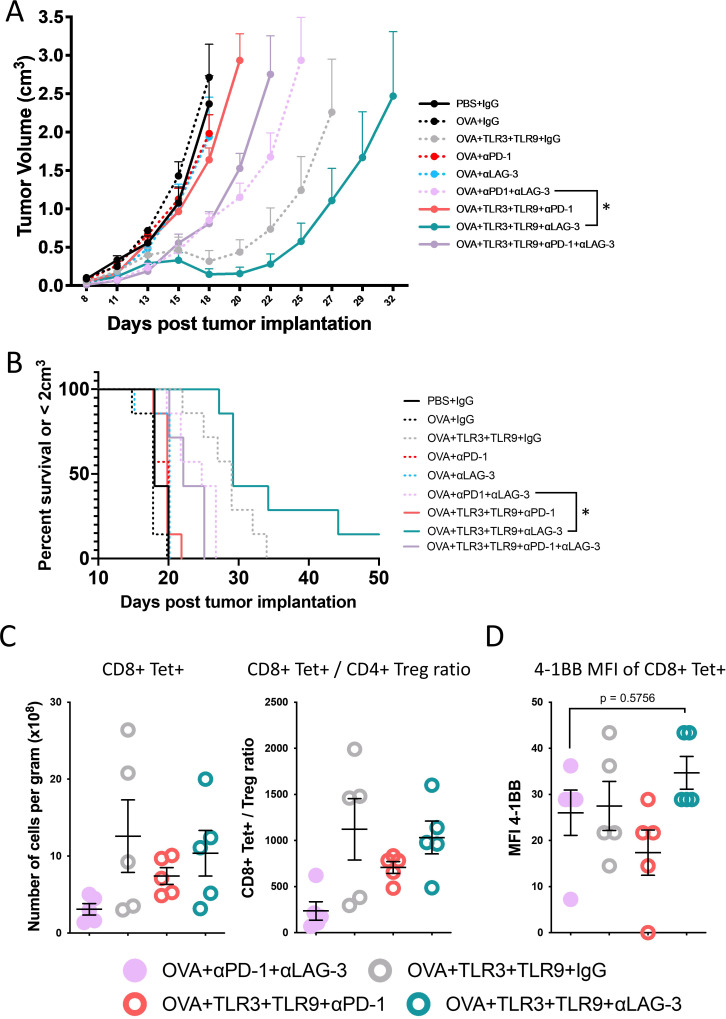
Immunization of E.G7-OVA tumor-bearing mice with SIINFEKL peptide vaccine, coadministered with TLR agonists and αCTLA-4, demonstrated greater antitumor efficacy than immunization with TLR agonists or αCTLA-4 alone. Conversely, the antitumor efficacy was abrogated when vaccine and TLR agonists were combined with αPD-1. TLR agonists suppressed PD-1 expression on regulatory T cells (Tregs) and activated this population. Depletion of Tregs in tumor-bearing mice led to greater antitumor efficacy of this combination therapy, even in the presence of αPD-1. Combining vaccination with TLR agonists and αCTLA-4 or αLAG-3 showed greater antitumor than with combinations with αTIM-3 or αVISTA.
The combination of TLR agonists and αCTLA-4 or αLAG-3 can further improve the efficacy of a cancer vaccine, an effect not observed using αPD-1 due to activation of Tregs when αPD-1 was combined with TLR3 and TLR9 agonists. These data suggest that optimal combinations of TLR agonists and immune checkpoint blockade may improve the efficacy of human anticancer vaccines.
T细胞检查点受体在T细胞被激活时表达,对这些受体的表达或信号传导进行调节可改变T细胞的功能及其抗肿瘤功效。我们之前发现,用同源抗原激活的T细胞中PD-1表达增加,而在多种Toll样受体(TLR)激动剂存在时这种增加会减弱,尤其是TLR3加TLR9。在本报告中,我们试图研究将TLR激动剂与免疫检查点阻断相结合是否能在小鼠肿瘤模型中进一步增强疫苗介导的T细胞抗肿瘤免疫。
将TLR激动剂(TLR3加TLR9)和免疫检查点抑制剂(靶向PD-1、CTLA-4、LAG-3、TIM-3或VISTA的抗体)联合,并与疫苗或疫苗激活的CD8+T细胞一起给予荷E.G7-OVA或MyC-CaP肿瘤的小鼠。评估肿瘤生长情况,然后收集肿瘤并通过流式细胞术进行分析。
用SIINFEKL肽疫苗免疫荷E.G7-OVA肿瘤的小鼠,并同时给予TLR激动剂和αCTLA-4,其抗肿瘤功效比单独用TLR激动剂或αCTLA-4免疫更强。相反,当疫苗和TLR激动剂与αPD-1联合时,抗肿瘤功效被消除。TLR激动剂抑制调节性T细胞(Tregs)上的PD-1表达并激活这群细胞。在荷瘤小鼠中清除Tregs导致这种联合治疗具有更强的抗肿瘤功效,即使在存在αPD-1的情况下也是如此。将疫苗接种与TLR激动剂和αCTLA-4或αLAG-3联合显示出比与αTIM-3或αVISTA联合更强的抗肿瘤效果。
TLR激动剂与αCTLA-4或αLAG-3联合可进一步提高癌症疫苗的疗效,当αPD-1与TLR3和TLR9激动剂联合时,由于Tregs被激活,使用αPD-1未观察到这种效果。这些数据表明,TLR激动剂与免疫检查点阻断的最佳组合可能会提高人类抗癌疫苗的疗效。