Unit of Pharmacogenetics and Clinical Psychopharmacology, Department of Psychiatry, Centre for Psychiatric Neuroscience, Lausanne University Hospital, University of Lausanne, Prilly, Switzerland.
Psychiatric Epidemiology and Psychopathology Research Center, Department of Psychiatry, Lausanne University Hospital, University of Lausanne, Prilly, Switzerland.
Eur J Nutr. 2024 Aug;63(5):1555-1564. doi: 10.1007/s00394-024-03351-9. Epub 2024 May 4.
Self-reported caffeine consumption has been widely used in research while it may be subject to bias. We sought to investigate the associations between self-reported caffeine consumption and plasma levels of caffeine and its two main metabolites (paraxanthine and theophylline) in the community.
Data from two population-based studies (SKIPOGH1 and 2 (N = 1246) and CoLaus|PsyCoLaus (N = 4461)) conducted in Switzerland were used. Self-reported caffeine consumption was assessed using questionnaires. Plasma levels of caffeine and its metabolites were quantified by ultra-high performance liquid chromatography coupled to a tandem quadrupole mass spectrometer.
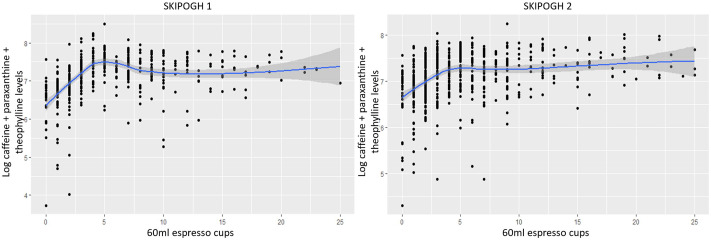
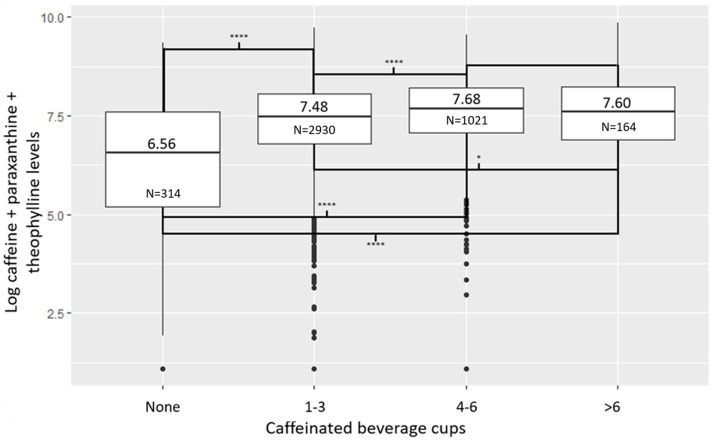
In both studies, mean log plasma levels of caffeine and its two metabolites were over 6.48 (plasma levels = 652 ng/ml) when no caffeine consumption was reported. Subsequently, nonlinear associations between log plasma levels and self-reported caffeine consumption were observed in SKIPOGH, with a change of the slope at 3-5 cups of espresso per day in SKIPOGH1 but not SKIPOGH2. In CoLaus|PsyCoLaus, increased daily consumption of caffeinated beverages was associated with increased log plasma levels with a change of the slope at 3 cups. In both studies, declared caffeine consumption higher than 3-5 cups per day was not associated with higher plasma levels of caffeine and its metabolites.
Self-reports of no or low caffeine consumption and consumption of more than 3-5 cups of coffee should be interpreted with caution, with possible under- or over-estimation. Quantifying plasma levels of caffeine and its metabolites may contribute to a better estimation of caffeine intake.
在研究中,人们广泛使用自我报告的咖啡因摄入量,但它可能存在偏差。我们旨在研究社区中自我报告的咖啡因摄入量与血浆中咖啡因及其两种主要代谢物(副黄嘌呤和茶碱)水平之间的关联。
使用来自瑞士两项基于人群的研究(SKIPOGH1 和 2(N=1246)和 CoLaus|PsyCoLaus(N=4461))的数据。使用问卷评估自我报告的咖啡因摄入量。通过超高效液相色谱-串联四极杆质谱联用仪定量测定血浆中咖啡因及其代谢物的水平。
在两项研究中,当报告没有咖啡因摄入时,平均对数血浆水平的咖啡因和两种代谢物均超过 6.48(血浆水平=652ng/ml)。随后,在 SKIPOGH 中观察到对数血浆水平与自我报告的咖啡因摄入量之间的非线性关联,在 SKIPOGH1 中,斜率在每天 3-5 杯浓咖啡时发生变化,但在 SKIPOGH2 中没有变化。在 CoLaus|PsyCoLaus 中,每天摄入更多含咖啡因的饮料与对数血浆水平增加相关,斜率在 3 杯时发生变化。在两项研究中,报告的每天 3-5 杯以上的咖啡因摄入量与咖啡因及其代谢物的血浆水平升高无关。
应谨慎解释无或低咖啡因摄入以及摄入超过 3-5 杯咖啡的报告,可能存在低估或高估。定量测定咖啡因及其代谢物的血浆水平可能有助于更好地估计咖啡因摄入量。