School of Sports Medicine and Health, Chengdu Sport University, Chengdu, China.
Department of Sports Medicine, Peking University Third Hospital, Institute of Sports Medicine of Peking University, Beijing, China.
BMC Musculoskelet Disord. 2024 May 4;25(1):357. doi: 10.1186/s12891-024-07445-7.
Rotator cuff tendinopathy (RCT) is a widespread musculoskeletal disorder and a primary cause of shoulder pain and limited function. The resulting pain and limited functionality have a detrimental impact on the overall quality of life. The purpose of this study was to perform a systematic review of the effects of extracorporeal shock wave therapy (ESWT) for RCT.
The literature search was conducted on the following databases from inception to February 20, 2024: PubMed, Web of Science, the Cochrane Library, Scopus, MEDLINE, EMBASE, EBSCO, and China National Knowledge Infrastructure (CNKI) were checked to identify the potential studies exploring the effect of ESWT for the treatment of Rotator cuff tendinopathy (Calcification or non-calcification), control group for sham, other treatments (including placebo), without restriction of date, language. Two researchers independently screened literature, extracted data, evaluated the risk of bias in the included studies, and performed meta-analysis using RevMan 5.3 software.
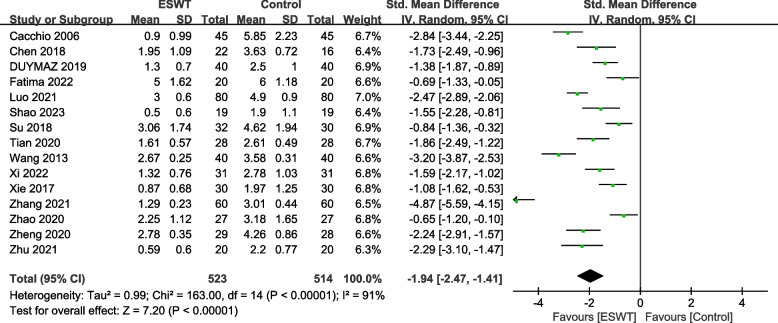
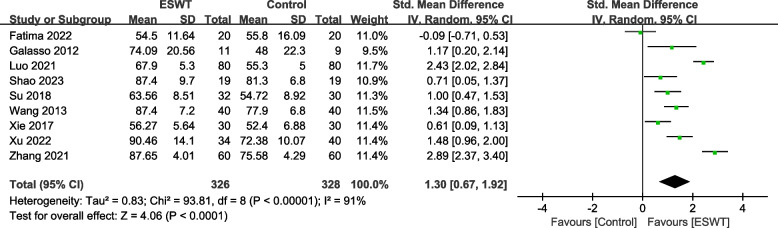
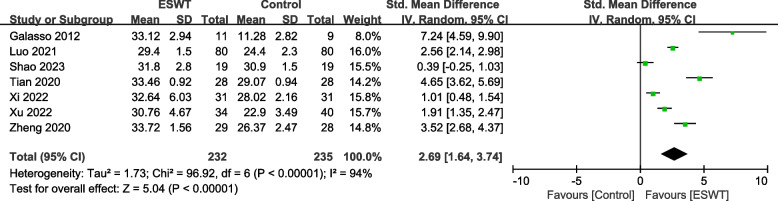
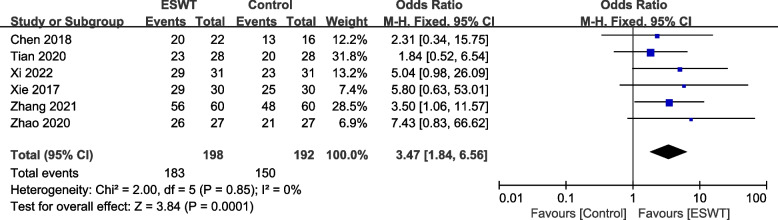
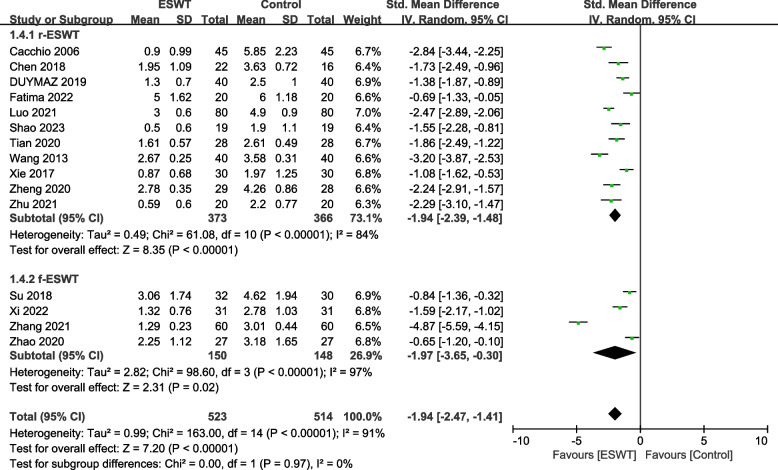
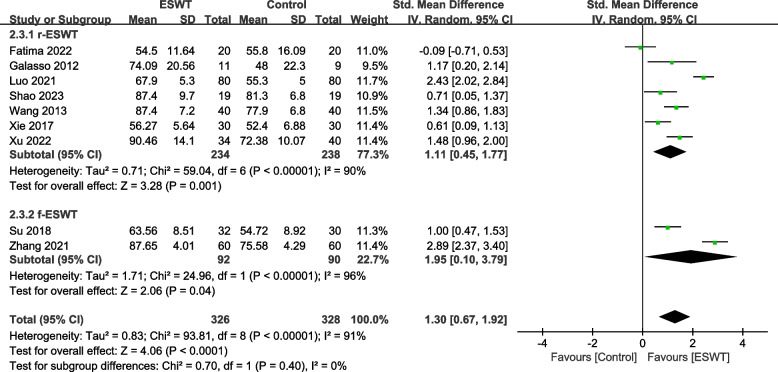
A total of 16 RCTs with 1093 patients were included. The results showed that compared with the control group, ESWT for pain score Visual Analogue Scale/Score (VAS) (SMD = -1.95, 95% CI -2.47, -1.41, P < 0.00001), function score Constant-Murley score (CMS) (SMD = 1.30, 95% CI 0.67, 1.92, P < 0.00001), University of California Los Angeles score (UCLA) (SMD = 2.69, 95% CI 1.64, 3.74, P < 0.00001), American Shoulder and Elbow Surgeons form (ASES) (SMD = 1.29, 95% CI 0.93, 1.65, P < 0.00001), Range of motion (ROM) External rotation (SMD = 1.00, 95% CI 0.29, 1.72, P = 0.02), Total effective rate (TER) (OR = 3.64, 95% CI 1.85, 7.14, P = 0.0002), the differences in the above results were statistically significant. But ROM-Abduction (SMD = 0.72, 95% CI -0.22, 1.66, P = 0.13), the difference was not statistically significant.
Currently limited evidence suggests that, compared with the control group, ESWT can provide better pain relief, functional recovery, and maintenance of function in patients with RCT.
肩袖肌腱病(RCT)是一种广泛存在的肌肉骨骼疾病,也是导致肩部疼痛和功能受限的主要原因。由此产生的疼痛和功能受限对整体生活质量有不利影响。本研究旨在对体外冲击波治疗(ESWT)治疗 RCT 的效果进行系统评价。
从建库至 2024 年 2 月 20 日,在以下数据库中进行文献检索:PubMed、Web of Science、Cochrane 图书馆、Scopus、MEDLINE、EMBASE、EBSCO 和中国知网(CNKI),以确定潜在的研究,这些研究探索了 ESWT 治疗肩袖肌腱病(钙化或非钙化)的效果,对照组为假治疗、其他治疗(包括安慰剂),不限制日期和语言。两名研究人员独立筛选文献、提取数据、评估纳入研究的偏倚风险,并使用 RevMan 5.3 软件进行荟萃分析。
共纳入 16 项 RCT,共 1093 例患者。结果表明,与对照组相比,ESWT 治疗疼痛评分视觉模拟评分/评分(VAS)(SMD=-1.95,95%CI-2.47,-1.41,P<0.00001)、功能评分Constant-Murley 评分(CMS)(SMD=1.30,95%CI0.67,1.92,P<0.00001)、加利福尼亚大学洛杉矶分校评分(UCLA)(SMD=2.69,95%CI1.64,3.74,P<0.00001)、美国肩肘外科医生协会评分(ASES)(SMD=1.29,95%CI0.93,1.65,P<0.00001)、运动范围(ROM)外旋(SMD=1.00,95%CI0.29,1.72,P=0.02)、总有效率(TER)(OR=3.64,95%CI1.85,7.14,P=0.0002),上述结果差异有统计学意义。但是 ROM-外展(SMD=0.72,95%CI-0.22,1.66,P=0.13),差异无统计学意义。
目前的有限证据表明,与对照组相比,ESWT 可在 RCT 患者中提供更好的疼痛缓解、功能恢复和功能维持。