Keski-Säntti Noora, Waltimo Elin, Mäkitie Antti, Hagström Jaana, Söderlund-Venermo Maria, Atula Timo, Haglund Caj, Sinkkonen Saku T, Jauhiainen Maria
Department of Virology, University of Helsinki, Helsinki, Finland.
Otorhinolaryngology - Head and Neck Surgery, University of Helsinki and Helsinki University Hospital, Helsinki, Finland.
J Oral Microbiol. 2024 Apr 26;16(1):2345941. doi: 10.1080/20002297.2024.2345941. eCollection 2024.
The etiology behind different types of chronic sialadenitis (CS), some of which exhibit IgG4 overexpression, is unknown. Further, IgG4-related disease (IgG4-RD) commonly affects the submandibular gland, but its relationship to IgG4-overexpressing CS, and the antigen triggering IgG4 overexpression, remain unknown.
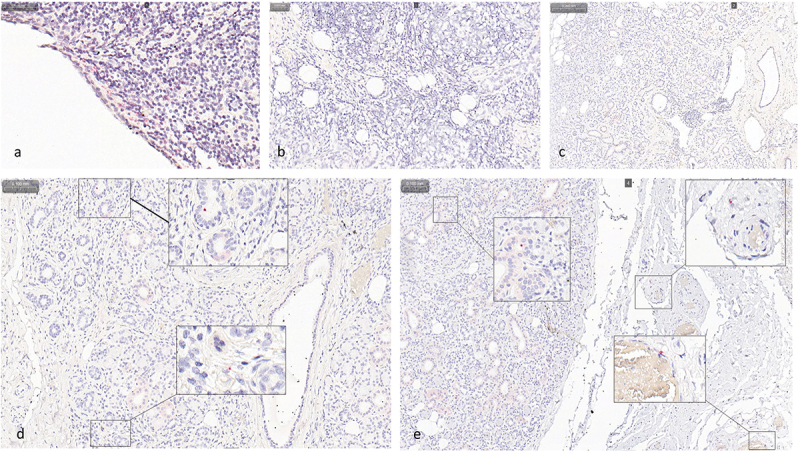
By qPCR, we assessed the presence of 21 DNA-viruses causing IgG4 overexpression in submandibular gland tissue from patients with IgG4-positive and IgG4-negative CS. Healthy submandibular glands and glands with sialolithiasis without CS were used as controls. We examined the distribution of HHV-7, HHV-6B and B19V DNA, within virus PCR-positive tissues with RNAscope in-situ hybridization (RISH).
We detected DNA from seven viruses in 48/61 samples. EBV DNA was more prevalent within the IgG4-positive samples (6/29; 21%) than the IgG4-negative ones (1/19; 5.3%). B19V DNA was more prevalent within the IgG4-negative samples (5/19; 26%) than the IgG4-positive ones (4/29; 14%). The differences in virus prevalence were not statistically significant. Of the IgG4-RD samples ( = 3) one contained HHV-6B DNA. RISH only showed signals of HHV-7.
None of the studied viruses are implicated as triggering IgG4-overexpression in CS. Although our results do not confirm viral etiology in the examined conditions, they provide valuable information on the prevalence of viruses in both diseased and healthy submandibular gland tissue.
不同类型的慢性涎腺炎(CS)的病因尚不清楚,其中一些表现为IgG4过表达。此外,IgG4相关疾病(IgG4-RD)通常累及下颌下腺,但其与IgG4过表达的CS的关系以及触发IgG4过表达的抗原仍不清楚。
通过qPCR,我们评估了21种导致IgG4过表达的DNA病毒在IgG4阳性和IgG4阴性CS患者下颌下腺组织中的存在情况。健康下颌下腺和有涎石病但无CS的腺体用作对照。我们使用RNAscope原位杂交(RISH)检查了病毒PCR阳性组织中HHV-7、HHV-6B和B19V DNA的分布。
我们在48/61个样本中检测到了7种病毒的DNA。EBV DNA在IgG4阳性样本(6/29;21%)中比IgG4阴性样本(1/19;5.3%)中更普遍。B19V DNA在IgG4阴性样本(5/19;26%)中比IgG4阳性样本(4/29;14%)中更普遍。病毒流行率的差异无统计学意义。在IgG4-RD样本(n = 3)中,有一个含有HHV-6B DNA。RISH仅显示HHV-7的信号。
所研究的病毒均未被认为是触发CS中IgG4过表达的因素。虽然我们的结果未在检查条件下证实病毒病因,但它们提供了关于患病和健康下颌下腺组织中病毒流行率的有价值信息。