Dasgupta Subham, Goodale Britton, Tanguay Robyn
Department of Biological Sciences, Clemson University, Clemson, SC.
Department of Environmental and Molecular Toxicology, Oregon State University, Corvallis, OR.
bioRxiv. 2024 Apr 28:2024.04.23.590755. doi: 10.1101/2024.04.23.590755.
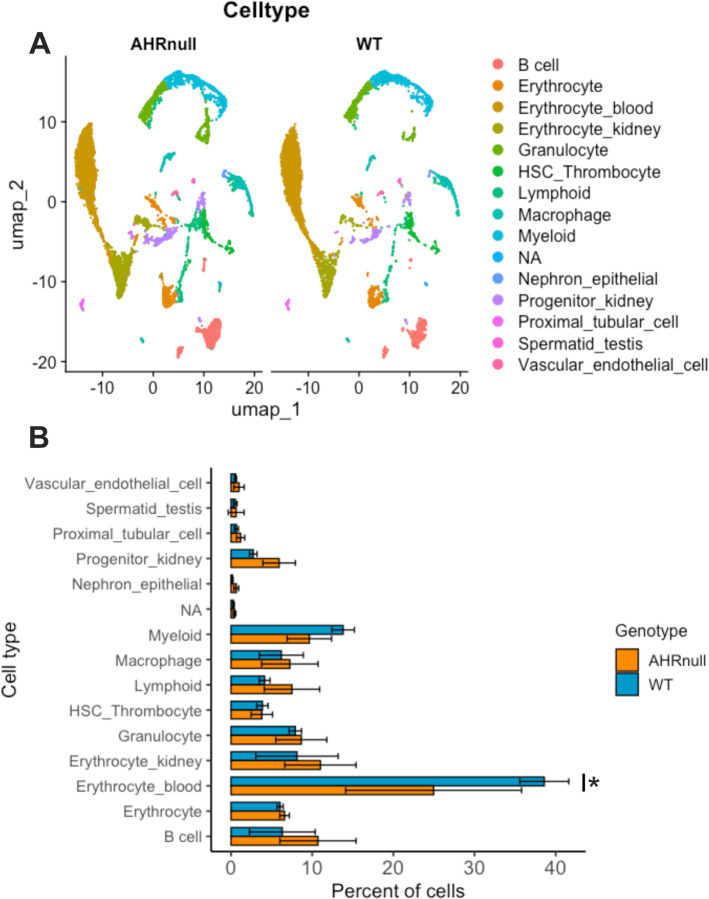
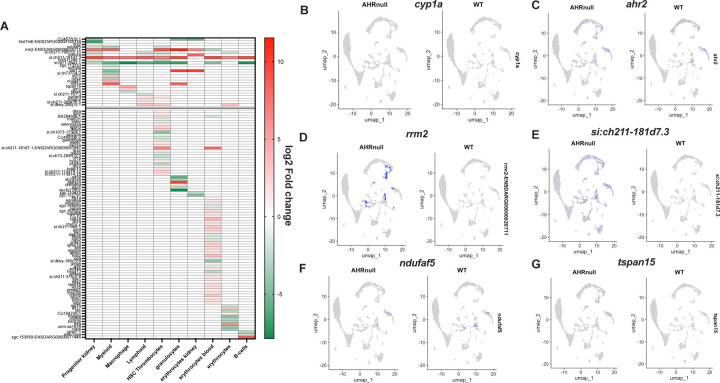
The aryl hydrocarbon receptor (AHR) is a ligand-dependent transcription factor that mediates a wide range of biological and toxicological responses. While largely studied in ligand-activated toxicant responses, AHR also plays important roles in endogenous physiological processes. We leveraged single cell sequencing and an AHR2 knockout zebrafish line to investigate the role of AHR2 in regulating hematopoiesis (production and differentiation of red and white blood cells from hematopoietic stem cells). Our objectives were to determine if absence of AHR2- 1) alters proportions of immune cell populations and/or 2) impacts gene expression within individual immune cell types. We dissected kidney marrow (organ of hematopoiesis in zebrafish) from adult wildtype and AHR2 knockout zebrafish (N=3/genotype), isolated single cells and sequenced ~ 5000 cells/sample (10X Genomics). We identified 14 cell clusters representing the expected major blood (erythrocytes, thrombocytes), immune (B cells, macrophages, lymphoid cells, granulocytes, etc), progenitors and kidney cell populations. We focused our analyses only on the progenitor and mature immune cell types. While there were no genotype-specific differences in proportion of individual cell types, gene expression differences were observed within several cell types. For known genes, such as , changes were up to 2000-fold, signifying their importance in AHR2-hematopoesis interaction. Several of the known genes are also identified as markers of carcinoma cells for an array of cancer types. However, many of the dysregulated genes are poorly annotated, limiting our ability to examine biological processes and pathways dysregulated on AHR2 mutation. Nevertheless, our study indicates that AHR2 plays an important endogenous role in hematopoiesis. Future work will focus on better characterizing anatomy of dysregulated genes and their functions in hematopoiesis.
芳烃受体(AHR)是一种依赖配体的转录因子,可介导多种生物学和毒理学反应。虽然AHR主要在配体激活的毒物反应中得到研究,但它在内源性生理过程中也发挥着重要作用。我们利用单细胞测序和AHR2基因敲除斑马鱼品系来研究AHR2在调节造血作用(造血干细胞产生和分化为红细胞和白细胞)中的作用。我们的目标是确定AHR2的缺失是否会:1)改变免疫细胞群体的比例和/或2)影响单个免疫细胞类型内的基因表达。我们从成年野生型和AHR2基因敲除斑马鱼(每种基因型N = 3)中解剖出肾脏骨髓(斑马鱼的造血器官),分离出单个细胞,并对每个样本约5000个细胞进行测序(10X基因组学)。我们鉴定出14个细胞簇,代表预期的主要血液细胞(红细胞、血小板)、免疫细胞(B细胞、巨噬细胞、淋巴细胞、粒细胞等)、祖细胞和肾细胞群体。我们的分析仅集中在祖细胞和成熟免疫细胞类型上。虽然单个细胞类型的比例没有基因型特异性差异,但在几种细胞类型中观察到了基因表达差异。对于已知基因,如 ,变化高达2000倍,表明它们在AHR2 - 造血相互作用中的重要性。已知的几个基因也被确定为一系列癌症类型癌细胞的标志物。然而,许多失调基因注释不佳,限制了我们检查AHR2突变时失调的生物学过程和途径的能力。尽管如此,我们的研究表明AHR2在造血过程中发挥着重要的内源性作用。未来的工作将集中在更好地表征失调基因的结构及其在造血中的功能。