Ouellet Julien, Assaf Roxane, Afzali Mohammad H, Nourbakhsh Sima, Potvin Stéphane, Conrod Patricia
CHU Sainte-Justine Research Center, Montreal, QC, Canada.
Department of Neuroscience, Université de Montréal, Montreal, QC, Canada.
Npj Ment Health Res. 2024 May 7;3(1):18. doi: 10.1038/s44184-024-00058-x.
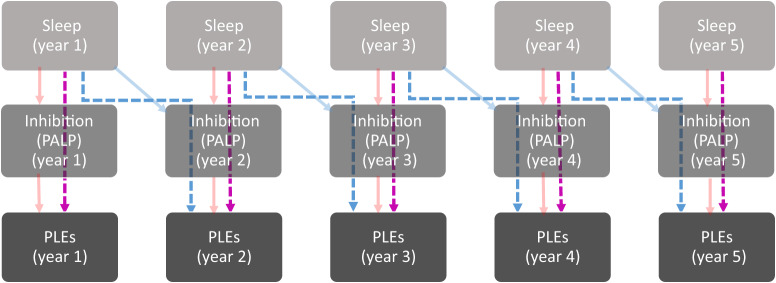
Adolescence is a key period for neurocognitive maturation where deviation from normal developmental trajectories may be tied to adverse mental health outcomes. Cognitive disruptions have been noted in populations at risk for psychosis and are known to accompany periods of sleep deprivation. This study aims to assess the role of cognition as a mediator between sleep disruptions and psychosis risk. A cohort of 3801 high school students (51% female, mean age = 12.8, SD = 0.45 years) was recruited from 31 Montreal high schools. Measures of sleep, psychotic-like experiences, inhibition, working memory, perceptual reasoning, and delayed recall were collected from participants on a yearly basis over the five years of their high school education. A multi-level model mediation analysis was performed controlling for sex and time squared. Response inhibition was shown to be associated with, and to mediate (B = -0.005, SD = 0.003, p = 0.005*) the relationship between sleep disruptions (B = -0.011, SD = 0.004, p < 0.001*) and psychotic-like experiences (B = 0.411, SD = 0.170, p = 0.005*). Spatial working memory deficits on a given year were associated with a higher frequency of psychotic-like experiences that same year (B = -0.046, SD = 0.018, p = 0.005*) and the following year (B = -0.051, SD = 0.023, p = 0.010*), but were not associated with sleep disturbances. No significant associations were found between our variables of interest and either delayed recall or perceptual reasoning at the within person level. Findings from this large longitudinal study provide evidence that the association between sleep disruptions and psychosis risk is specifically mediated by inhibitory rather than general cognitive impairments. The association of spatial working memory, response inhibition, and sleep disruptions with psychotic-like experiences suggests that these factors may represent potential targets for preventative interventions.
青春期是神经认知成熟的关键时期,在此期间偏离正常发育轨迹可能与不良心理健康结果相关。在有精神病风险的人群中已注意到认知障碍,并且已知其与睡眠剥夺时期相伴。本研究旨在评估认知作为睡眠中断与精神病风险之间中介因素的作用。从蒙特利尔的31所高中招募了3801名高中生队列(51%为女性,平均年龄 = 12.8岁,标准差 = 0.45岁)。在高中教育的五年期间,每年从参与者那里收集睡眠、类精神病体验、抑制、工作记忆、知觉推理和延迟回忆的测量数据。进行了控制性别和时间平方的多层次模型中介分析。结果显示,反应抑制与睡眠中断(B = -0.011,标准差 = 0.004,p < 0.001*)和类精神病体验(B = 0.411,标准差 = 0.170,p = 0.005*)之间的关系相关,并起到中介作用(B = -0.005,标准差 = 0.003,p = 0.005*)。特定年份的空间工作记忆缺陷与同年(B = -0.046,标准差 = 0.018,p = 0.005*)及次年(B = -0.051,标准差 = 0.023,p = 0.010*)较高频率的类精神病体验相关,但与睡眠障碍无关。在个体层面上,我们感兴趣的变量与延迟回忆或知觉推理之间未发现显著关联。这项大型纵向研究的结果提供了证据,表明睡眠中断与精神病风险之间的关联具体是由抑制性而非一般性认知损害介导的。空间工作记忆、反应抑制和睡眠中断与类精神病体验之间的关联表明,这些因素可能代表预防性干预的潜在目标。