Department of Orthopaedic Surgery, University of Groningen, University Medical Center Groningen, P.O. Box 30.001, 9700 RB, Groningen, The Netherlands.
Department of Orthopaedic Surgery, Martini Hospital, Groningen, The Netherlands.
J Orthop Surg Res. 2024 May 7;19(1):283. doi: 10.1186/s13018-024-04760-6.
The disparity in patient-reported outcomes between total knee arthroplasty (TKA) following high tibial osteotomy (HTO) and primary TKA has yet to be fully comprehended. This study aims to compare the patient-reported outcomes, radiological parameters and complication rates between TKA following HTO and primary TKA.
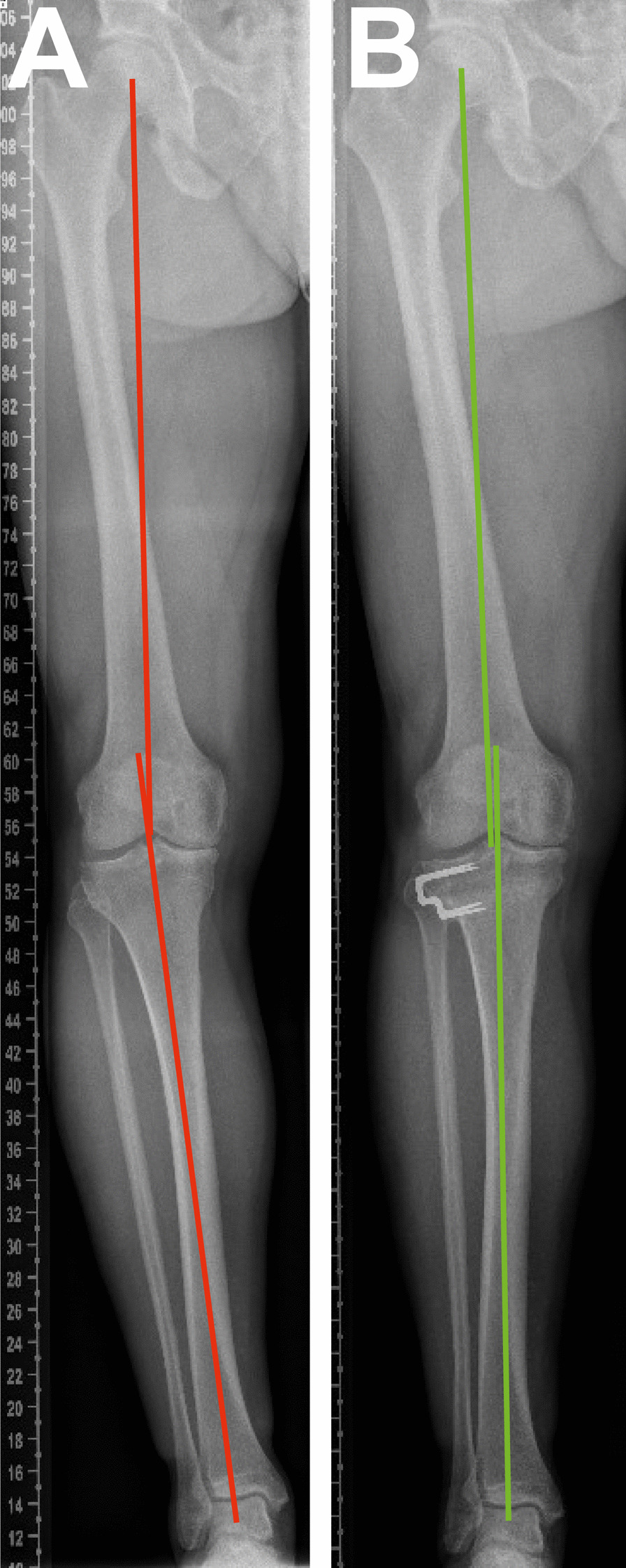
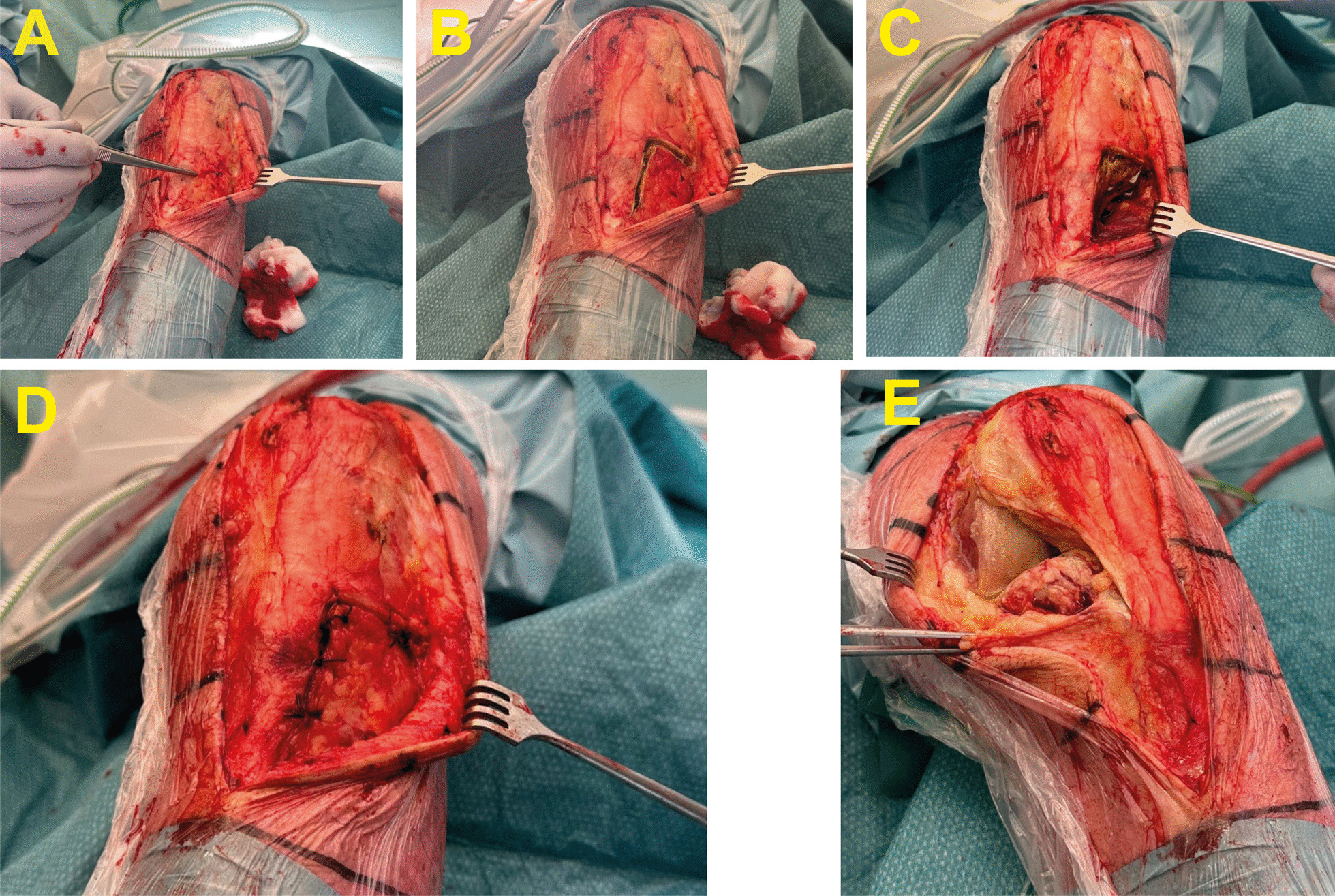
Sixty-five patients who underwent TKA following lateral closing-wedge HTO were compared to a matched group of primary TKA at postoperative 6-months and 1-year. Between-group confounders of age, gender, smoking status, Body Mass index, preoperative Numeric Rating Scale (NRS) pain in rest, Knee injury and Osteoarthritis Outcome Score-Physical function Shortform (KOOS-PS), EuroQol five-dimensional (EQ-5D) overall health score, and Oxford Knee Score (OKS) were balanced by propensity score matching. Patient-reported outcome measures were NRS pain in rest, KOOS-PS, EQ-5D overall health score, and OKS. Radiological parameters were femorotibial angle, medial proximal tibial angle, anatomical lateral distal femoral angle, posterior tibial slope, and patellar height assessed by Insall-Salvati ratio. The complication rates of TKA were compared between the two groups. The HTO survival time, the choice of staple removal before or during TKA in patients who underwent TKA following HTO patients, and the rate of patellar resurfacing were assessed. The p value < 0.0125 indicates statistical significance after Bonferroni correction.
After propensity score matching, no significant between-group differences in the patient-reported outcome measures, radiographical parameters and complication rates were found (p > 0.0125). In the TKA following HTO group, with an average HTO survival time of 8.7 years, staples were removed before TKA in 46 patients (71%) and during TKA in 19 patients, and 11 cases (17%) had patella resurfacing. In the primary TKA group, 15 cases (23%) had patella resurfacing.
The short-term assessment of TKA following HTO indicates outcomes similar to primary TKA. A previous HTO does not impact the early results of subsequent TKA, suggesting that the previous HTO has minimal influence on TKA outcomes.
III, cohort study.
全膝关节置换术(TKA)后行胫骨高位截骨术(HTO)与初次 TKA 患者的报告结局存在差异,目前尚未完全阐明。本研究旨在比较 HTO 后 TKA 与初次 TKA 的患者报告结局、影像学参数和并发症发生率。
术后 6 个月和 1 年时,将 65 例行外侧闭合楔形 HTO 后 TKA 的患者与初次 TKA 患者进行比较。通过倾向性评分匹配平衡组间年龄、性别、吸烟状况、体重指数、术前静息状态下数字评定量表(NRS)疼痛评分、膝关节损伤和骨关节炎结果评分-物理功能短表(KOOS-PS)、欧洲五维健康量表(EQ-5D)总体健康评分和牛津膝关节评分(OKS)的混杂因素。患者报告结局指标包括静息状态下 NRS 疼痛评分、KOOS-PS、EQ-5D 总体健康评分和 OKS。影像学参数包括股胫角、胫骨近端内侧角、解剖外侧远端股骨角、胫骨后倾角和髌骨高度,采用 Insall-Salvati 比值评估。比较两组 TKA 的并发症发生率。评估行 HTO 后 TKA 患者的 HTO 生存时间、术中或术前选择取出钢钉以及髌骨再成形术的比例。Bonferroni 校正后 p 值<0.0125 表示具有统计学意义。
经倾向性评分匹配后,两组患者报告结局、影像学参数和并发症发生率无显著差异(p>0.0125)。在 HTO 后 TKA 组中,平均 HTO 生存时间为 8.7 年,46 例(71%)患者在 TKA 前取出钢钉,19 例(30%)患者在 TKA 中取出钢钉,11 例(17%)患者行髌骨再成形术。在初次 TKA 组中,15 例(23%)患者行髌骨再成形术。
HTO 后 TKA 的短期评估结果与初次 TKA 相似。既往 HTO 不会影响后续 TKA 的早期结果,这表明既往 HTO 对 TKA 结果的影响较小。
III 级,队列研究。