Max-Planck-Institut für Quantenoptik, Garching, Germany.
Nature. 2024 May;629(8012):567-572. doi: 10.1038/s41586-024-07357-5. Epub 2024 May 8.
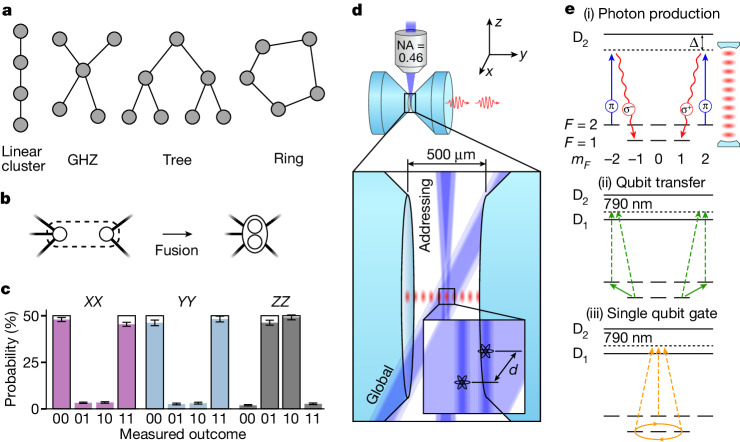
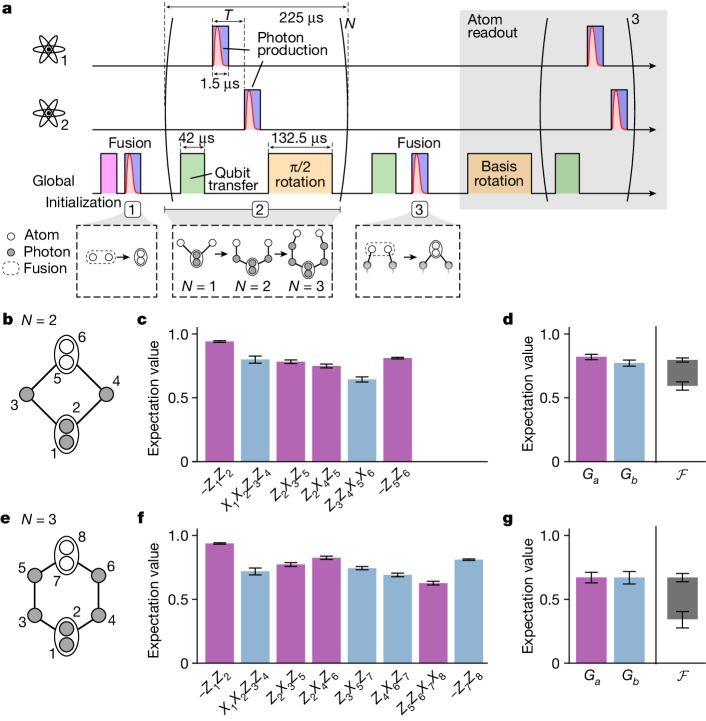
Entanglement has evolved from an enigmatic concept of quantum physics to a key ingredient of quantum technology. It explains correlations between measurement outcomes that contradict classical physics and has been widely explored with small sets of individual qubits. Multi-partite entangled states build up in gate-based quantum-computing protocols and-from a broader perspective-were proposed as the main resource for measurement-based quantum-information processing. The latter requires the ex-ante generation of a multi-qubit entangled state described by a graph. Small graph states such as Bell or linear cluster states have been produced with photons, but the proposed quantum-computing and quantum-networking applications require fusion of such states into larger and more powerful states in a programmable fashion. Here we achieve this goal by using an optical resonator containing two individually addressable atoms. Ring and tree graph states with up to eight qubits, with the names reflecting the entanglement topology, are efficiently fused from the photonic states emitted by the individual atoms. The fusion process itself uses a cavity-assisted gate between the two atoms. Our technique is, in principle, scalable to even larger numbers of qubits and is the decisive step towards, for instance, a memory-less quantum repeater in a future quantum internet.
纠缠已经从量子物理学中一个神秘的概念发展成为量子技术的关键组成部分。它解释了与经典物理学相矛盾的测量结果之间的相关性,并已经通过小数量的单个量子位进行了广泛的探索。基于门的量子计算协议中会产生多部分纠缠态,并且——从更广泛的角度来看——被提议作为基于测量的量子信息处理的主要资源。后者需要预先生成由图描述的多量子位纠缠态。已经使用光子产生了贝尔态或线性簇态等小图态,但所提出的量子计算和量子网络应用需要以可编程的方式将这些态融合成更大和更强大的态。在这里,我们通过使用包含两个可单独寻址原子的光学谐振器来实现这一目标。具有多达八个量子位的环形和树形图态,其名称反映了纠缠拓扑,是从单个原子发射的光子态中高效地融合而成的。融合过程本身使用两个原子之间的腔辅助门。我们的技术原则上可以扩展到更多数量的量子位,并且是迈向例如未来量子互联网中的无记忆量子中继器的关键一步。