School of Biomedical Engineering and Sciences, Virginia Tech-Wake Forest University, Blacksburg, VA, USA.
Department of Chemical Engineering, Virginia Tech, Blacksburg, VA, USA.
Commun Biol. 2024 May 8;7(1):551. doi: 10.1038/s42003-024-06201-w.
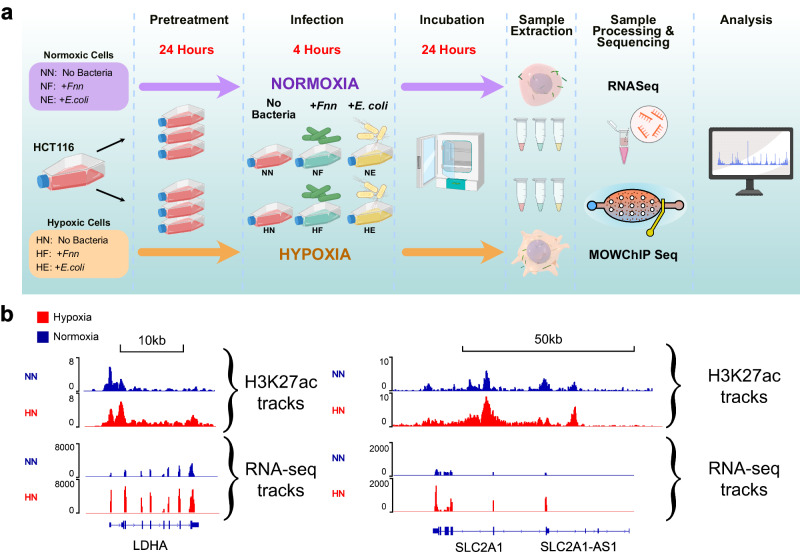
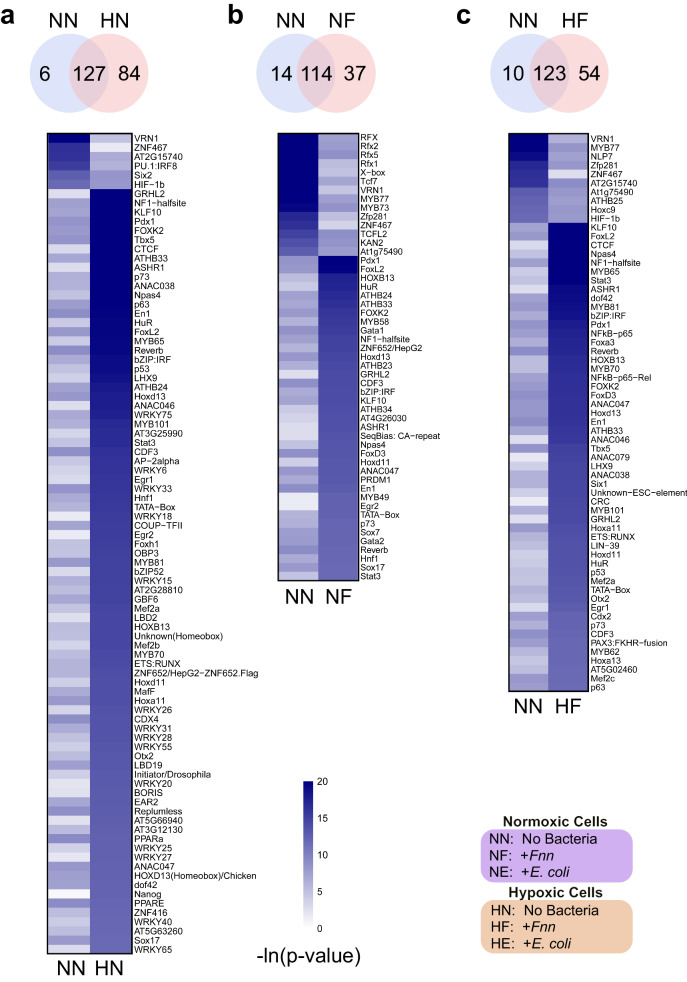
Fusobacterium nucleatum, a gram-negative oral bacterium, has been consistently validated as a strong contributor to the progression of several types of cancer, including colorectal (CRC) and pancreatic cancer. While previous in vitro studies have shown that intracellular F. nucleatum enhances malignant phenotypes such as cell migration, the dependence of this regulation on features of the tumor microenvironment (TME) such as oxygen levels are wholly uncharacterized. Here we examine the influence of hypoxia in facilitating F. nucleatum invasion and its effects on host responses focusing on changes in the global epigenome and transcriptome. Using a multiomic approach, we analyze epigenomic alterations of H3K27ac and global transcriptomic alterations sustained within a hypoxia and normoxia conditioned CRC cell line HCT116 at 24 h following initial infection with F. nucleatum. Our findings reveal that intracellular F. nucleatum activates signaling pathways and biological processes in host cells similar to those induced upon hypoxia conditioning in the absence of infection. Furthermore, we show that a hypoxic TME favors F. nucleatum invasion and persistence and therefore infection under hypoxia may amplify malignant transformation by exacerbating the effects induced by hypoxia alone. These results motivate future studies to investigate host-microbe interactions in tumor tissue relevant conditions that more accurately define parameters for targeted cancer therapies.
具核梭杆菌是一种革兰氏阴性口腔细菌,它一直被证实是多种癌症(包括结直肠癌和胰腺癌)进展的重要因素。虽然之前的体外研究表明,细胞内的具核梭杆菌增强了恶性表型,如细胞迁移,但这种调节对肿瘤微环境(TME)特征(如氧水平)的依赖性尚未完全阐明。在这里,我们研究了缺氧对促进具核梭杆菌侵袭的影响及其对宿主反应的影响,重点关注全基因组表观基因组和转录组的变化。我们使用多组学方法,分析了在初始感染具核梭杆菌 24 小时后,在缺氧和常氧条件下培养的结直肠癌细胞系 HCT116 中 H3K27ac 的表观基因组改变和持续的全转录组改变。我们的研究结果表明,细胞内的具核梭杆菌在宿主细胞中激活了信号通路和生物学过程,这些过程与缺氧条件下没有感染时诱导的过程相似。此外,我们还表明,缺氧的 TME 有利于具核梭杆菌的侵袭和持续存在,因此,在缺氧条件下的感染可能会通过加剧缺氧本身引起的影响,从而放大恶性转化。这些结果促使未来的研究在更准确地定义靶向癌症治疗参数的肿瘤组织相关条件下,研究宿主-微生物相互作用。