Urban Health Collaborative, Dornsife School of Public Health, Drexel University, 3600 Market St, 7th Floor, Philadelphia, PA, 19104, USA.
UniSA Allied Health & Human Performance, University of South Australia, North Terrace, Adelaide, SA, 5000, Australia.
Int J Behav Nutr Phys Act. 2024 May 8;21(1):54. doi: 10.1186/s12966-024-01570-1.
Transportation policies can impact health outcomes while simultaneously promoting social equity and environmental sustainability. We developed an agent-based model (ABM) to simulate the impacts of fare subsidies and congestion taxes on commuter decision-making and travel patterns. We report effects on mode share, travel time and transport-related physical activity (PA), including the variability of effects by socioeconomic strata (SES), and the trade-offs that may need to be considered in the implementation of these policies in a context with high levels of necessity-based physical activity.
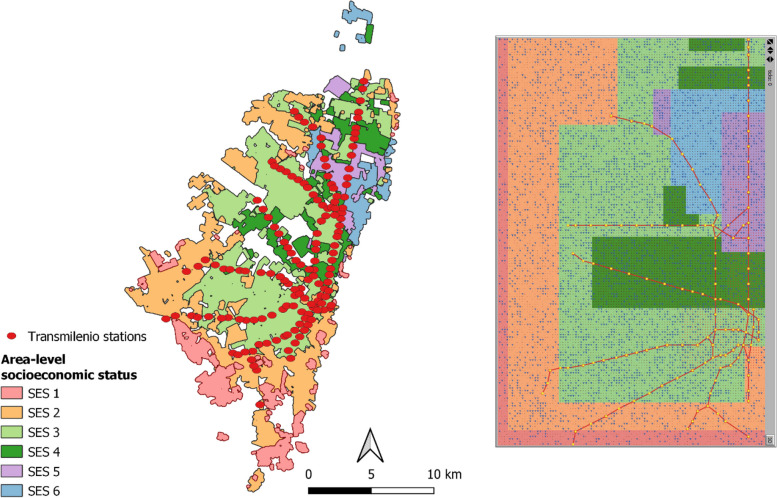
The ABM design was informed by local stakeholder engagement. The demographic and spatial characteristics of the in-silico city, and its residents, were informed by local surveys and empirical studies. We used ridership and travel time data from the 2019 Bogotá Household Travel Survey to calibrate and validate the model by SES. We then explored the impacts of fare subsidy and congestion tax policy scenarios.
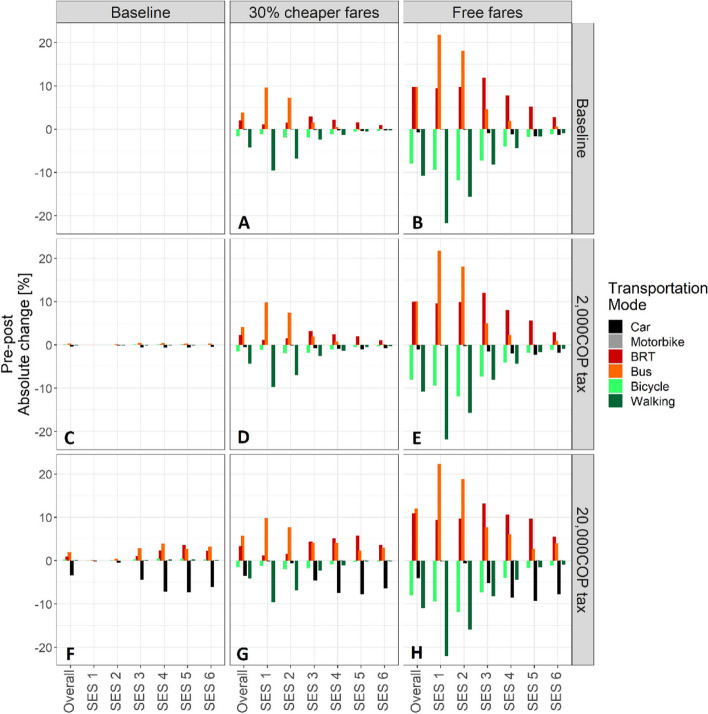
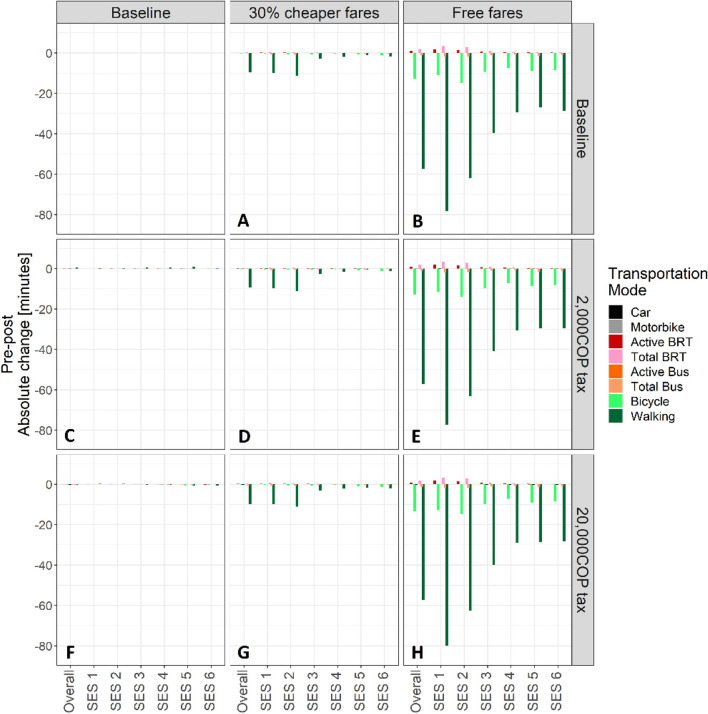
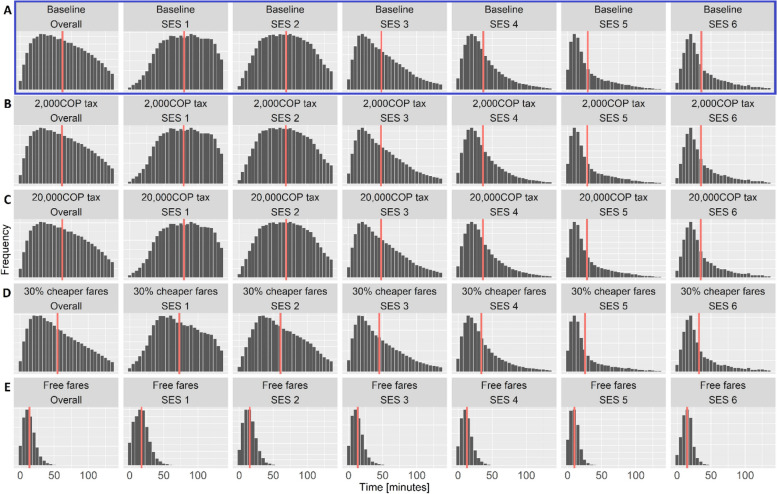
Our model reproduced commuting patterns observed in Bogotá, including substantial necessity-based walking for transportation. At the city-level, congestion taxes fractionally reduced car use, including among mid-to-high SES groups but not among low SES commuters. Neither travel times nor physical activity levels were impacted at the city level or by SES. Comparatively, fare subsidies promoted city-level public transportation (PT) ridership, particularly under a 'free-fare' scenario, largely through reductions in walking trips. 'Free fare' policies also led to a large reduction in very long walking times and an overall reduction in the commuting-based attainment of physical activity guidelines. Differential effects were observed by SES, with free fares promoting PT ridership primarily among low-and-middle SES groups. These shifts to PT reduced median walking times among all SES groups, particularly low-SES groups. Moreover, the proportion of low-to-mid SES commuters meeting weekly physical activity recommendations decreased under the 'freefare' policy, with no change observed among high-SES groups.
Transport policies can differentially impact SES-level disparities in necessity-based walking and travel times. Understanding these impacts is critical in shaping transportation policies that balance the dual aims of reducing SES-level disparities in travel time (and time poverty) and the promotion of choice-based physical activity.
交通政策不仅可以影响健康结果,还可以促进社会公平和环境可持续性。我们开发了一个基于代理的模型(ABM)来模拟票价补贴和拥堵税对通勤者决策和出行模式的影响。我们报告了模式份额、旅行时间和与交通相关的体力活动(PA)的变化,包括社会经济阶层(SES)差异的影响,以及在高必要体力活动水平背景下实施这些政策可能需要考虑的权衡。
ABM 的设计是基于当地利益相关者的参与。虚拟城市及其居民的人口统计学和空间特征是根据当地调查和实证研究得出的。我们使用 2019 年波哥大家庭出行调查的出行量和旅行时间数据,根据 SES 对模型进行校准和验证。然后,我们探索了票价补贴和拥堵税政策情景的影响。
我们的模型再现了在波哥大观察到的通勤模式,包括大量用于交通的必要步行。在城市层面,拥堵税略微减少了汽车使用,包括中高 SES 群体,但不包括低 SES 通勤者。无论是在城市层面还是 SES 层面,旅行时间或体力活动水平都没有受到影响。相比之下,票价补贴促进了城市层面的公共交通(PT)出行,特别是在“免费票价”情景下,主要是通过减少步行出行。“免费票价”政策还导致非常长的步行时间大幅减少,以及整体减少通勤达到体力活动指南。SES 存在差异效应,免费票价主要促进了低中 SES 群体的 PT 出行。这些向 PT 的转变减少了所有 SES 群体的平均步行时间,特别是低 SES 群体。此外,在“免费票价”政策下,低到中 SES 通勤者符合每周体力活动建议的比例下降,高 SES 群体没有观察到变化。
交通政策可能会对基于必要性的步行和旅行时间的 SES 水平差异产生不同的影响。了解这些影响对于制定交通政策至关重要,这些政策需要平衡减少 SES 水平旅行时间(和时间贫困)差异和促进基于选择的体力活动的双重目标。