Department of Neurology, Vanderbilt University Medical Center, Nashville, TN, USA.
Department of Radiology and Radiological Sciences, Vanderbilt University Medical Center, Nashville, TN, USA.
Fluids Barriers CNS. 2024 May 9;21(1):40. doi: 10.1186/s12987-024-00542-8.
Parkinson's disease is characterized by dopamine-responsive symptoms as well as aggregation of α-synuclein protofibrils. New diagnostic methods assess α-synuclein aggregation characteristics from cerebrospinal fluid (CSF) and recent pathophysiologic mechanisms suggest that CSF circulation disruptions may precipitate α-synuclein retention. Here, diffusion-weighted MRI with low-to-intermediate diffusion-weightings was applied to test the hypothesis that CSF motion is reduced in Parkinson's disease relative to healthy participants.
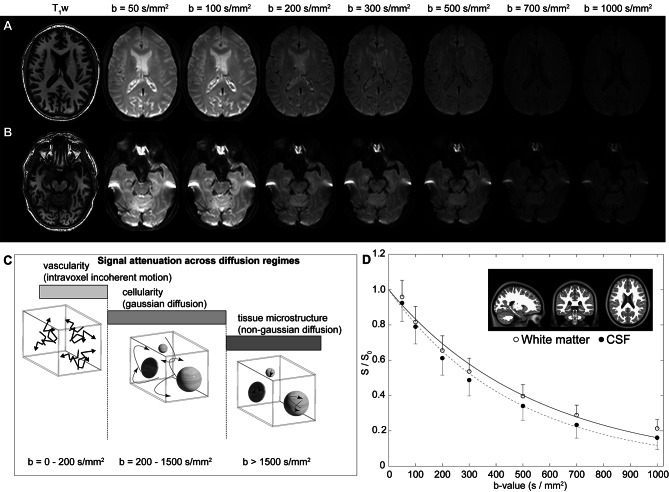
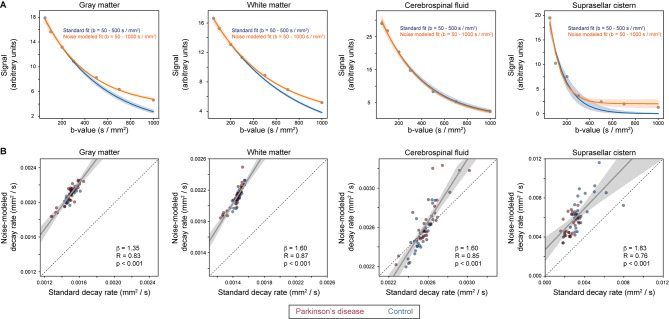
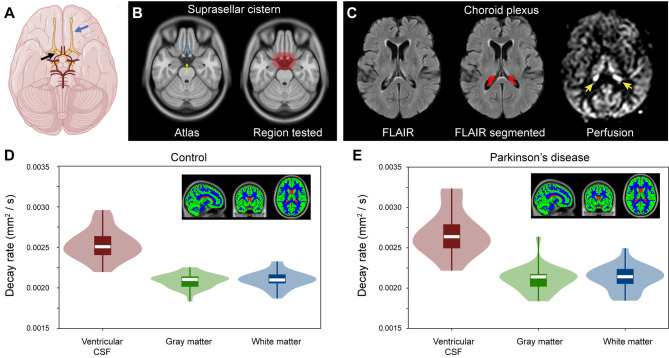
Multi-shell diffusion weighted MRI (spatial resolution = 1.8 × 1.8 × 4.0 mm) with low-to-intermediate diffusion weightings (b-values = 0, 50, 100, 200, 300, 700, and 1000 s/mm) was applied over the approximate kinetic range of suprasellar cistern fluid motion at 3 Tesla in Parkinson's disease (n = 27; age = 66 ± 6.7 years) and non-Parkinson's control (n = 32; age = 68 ± 8.9 years) participants. Wilcoxon rank-sum tests were applied to test the primary hypothesis that the noise floor-corrected decay rate of CSF signal as a function of b-value, which reflects increasing fluid motion, is reduced within the suprasellar cistern of persons with versus without Parkinson's disease and inversely relates to choroid plexus activity assessed from perfusion-weighted MRI (significance-criteria: p < 0.05).
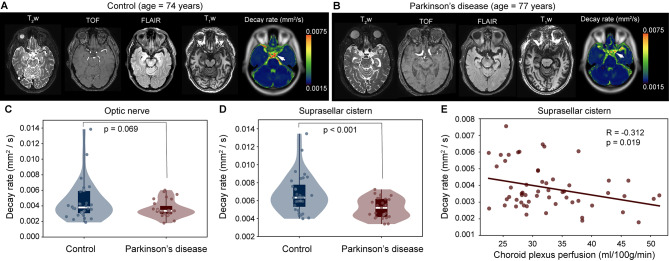
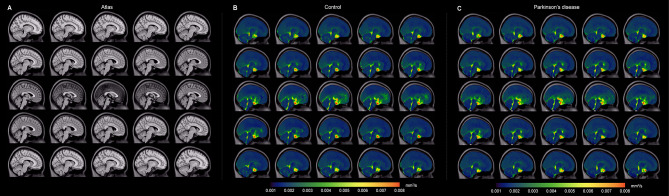
Consistent with the primary hypothesis, CSF decay rates were higher in healthy (D = 0.00673 ± 0.00213 mm/s) relative to Parkinson's disease (D = 0.00517 ± 0.00110 mm/s) participants. This finding was preserved after controlling for age and sex and was observed in the posterior region of the suprasellar cistern (p < 0.001). An inverse correlation between choroid plexus perfusion and decay rate in the voxels within the suprasellar cistern (Spearman's-r=-0.312; p = 0.019) was observed.
Multi-shell diffusion MRI was applied to identify reduced CSF motion at the level of the suprasellar cistern in adults with versus without Parkinson's disease; the strengths and limitations of this methodology are discussed in the context of the growing literature on CSF flow.
帕金森病的特征是多巴胺反应症状以及α-突触核蛋白原纤维的聚集。新的诊断方法评估脑脊液(CSF)中的α-突触核蛋白聚集特征,最近的病理生理机制表明 CSF 循环中断可能导致α-突触核蛋白滞留。在这里,应用低至中等扩散权重的扩散加权 MRI 来检验 CSF 运动在帕金森病患者中相对于健康参与者减少的假设。
多壳扩散加权 MRI(空间分辨率 = 1.8 × 1.8 × 4.0mm),具有低至中等扩散权重(b 值 = 0、50、100、200、300、700 和 1000s/mm),应用于 3 Tesla 下的鞍上池脑脊液运动的近似动力学范围,包括帕金森病患者(n = 27;年龄 = 66 ± 6.7 岁)和非帕金森病对照组(n = 32;年龄 = 68 ± 8.9 岁)。Wilcoxon 秩和检验用于检验主要假设,即作为 b 值函数的 CSF 信号的噪声基底校正衰减率,反映了越来越大的流体运动,在有与无帕金森病的个体的鞍上池内降低,并且与从灌注加权 MRI 评估的脉络丛活性呈反比(显著性标准:p < 0.05)。
与主要假设一致,健康者的 CSF 衰减率较高(D = 0.00673 ± 0.00213mm/s),相对于帕金森病患者(D = 0.00517 ± 0.00110mm/s)。在控制年龄和性别后,这一发现得到了保留,并且在前颅窝的后部观察到了(p < 0.001)。在鞍上池内的体素中观察到脉络丛灌注与衰减率之间的负相关(Spearman's-r=-0.312;p = 0.019)。
多壳扩散 MRI 被应用于识别有与无帕金森病的成年人中鞍上池水平的 CSF 运动减少;在 CSF 流动的不断增长的文献背景下,讨论了这种方法的优缺点。