Department of Radiology, Juntendo University Graduate School of Medicine, Tokyo, Japan; Melbourne Neuropsychiatry Centre, Department of Psychiatry, The University of Melbourne & Melbourne Health, Parkville, VIC, Australia.
Melbourne Neuropsychiatry Centre, Department of Psychiatry, The University of Melbourne & Melbourne Health, Parkville, VIC, Australia; Melbourne School of Engineering, University of Melbourne, Melbourne, Australia.
Neuroimage Clin. 2017 Nov 10;17:518-529. doi: 10.1016/j.nicl.2017.11.007. eCollection 2018.
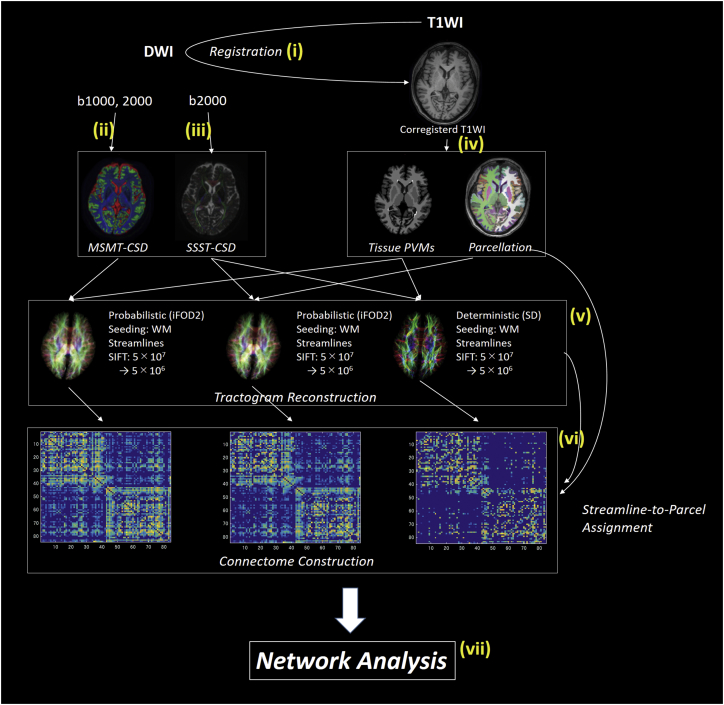
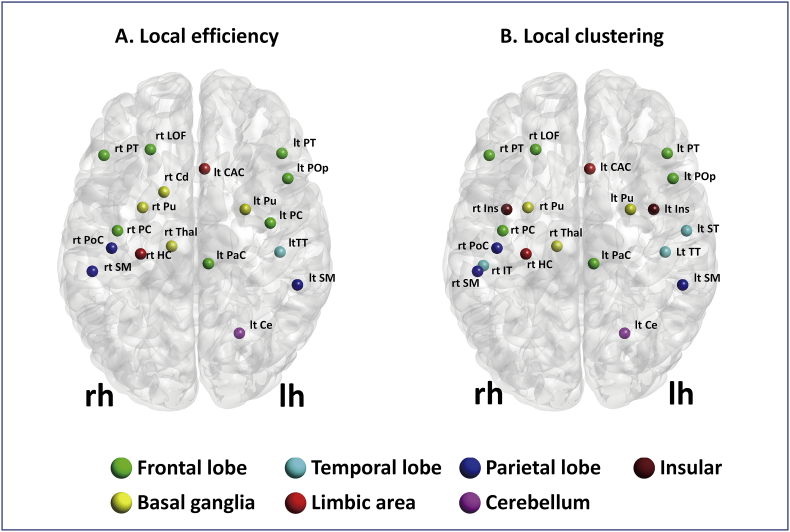
Parkinson's disease (PD) is a progressive neurodegenerative disorder that affects extensive regions of the central nervous system. In this work, we evaluated the structural connectome of patients with PD, as mapped by diffusion-weighted MRI tractography and a multi-shell, multi-tissue (MSMT) constrained spherical deconvolution (CSD) method to increase the precision of tractography at tissue interfaces. The connectome was mapped with probabilistic MSMT-CSD in 21 patients with PD and in 21 age- and gender-matched controls. Mapping was also performed by deterministic single-shell, single tissue (SSST)-CSD tracking and probabilistic SSST-CSD tracking for comparison. A support vector machine was trained to predict diagnosis based on a linear combination of graph metrics. We showed that probabilistic MSMT-CSD could detect significantly reduced global strength, efficiency, clustering, and small-worldness, and increased global path length in patients with PD relative to healthy controls; by contrast, probabilistic SSST-CSD only detected the difference in global strength and small-worldness. In patients with PD, probabilistic MSMT-CSD also detected a significant reduction in local efficiency and detected clustering in the motor, frontal temporoparietal associative, limbic, basal ganglia, and thalamic areas. The network-based statistic identified a subnetwork of reduced connectivity by MSMT-CSD and probabilistic SSST-CSD in patients with PD, involving key components of the cortico-basal ganglia-thalamocortical network. Finally, probabilistic MSMT-CSD had superior diagnostic accuracy compared with conventional probabilistic SSST-CSD and deterministic SSST-CSD tracking. In conclusion, probabilistic MSMT-CSD detected a greater extent of connectome pathology in patients with PD, including those with cortico-basal ganglia-thalamocortical network disruptions. Connectome analysis based on probabilistic MSMT-CSD may be useful when evaluating the extent of white matter connectivity disruptions in PD.
帕金森病(PD)是一种进行性神经退行性疾病,影响中枢神经系统的广泛区域。在这项工作中,我们通过扩散加权 MRI 轨迹和多壳层、多组织(MSMT)约束球谐分解(CSD)方法评估了 PD 患者的结构连接组,以提高在组织界面处轨迹的精度。使用概率 MSMT-CSD 在 21 名 PD 患者和 21 名年龄和性别匹配的对照中绘制了连接组图。还通过确定性单壳层、单组织(SSST)-CSD 跟踪和概率 SSST-CSD 跟踪进行了映射,以便进行比较。使用支持向量机基于图度量的线性组合来训练以预测诊断。我们表明,与健康对照组相比,概率 MSMT-CSD 可以检测到 PD 患者的全局强度、效率、聚类和小世界特征显著降低,全局路径长度增加;相比之下,概率 SSST-CSD 仅检测到全局强度和小世界特征的差异。在 PD 患者中,概率 MSMT-CSD 还检测到局部效率降低和运动、额颞顶叶联合、边缘、基底节和丘脑区域的聚类。基于网络的统计数据通过 MSMT-CSD 和概率 SSST-CSD 在 PD 患者中识别出一个连通性降低的子网络,涉及皮质基底节丘脑皮质网络的关键组件。最后,与传统的概率 SSST-CSD 和确定性 SSST-CSD 跟踪相比,概率 MSMT-CSD 具有更高的诊断准确性。总之,概率 MSMT-CSD 在 PD 患者中检测到更大程度的连接组病理学,包括皮质基底节丘脑皮质网络中断。基于概率 MSMT-CSD 的连接组分析可能有助于评估 PD 中白质连接中断的程度。