Center for Critical Care, Houston Methodist, 6550 Fannin St., Houston, TX, 77030, USA.
Office of Sustainability, Houston Methodist, 6550 Fannin St., Houston, TX, 77030, USA.
Crit Care. 2024 May 9;28(1):154. doi: 10.1186/s13054-024-04937-9.
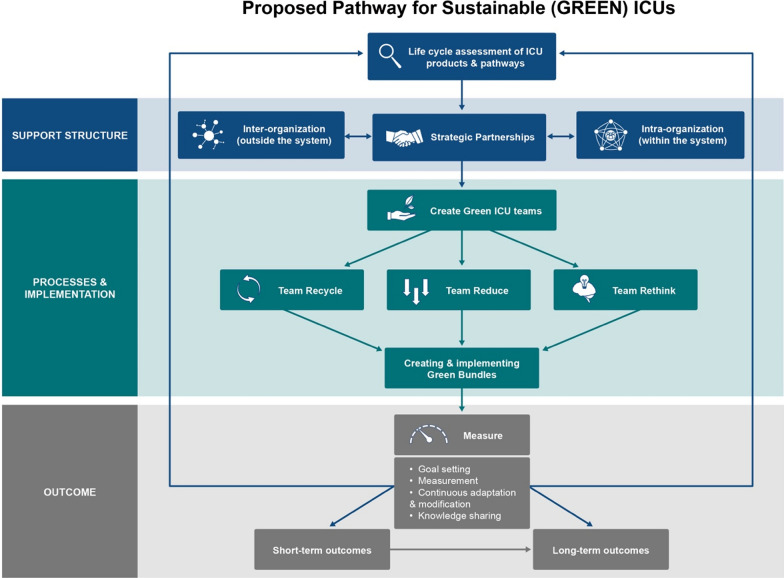
Healthcare systems are large contributors to global emissions, and intensive care units (ICUs) are a complex and resource-intensive component of these systems. Recent global movements in sustainability initiatives, led mostly by Europe and Oceania, have tried to mitigate ICUs' notable environmental impact with varying success. However, there exists a significant gap in the U.S. knowledge and published literature related to sustainability in the ICU. After a narrative review of the literature and related industry standards, we share our experience with a Green ICU initiative at a large hospital system in Texas. Our process has led to a 3-step pathway to inform similar initiatives for sustainable (green) critical care. This pathway involves (1) establishing a baseline by quantifying the status quo carbon footprint of the affected ICU as well as the cumulative footprint of all the ICUs in the healthcare system; (2) forming alliances and partnerships to target each major source of these pollutants and implement specific intervention programs that reduce the ICU-related greenhouse gas emissions and solid waste; and (3) finally to implement a systemwide Green ICU which requires the creation of multiple parallel pathways that marshal the resources at the grass-roots level to engage the ICU staff and institutionalize a mindset that recognizes and respects the impact of ICU functions on our environment. It is expected that such a systems-based multi-stakeholder approach would pave the way for improved sustainability in critical care.
医疗保健系统是全球排放的主要贡献者,而重症监护病房(ICU)是这些系统中复杂且资源密集型的组成部分。最近,欧洲和大洋洲等地区主导的可持续发展倡议在全球范围内取得了一定成效,试图减轻 ICU 对环境的显著影响。然而,美国在 ICU 可持续性方面的知识和已发表文献方面存在显著差距。在对文献和相关行业标准进行叙述性审查后,我们分享了在德克萨斯州一家大型医院系统中开展绿色 ICU 计划的经验。我们的方法已形成一个三步路径,为可持续(绿色)重症监护提供类似的计划。该路径包括:(1)通过量化受影响 ICU 的现状碳足迹以及整个医疗保健系统中所有 ICU 的累积足迹来建立基线;(2)建立联盟和伙伴关系,针对这些污染物的主要来源,并实施具体的干预计划,以减少 ICU 相关的温室气体排放和固体废物;(3)最后实施全院范围的绿色 ICU,这需要创建多个并行路径,调动基层资源,让 ICU 工作人员参与其中,并形成一种认识到并尊重 ICU 功能对环境影响的心态。预计这种基于系统的多方利益相关者方法将为重症监护的可持续性发展铺平道路。