Liu Menghua, Wu Anping, Liu Jiaxin, Zhao Yanfeng, Dong Xinyi, Sun Tao, Shi Qing, Wang Huaping
Intelligent Robotics Institute, School of Mechatronical Engineering, Beijing Institute of Technology, Beijing 100081, China.
School of Medical Technology, Beijing Institute of Technology, Beijing 100081, China.
Cyborg Bionic Syst. 2024 May 9;5:0095. doi: 10.34133/cbsystems.0095. eCollection 2024.
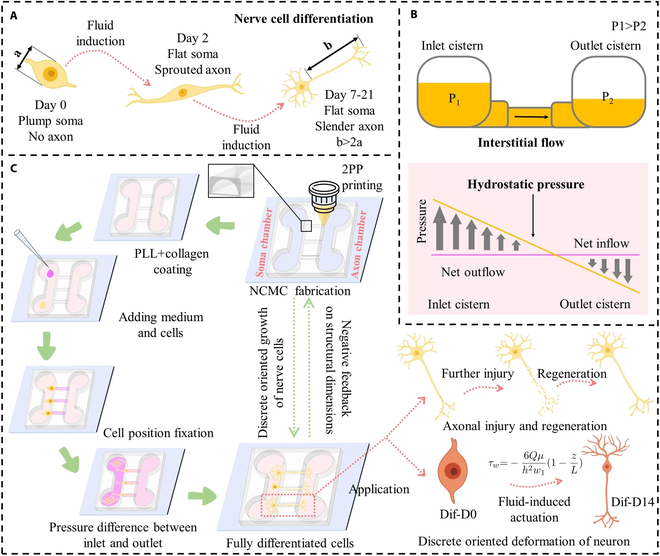
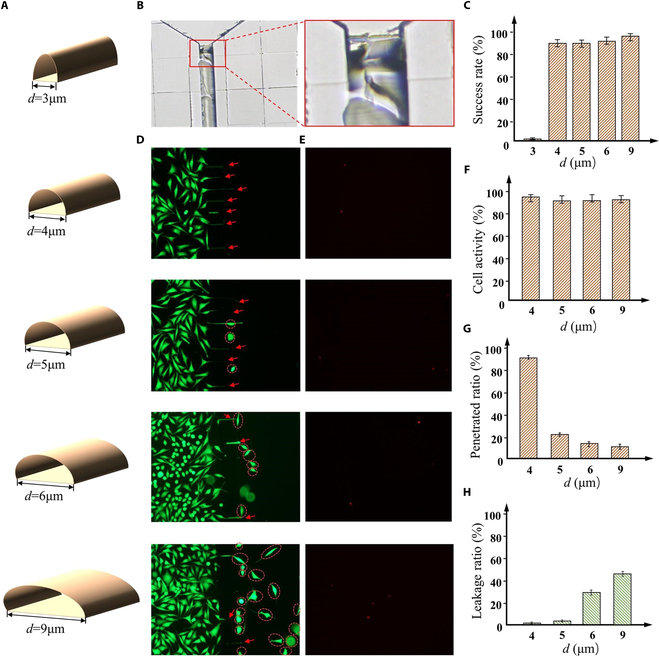
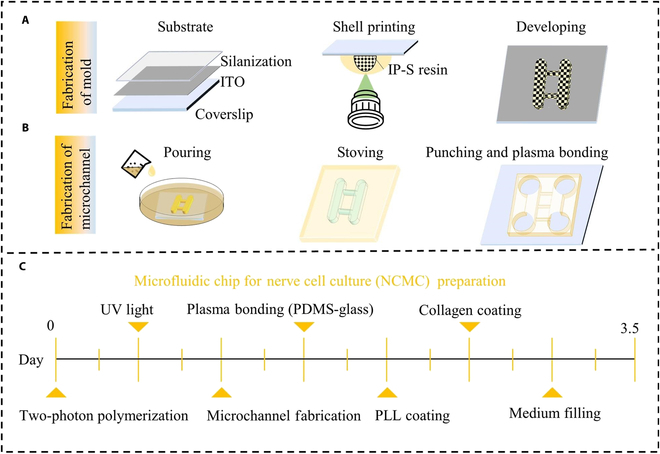
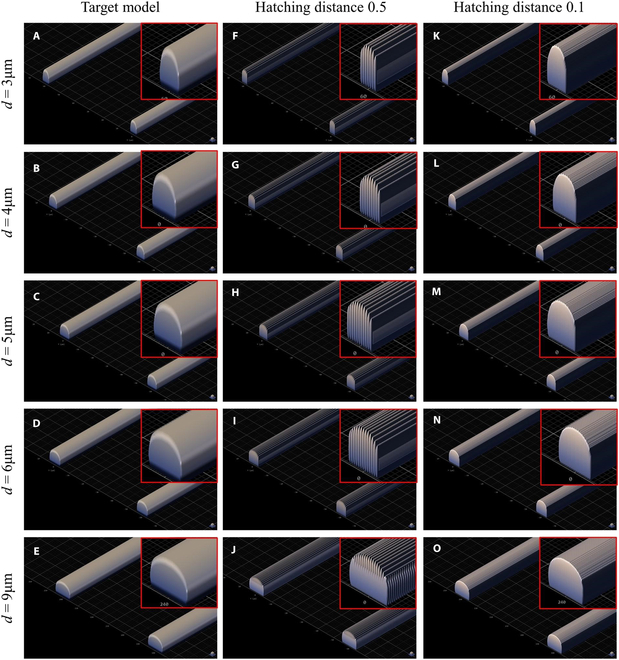
Microfluidic chips offer high customizability and excellent biocompatibility, holding important promise for the precise control of biological growth at the microscale. However, the microfluidic chips employed in the studies of regulating cell growth are typically fabricated through 2D photolithography. This approach partially restricts the diversity of cell growth platform designs and manufacturing efficiency. This paper presents a method for designing and manufacturing neural cell culture microfluidic chips (NCMC) using two-photon polymerization (TPP), where the discrete and directional cell growth is optimized through studying the associated geometric parameters of on-chip microchannels. This study involves simulations and discussions regarding the effects of different hatching distances on the mold surface topography and printing time in the Describe print preview module, which determines the appropriate printing accuracy corresponding to the desired mold structure. With the assistance of the 3D maskless lithography system, micron-level rapid printing of target molds with different dimensions were achieved. For NCMC with different geometric parameters, COMSOL software was used to simulate the local flow velocity and shear stress characteristics within the microchannels. SH-SY5Y cells were selected for directional differentiation experiments on NCMC with different geometric parameters. The results demonstrate that the TPP-based manufacturing method efficiently constructs neural microfluidic chips with high precision, optimizing the discrete and directional cell growth. We anticipate that our method for designing and manufacturing NCMC will hold great promise in construction and application of microscale 3D drug models.
微流控芯片具有高度的可定制性和出色的生物相容性,在微观尺度上对生物生长进行精确控制方面有着重要前景。然而,用于调节细胞生长研究的微流控芯片通常是通过二维光刻制造的。这种方法部分限制了细胞生长平台设计的多样性和制造效率。本文提出了一种使用双光子聚合(TPP)设计和制造神经细胞培养微流控芯片(NCMC)的方法,通过研究芯片上微通道的相关几何参数来优化离散和定向的细胞生长。本研究涉及在描述打印预览模块中对不同孵化距离对模具表面形貌和打印时间的影响进行模拟和讨论,从而确定与所需模具结构相对应的合适打印精度。在3D无掩膜光刻系统的辅助下,实现了不同尺寸目标模具的微米级快速打印。对于具有不同几何参数的NCMC,使用COMSOL软件模拟微通道内的局部流速和剪切应力特性。选择SH-SY5Y细胞在具有不同几何参数的NCMC上进行定向分化实验。结果表明,基于TPP的制造方法能够高效地高精度构建神经微流控芯片,优化离散和定向的细胞生长。我们预计,我们设计和制造NCMC的方法在微尺度3D药物模型的构建和应用中将具有巨大潜力。