Department of Cardiovascular, Affiliated Hospital of Hebei University, Baoding 071000, Hebei, China.
Department of Cardiovascular Sciences, Hebei Medical University, Shijiazhuang 050017, Hebei, China.
Aging (Albany NY). 2024 May 8;16(9):8142-8154. doi: 10.18632/aging.205808.
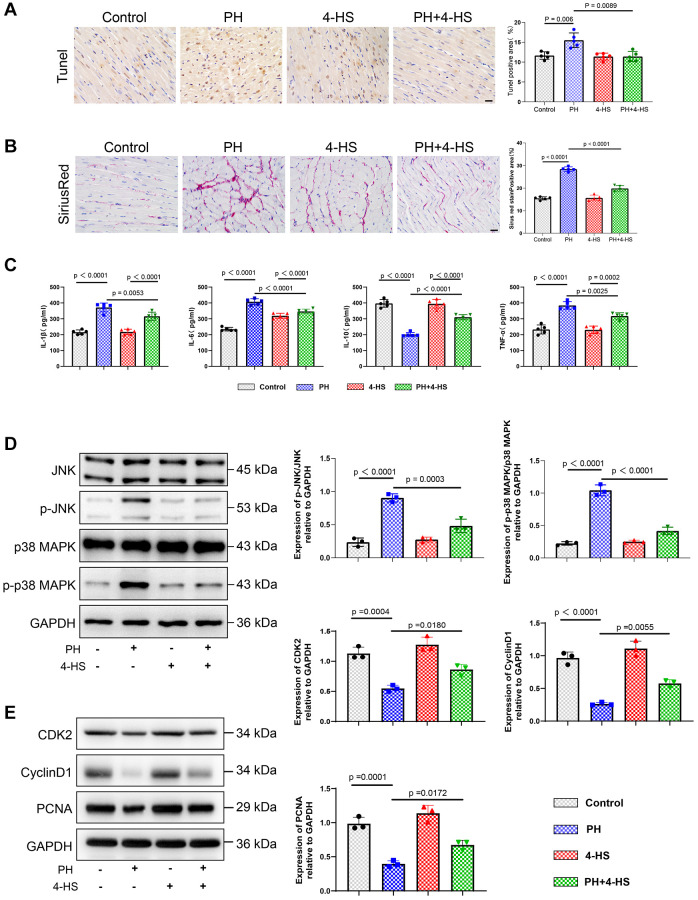
The specific mechanism of 4-hydroxysesamin (4-HS), a modification of Sesamin, on right ventricular failure due to pulmonary hypertension (PH) is ominous. By creating a rat model of PH and a model of pulmonary artery smooth muscle cell (PASMC) hypoxia and inflammation , the current work aimed to investigate in depth the molecular mechanism of the protective effect of 4-HS. In an model of hypoxia PASMC, changes in cell proliferation and inflammatory factors were detected after treatment with 4-HS, followed by changes in the JNK/p38 MAPK signaling pathway as detected by Western blot signaling pathway. The findings demonstrated that 4-HS was able to minimize PASMC cell death, block the JNK/p38 MAPK signaling pathway, and resist the promoting effect of hypoxia on PASMC cell proliferation. Following that, we found that 4-HS could both mitigate the right ventricular damage brought on by MCT and had a protective impact on rats Monocrotaline (MCT)-induced PH in investigations. The key finding of this study is that 4-HS may protect against PH by inhibiting the JNK/p38 MAPK signaling pathway.
4-羟基芝麻素(4-HS)是芝麻素的一种修饰形式,其对肺动脉高压(PH)所致右心衰竭的具体作用机制尚不清楚。本研究通过构建 PH 大鼠模型和肺动脉平滑肌细胞(PASMC)缺氧和炎症模型,深入研究 4-HS 的保护作用的分子机制。在缺氧 PASMC 模型中,用 4-HS 处理后检测细胞增殖和炎症因子的变化,然后用 Western blot 信号通路检测 JNK/p38 MAPK 信号通路的变化。结果表明,4-HS 能够减少 PASMC 细胞死亡,阻断 JNK/p38 MAPK 信号通路,抵抗缺氧对 PASMC 细胞增殖的促进作用。随后,我们发现 4-HS 既能减轻 MCT 引起的右心室损伤,又能在研究中对 MCT 诱导的 PH 大鼠产生保护作用。本研究的关键发现是,4-HS 可能通过抑制 JNK/p38 MAPK 信号通路来预防 PH。