College of Medicine, Southwest Jiaotong University, Chengdu, Sichuan, China.
Department of Oncology, People's Liberation Army the General Hospital of Western Theater Command, Chengdu, Sichuan, China.
Medicine (Baltimore). 2024 May 10;103(19):e38129. doi: 10.1097/MD.0000000000038129.
The prognostic significance of tumor-infiltrating immune cells in endometrial cancer is a subject of ongoing debate. Recent evidence increasingly suggests that these immune cells and cytokines, abundant in endometrial cancer tissues, play a pivotal role in stimulating the body inherent anti-tumor immune responses.
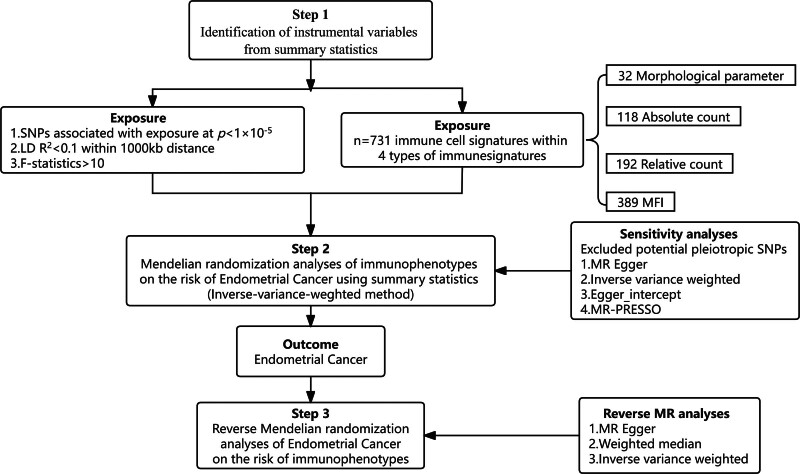
Leveraging publicly accessible genetic data, we conducted an exhaustive 2-sample Mendelian randomization (MR) study. This study aimed to explore the causal links between 731 immunophenotypes and the risk of endometrial cancer. We thoroughly assessed the robustness, heterogeneity, and potential horizontal pleiotropy of our findings through extensive sensitivity analyses.
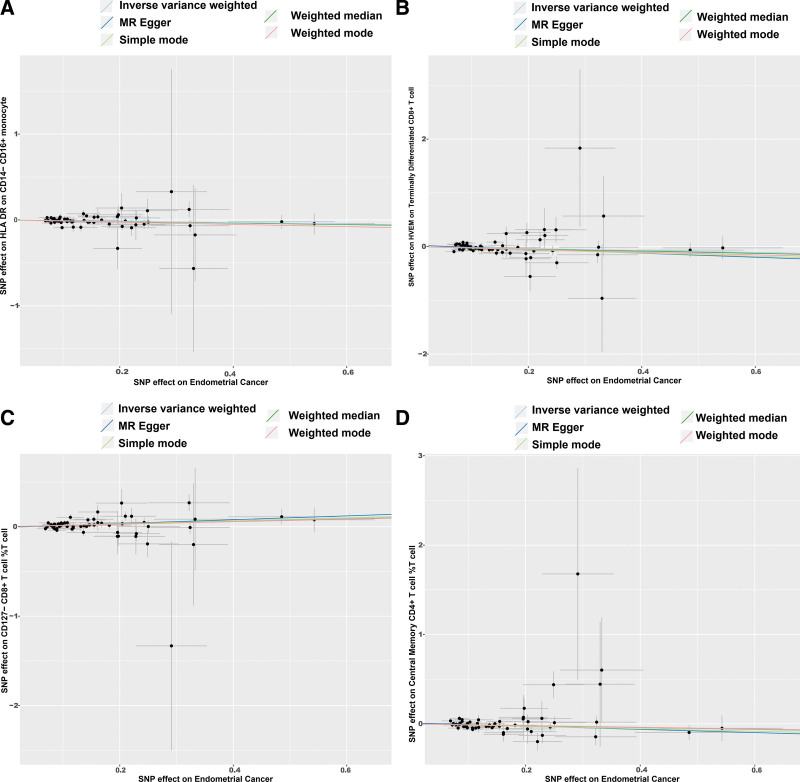
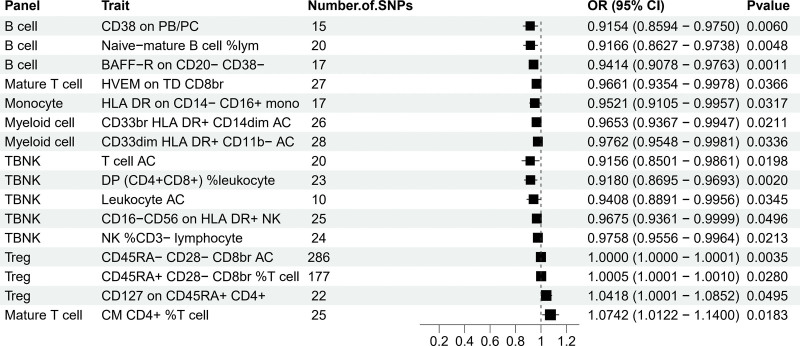
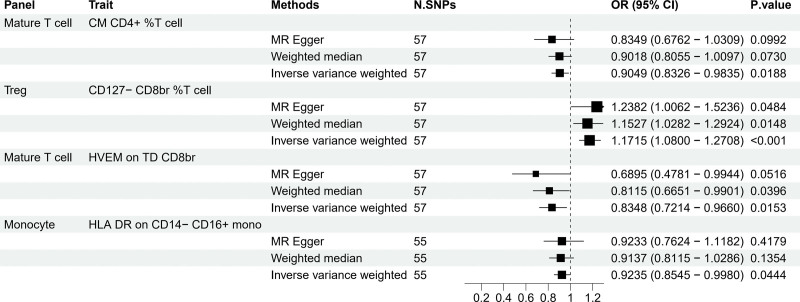
Our study identified 36 immunophenotypes associated with endometrial cancer risk. Specific immunophenotypes, such as the percentage of Naive-mature B-cells in lymphocytes (OR = 0.917, 95% CI = 0.863-0.974, P = .005), and HLA DR expression on CD14-CD16 + monocytes (OR = 0.952, 95% CI = 0.911-0.996, P = .032), exhibited a negative correlation with endometrial cancer. Conversely, CD127 expression on CD45RA + CD4 + in Treg cells (OR = 1.042, 95% CI = 1.000-1.085, P = .049), and CM CD4+%T in T cell maturation stages (OR = 1.074, 95% CI = 1.012-1.140, P = .018) showed a positive correlation. Reverse MR analysis linked endometrial cancer to 4 immunophenotypes, including a positive correlation with CD127-CD8br %T cell of Treg (OR = 1.172, 95% CI = 1.080-1.270, P = .0001), and negative correlations with 3 others, including CM CD4+%T cell (OR = 0.905, 95% CI = 0.832-0.984, P = .019).
Our findings underscore a significant causal relationship between immunophenotypes and endometrial cancer in bidirectional MR analyses. Notably, the CM CD4+%T immunophenotype emerged as potentially crucial in endometrial cancer development.
肿瘤浸润免疫细胞在子宫内膜癌中的预后意义是一个正在争论的问题。最近的证据越来越表明,这些免疫细胞和细胞因子在子宫内膜癌组织中大量存在,在刺激机体固有抗肿瘤免疫反应方面发挥着关键作用。
利用公开的遗传数据,我们进行了一项详尽的 2 样本孟德尔随机化(MR)研究。本研究旨在探讨 731 种免疫表型与子宫内膜癌风险之间的因果关系。我们通过广泛的敏感性分析,彻底评估了我们研究结果的稳健性、异质性和潜在的水平多效性。
本研究确定了 36 种与子宫内膜癌风险相关的免疫表型。特定的免疫表型,如淋巴细胞中幼稚成熟 B 细胞的百分比(OR=0.917,95%CI=0.863-0.974,P=0.005)和 CD14-CD16+单核细胞上 HLA DR 的表达(OR=0.952,95%CI=0.911-0.996,P=0.032),与子宫内膜癌呈负相关。相反,Treg 细胞中 CD45RA+CD4+上 CD127 的表达(OR=1.042,95%CI=1.000-1.085,P=0.049)和 T 细胞成熟阶段的 CM CD4+%T(OR=1.074,95%CI=1.012-1.140,P=0.018)呈正相关。反向 MR 分析将子宫内膜癌与 4 种免疫表型联系起来,包括与 Treg 上 CD127-CD8br%T 细胞的正相关(OR=1.172,95%CI=1.080-1.270,P=0.0001)和与其他 3 种免疫表型的负相关,包括 CM CD4+%T 细胞(OR=0.905,95%CI=0.832-0.984,P=0.019)。
双向 MR 分析强调了免疫表型与子宫内膜癌之间的显著因果关系。值得注意的是,CM CD4+%T 免疫表型在子宫内膜癌的发展中可能是至关重要的。