Guangdong Provincial Key Laboratory of Food, Nutrition and Health, PR China; Department of Nutrition, School of Public Health, Sun Yat-sen University, Guangzhou, PR China.
Guangdong Provincial Key Laboratory of Food, Nutrition and Health, PR China; Department of Statistics and Epidemiology, School of Public Health, Sun Yat-sen University, Guangzhou, PR China.
EBioMedicine. 2024 Jun;104:105150. doi: 10.1016/j.ebiom.2024.105150. Epub 2024 May 9.
Non-high-density lipoprotein cholesterol (non-HDL-c) was a strong risk factor for incident cardiovascular diseases and proved to be a better target of lipid-lowering therapies. Recently, gut microbiota has been implicated in the regulation of host metabolism. However, its causal role in the variation of non-HDL-c remains unclear.
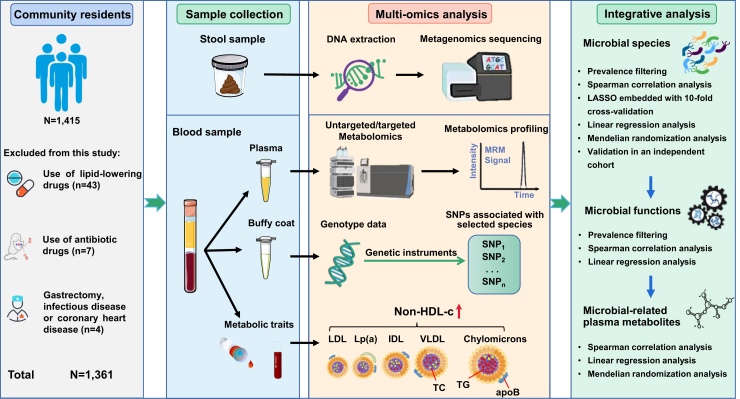
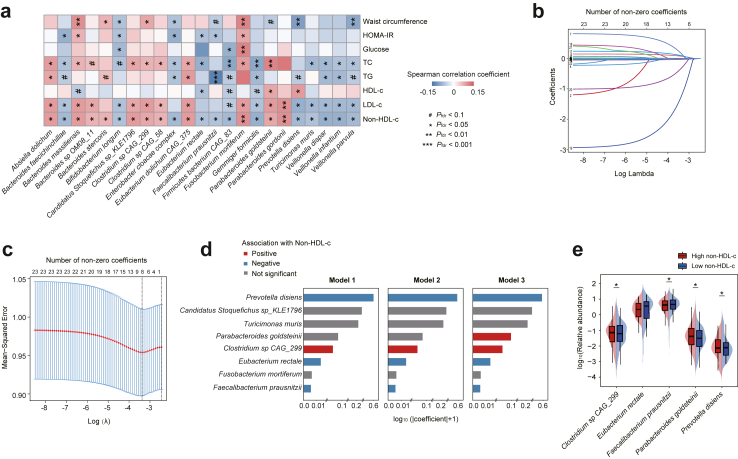
Microbial species and metabolic capacities were assessed with fecal metagenomics, and their associations with non-HDL-c were evaluated by Spearman correlation, followed by LASSO and linear regression adjusted for established cardiovascular risk factors. Moreover, integrative analysis with plasma metabolomics were performed to determine the key molecules linking microbial metabolism and variation of non-HDL-c. Furthermore, bi-directional mendelian randomization analysis was performed to determine the potential causal associations of selected species and metabolites with non-HDL-c.
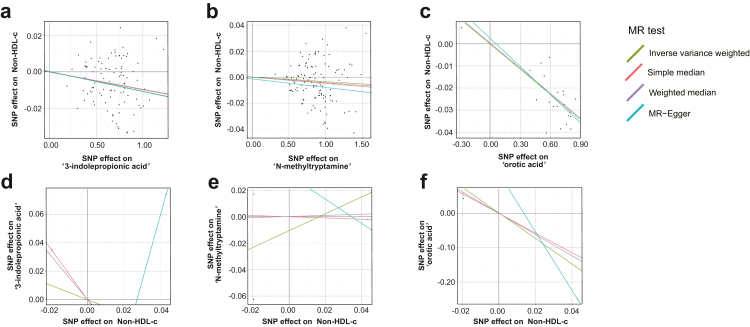
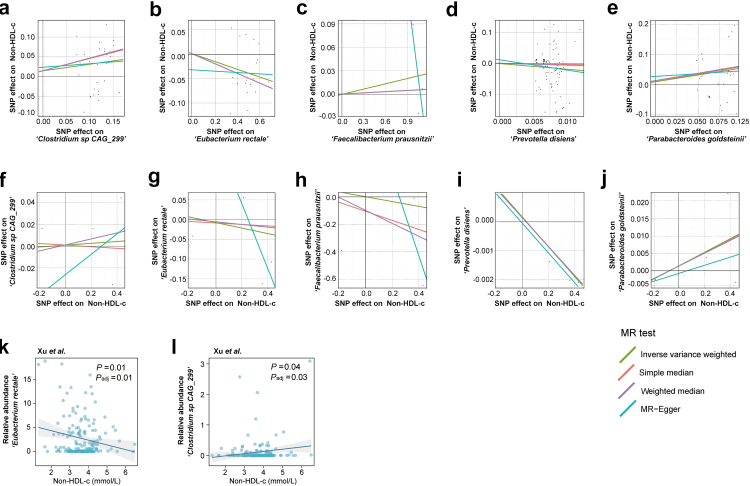
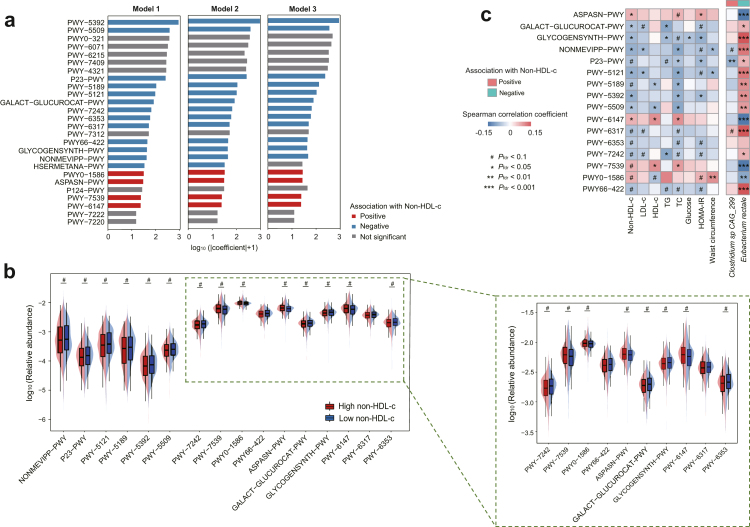
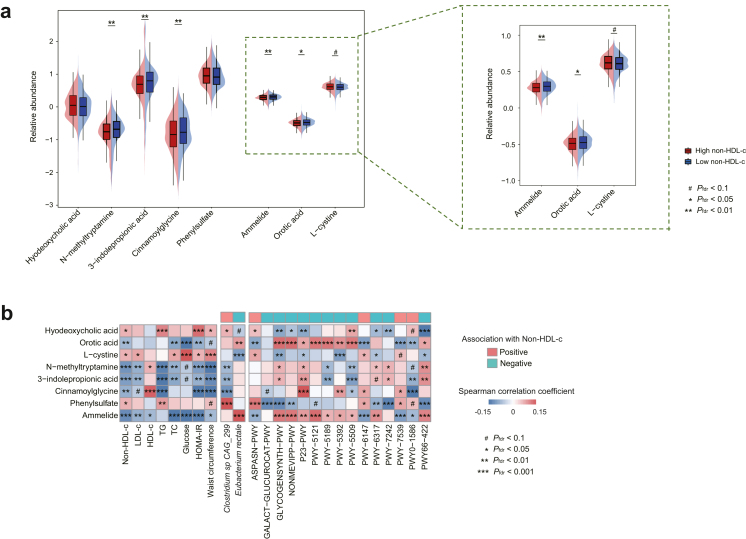
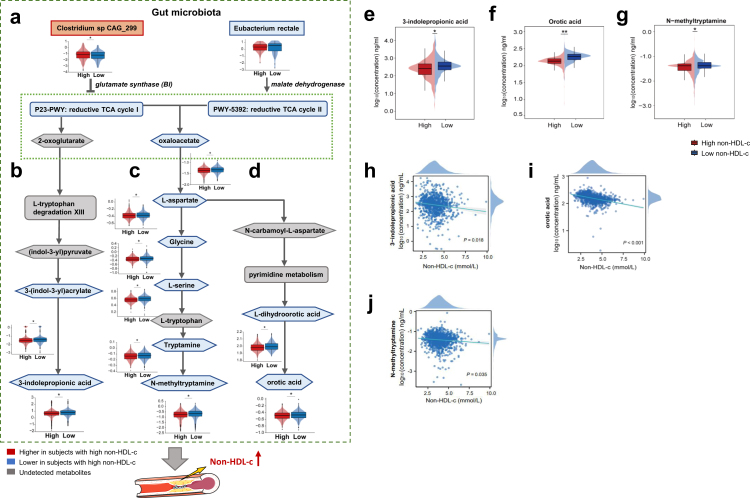
Decreased Eubacterium rectale but increased Clostridium sp CAG_299 were causally linked to a higher level of non-HDL-c. A total of 16 microbial capacities were found to be independently associated with non-HDL-c after correcting for age, sex, demographics, lifestyles and comorbidities, with the strongest association observed for tricarboxylic acid (TCA) cycle. Furthermore, decreased 3-indolepropionic acid and N-methyltryptamine, resulting from suppressed capacities for microbial reductive TCA cycle, functioned as major microbial effectors to the elevation of circulating non-HDL-c.
Overall, our findings provided insight into the causal effects of gut microbes on non-HDL-c and uncovered a novel link between non-HDL-c and microbial metabolism, highlighting the possibility of regulating non-HDL-c by microbiota-modifying interventions.
A full list of funding bodies can be found in the Sources of funding section.
非高密度脂蛋白胆固醇(non-HDL-c)是非心血管疾病的强风险因素,并且被证明是降脂治疗的更好靶点。最近,肠道微生物群被认为参与了宿主代谢的调节。然而,其在非高密度脂蛋白胆固醇变化中的因果作用尚不清楚。
采用粪便宏基因组学评估微生物种类和代谢能力,并通过 Spearman 相关分析评估其与非高密度脂蛋白胆固醇的相关性,然后进行 LASSO 和线性回归分析,调整已确定的心血管风险因素。此外,还进行了与血浆代谢组学的综合分析,以确定将微生物代谢与非高密度脂蛋白胆固醇变化联系起来的关键分子。此外,还进行了双向孟德尔随机化分析,以确定与非高密度脂蛋白胆固醇相关的选定物种和代谢物的潜在因果关系。
Eubacterium rectale 的减少和 Clostridium sp CAG_299 的增加与非高密度脂蛋白胆固醇水平升高有关。在纠正年龄、性别、人口统计学、生活方式和合并症后,发现 16 种微生物能力与非高密度脂蛋白胆固醇独立相关,其中与三羧酸(TCA)循环的相关性最强。此外,由于微生物还原性 TCA 循环能力受到抑制,导致 3-吲哚丙酸和 N-甲基色胺减少,作为主要的微生物效应物,导致循环中非高密度脂蛋白胆固醇升高。
总的来说,我们的研究结果提供了肠道微生物对非高密度脂蛋白胆固醇的因果作用的见解,并揭示了非高密度脂蛋白胆固醇与微生物代谢之间的新联系,突出了通过调节微生物群来调节非高密度脂蛋白胆固醇的可能性。
可在“资金来源”部分找到资助机构的完整列表。