Center for Cellular Immunotherapies, University of Pennsylvania, Philadelphia, PA, USA.
School of Engineering and Applied Science, University of Pennsylvania, Philadelphia, PA, USA.
Nat Commun. 2024 May 10;15(1):3937. doi: 10.1038/s41467-024-47574-0.
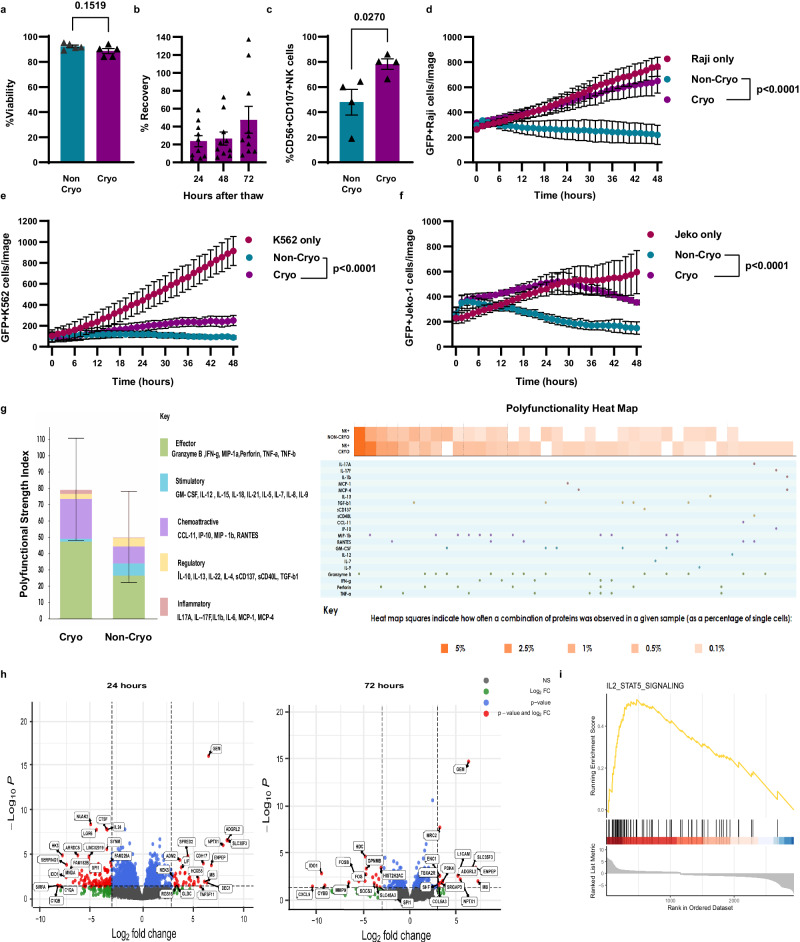
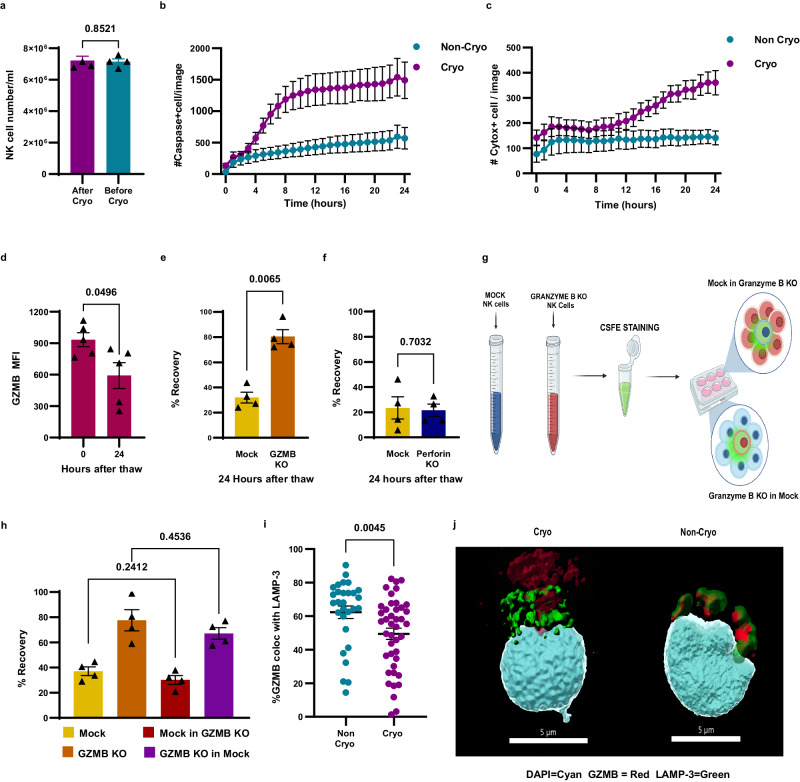
Human natural killer (NK) cell-based therapies are under assessment for treating various cancers, but cryopreservation reduces both the recovery and function of NK cells, thereby limiting their therapeutic feasibility. Using cryopreservation protocols optimized for T cells, here we find that ~75% of NK cells die within 24 h post-thaw, with the remaining cells displaying reduced cytotoxicity. Using CRISPR-Cas9 gene editing and confocal microscopy, we find that cryopreserved NK cells largely die via apoptosis initiated by leakage of granzyme B from cytotoxic vesicles. Pretreatment of NK cells with a combination of Interleukins-15 (IL-15) and IL-18 prior to cryopreservation improves NK cell recovery to ~90-100% and enables equal tumour control in a xenograft model of disseminated Raji cell lymphoma compared to non-cryopreserved NK cells. The mechanism of IL-15 and IL-18-induced protection incorporates two mechanisms: a transient reduction in intracellular granzyme B levels via degranulation, and the induction of antiapoptotic genes.
基于人自然杀伤 (NK) 细胞的疗法正在评估用于治疗各种癌症,但冷冻保存会降低 NK 细胞的恢复和功能,从而限制其治疗的可行性。使用针对 T 细胞优化的冷冻保存方案,我们发现解冻后 24 小时内约有 75%的 NK 细胞死亡,剩余的细胞显示出降低的细胞毒性。使用 CRISPR-Cas9 基因编辑和共聚焦显微镜,我们发现冷冻保存的 NK 细胞主要通过细胞毒性囊泡中颗粒酶 B 的渗漏引发凋亡而死亡。在冷冻保存之前,用白细胞介素-15 (IL-15) 和白细胞介素-18 的组合预处理 NK 细胞可将 NK 细胞的恢复提高到约 90-100%,并使在弥漫性 Raji 细胞淋巴瘤的异种移植模型中的肿瘤控制与非冷冻保存的 NK 细胞相当。IL-15 和 IL-18 诱导的保护机制包含两种机制:通过脱颗粒暂时降低细胞内颗粒酶 B 水平,以及诱导抗凋亡基因。