• 文献检索
  • 文档翻译
  • 深度研究
  • 学术资讯
  • Suppr Zotero 插件Zotero 插件
  • 邀请有礼
  • 套餐&价格
  • 历史记录
应用&插件
Suppr Zotero 插件Zotero 插件浏览器插件Mac 客户端Windows 客户端微信小程序
定价
高级版会员购买积分包购买API积分包
服务
文献检索文档翻译深度研究API 文档MCP 服务
关于我们
关于 Suppr公司介绍联系我们用户协议隐私条款
关注我们

Suppr 超能文献

核心技术专利:CN118964589B侵权必究
粤ICP备2023148730 号-1Suppr @ 2026

文献检索

告别复杂PubMed语法,用中文像聊天一样搜索,搜遍4000万医学文献。AI智能推荐,让科研检索更轻松。

立即免费搜索

文件翻译

保留排版,准确专业,支持PDF/Word/PPT等文件格式,支持 12+语言互译。

免费翻译文档

深度研究

AI帮你快速写综述,25分钟生成高质量综述,智能提取关键信息,辅助科研写作。

立即免费体验

根据PALCOM量表分析姑息治疗需求和患者特征的复杂性演变(第二部分):晚期癌症患者中PALCOM量表开发与验证队列的汇总分析

Evolution of Complexity of Palliative Care Needs and Patient Profiles According to the PALCOM Scale (Part Two): Pooled Analysis of the Cohorts for the Development and Validation of the PALCOM Scale in Advanced Cancer Patients.

作者信息

Tuca Albert, Viladot Margarita, Carrera Gemma, Llavata Lucia, Barrera Carmen, Chicote Manoli, Marco-Hernández Javier, Padrosa Joan, Zamora-Martínez Carles, Grafia Ignacio, Pascual Anais, Font Carme, Font Elena

机构信息

Unit of Supportive Care in Cancer, Medical Oncology Department, Hospital Clinic and Translational Genomics and Targeted Therapies in Solid Tumors, IDIBAPS, University of Barcelona, 08036 Barcelona, Spain.

Psychosocial Support Team, "La Caixa" Foundation (EAPS), Clinic Hospital of Barcelona, 08036 Barcelona, Spain.

出版信息

Cancers (Basel). 2024 Apr 29;16(9):1744. doi: 10.3390/cancers16091744.

DOI:10.3390/cancers16091744
PMID:38730696
原文链接:https://pmc.ncbi.nlm.nih.gov/articles/PMC11083064/
Abstract

INTRODUCTION

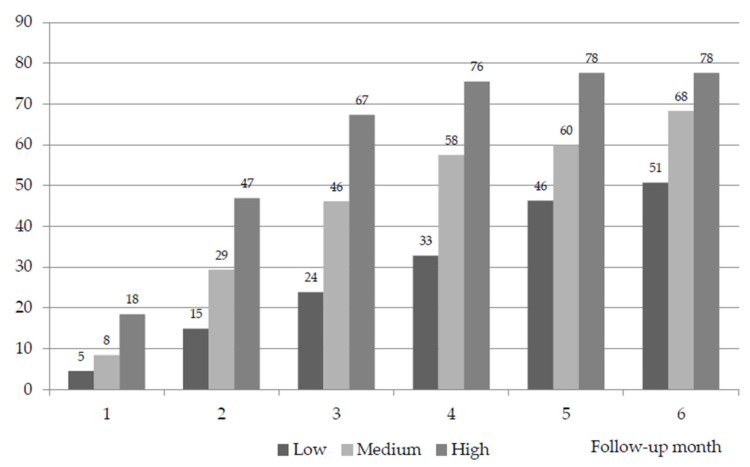
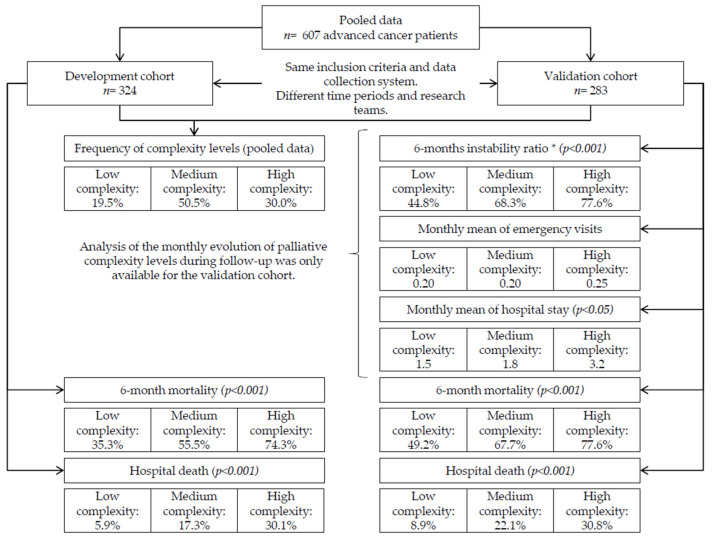
Identifying the complexity of palliative care needs is a key aspect of referral to specialized multidisciplinary early palliative care (EPC) teams. The PALCOM scale is an instrument consisting of five multidimensional assessment domains developed in 2018 and validated in 2023 to identify the level of complexity in patients with advanced cancer. (1) Objectives: The main objective of this study was to determine the degree of instability (likelihood of level change or death), health resource consumption and the survival of patients according to the level of palliative complexity assigned at the baseline visit during a 6-month follow-up. (2) Method: An observational, prospective, multicenter study was conducted using pooled data from the development and validation cohort of the PALCOM scale. The main outcome variables were as follows: (a) instability ratio (IR), defined as the probability of level change or death; (b) emergency department visits; (c) days of hospitalization; (d) hospital death; (e) survival. All the variables were analyzed monthly according to the level of complexity assigned at the baseline visit. (3) Results: A total of 607 patients with advanced cancer were enrolled. According to the PALCOM scale, 20% of patients were classified as low complexity, 50% as medium and 30% as high complexity. The overall IR was 45% in the low complexity group, 68% in the medium complexity group and 78% in the high complexity group ( < 0.001). No significant differences in mean monthly emergency department visits (0.2 visits/ patient/month) were observed between the different levels of complexity. The mean number of days spent in hospital per month was 1.5 in the low complexity group, 1.8 in the medium complexity group and 3.2 in the high complexity group ( < 0.001). The likelihood of in-hospital death was significantly higher in the high complexity group (29%) compared to the medium (16%) and low (8%) complexity groups ( < 0.001). Six-month survival was significantly lower in the high complexity group (24%) compared to the medium (37%) and low (57%) complexity groups ( < 0.001).

CONCLUSION

According to the PALCOM scale, more complex cases are associated with greater instability and use of hospital resources and lower survival. The data also confirm that the PALCOM scale is a consistent and useful tool for describing complexity profiles, targeting referrals to the EPC and managing the intensity of shared care.

摘要

引言

识别姑息治疗需求的复杂性是转介至专业多学科早期姑息治疗(EPC)团队的关键环节。PALCOM量表是一种由五个多维度评估领域组成的工具,于2018年开发,并于2023年得到验证,用于识别晚期癌症患者的复杂程度。(1)目的:本研究的主要目的是根据基线访视时分配的姑息治疗复杂程度,确定患者在6个月随访期间的不稳定程度(水平变化或死亡的可能性)、卫生资源消耗和生存率。(2)方法:使用PALCOM量表开发和验证队列的汇总数据进行了一项观察性、前瞻性、多中心研究。主要结局变量如下:(a)不稳定率(IR),定义为水平变化或死亡的概率;(b)急诊就诊次数;(c)住院天数;(d)院内死亡;(e)生存率。所有变量均根据基线访视时分配的复杂程度每月进行分析。(3)结果:共纳入607例晚期癌症患者。根据PALCOM量表,20%的患者被归类为低复杂程度,50%为中等复杂程度,30%为高复杂程度。低复杂程度组的总体IR为45%,中等复杂程度组为68%,高复杂程度组为78%(<0.001)。不同复杂程度水平之间在平均每月急诊就诊次数(0.2次/患者/月)方面未观察到显著差异。低复杂程度组每月平均住院天数为1.5天,中等复杂程度组为1.8天,高复杂程度组为3.2天(<0.001)。高复杂程度组的院内死亡可能性(29%)显著高于中等(16%)和低(8%)复杂程度组(<0.001)。高复杂程度组的6个月生存率(24%)显著低于中等(37%)和低(57%)复杂程度组(<0.001)。

结论

根据PALCOM量表,更复杂的病例与更高的不稳定性、医院资源使用以及更低的生存率相关。数据还证实,PALCOM量表是描述复杂程度概况、针对EPC进行转介以及管理共享护理强度的一种连贯且有用的工具。
https://cdn.ncbi.nlm.nih.gov/pmc/blobs/27d9/11083064/dd8e9318be53/cancers-16-01744-g003.jpg
https://cdn.ncbi.nlm.nih.gov/pmc/blobs/27d9/11083064/1d5e685e603a/cancers-16-01744-g001.jpg
https://cdn.ncbi.nlm.nih.gov/pmc/blobs/27d9/11083064/0e372a0391ce/cancers-16-01744-g002.jpg
https://cdn.ncbi.nlm.nih.gov/pmc/blobs/27d9/11083064/dd8e9318be53/cancers-16-01744-g003.jpg
https://cdn.ncbi.nlm.nih.gov/pmc/blobs/27d9/11083064/1d5e685e603a/cancers-16-01744-g001.jpg
https://cdn.ncbi.nlm.nih.gov/pmc/blobs/27d9/11083064/0e372a0391ce/cancers-16-01744-g002.jpg
https://cdn.ncbi.nlm.nih.gov/pmc/blobs/27d9/11083064/dd8e9318be53/cancers-16-01744-g003.jpg

相似文献

1
Evolution of Complexity of Palliative Care Needs and Patient Profiles According to the PALCOM Scale (Part Two): Pooled Analysis of the Cohorts for the Development and Validation of the PALCOM Scale in Advanced Cancer Patients.根据PALCOM量表分析姑息治疗需求和患者特征的复杂性演变(第二部分):晚期癌症患者中PALCOM量表开发与验证队列的汇总分析
Cancers (Basel). 2024 Apr 29;16(9):1744. doi: 10.3390/cancers16091744.
2
Validation Study of the PALCOM Scale of Complexity of Palliative Care Needs: A Cohort Study in Advanced Cancer Patients.姑息治疗需求复杂性PALCOM量表的验证研究:一项针对晚期癌症患者的队列研究
Cancers (Basel). 2023 Aug 20;15(16):4182. doi: 10.3390/cancers15164182.
3
Predictive model of complexity in early palliative care: a cohort of advanced cancer patients (PALCOM study).早期姑息治疗复杂性的预测模型:晚期癌症患者队列研究(PALCOM研究)
Support Care Cancer. 2018 Jan;26(1):241-249. doi: 10.1007/s00520-017-3840-3. Epub 2017 Aug 6.
4
Consultations' demand for a hospital palliative care unit: how to increase appropriateness? Implementing and evaluating a multicomponent educational intervention aimed at increase palliative care complexity perception skill.咨询对医院姑息治疗单位的需求:如何提高适宜性?实施和评估一项多成分教育干预措施,旨在提高姑息治疗复杂性感知技能。
BMC Palliat Care. 2022 May 26;21(1):90. doi: 10.1186/s12904-022-00968-7.
5
Folic acid supplementation and malaria susceptibility and severity among people taking antifolate antimalarial drugs in endemic areas.在流行地区,服用抗叶酸抗疟药物的人群中,叶酸补充剂与疟疾易感性和严重程度的关系。
Cochrane Database Syst Rev. 2022 Feb 1;2(2022):CD014217. doi: 10.1002/14651858.CD014217.
6
7
A systematic review of classifications systems to determine complexity of patient care needs in palliative care.一项关于确定姑息治疗中患者护理需求复杂性的分类系统的系统评价。
Palliat Med. 2021 Apr;35(4):636-650. doi: 10.1177/0269216321996983. Epub 2021 Mar 12.
8
The effectiveness and cost-effectiveness of hospital-based specialist palliative care for adults with advanced illness and their caregivers.针对患有晚期疾病的成年人及其护理人员的医院专科姑息治疗的有效性和成本效益。
Cochrane Database Syst Rev. 2020 Sep 30;9(9):CD012780. doi: 10.1002/14651858.CD012780.pub2.
9
Community-based care for the specialized management of heart failure: an evidence-based analysis.基于社区的心力衰竭专科管理:一项循证分析
Ont Health Technol Assess Ser. 2009;9(17):1-42. Epub 2009 Nov 1.
10
Effects of a palliative care intervention on clinical outcomes in patients with advanced cancer: the Project ENABLE II randomized controlled trial.姑息治疗干预对晚期癌症患者临床结局的影响:ENABLE II项目随机对照试验
JAMA. 2009 Aug 19;302(7):741-9. doi: 10.1001/jama.2009.1198.

引用本文的文献

1
Prevalence of Ethical Issues in Patients with Advanced Cancer: Secondary Analysis of Pooled Data from the Development and Validation Cohorts of the PALCOM Scale for the Complexity of Palliative Care Needs.晚期癌症患者伦理问题的患病率:对姑息治疗需求复杂性PALCOM量表开发与验证队列汇总数据的二次分析
Cancers (Basel). 2025 Apr 16;17(8):1345. doi: 10.3390/cancers17081345.
2
Australian Palliative Care Outcome Collaboration (PCOC) phases: cross cultural adaptation and psychometric validation for Polish palliative settings.澳大利亚姑息治疗结果协作组(PCOC)阶段:针对波兰姑息治疗环境的跨文化调适与心理测量学验证
BMC Palliat Care. 2024 Dec 27;23(1):301. doi: 10.1186/s12904-024-01616-y.
3

本文引用的文献

1
Validation Study of the PALCOM Scale of Complexity of Palliative Care Needs: A Cohort Study in Advanced Cancer Patients.姑息治疗需求复杂性PALCOM量表的验证研究:一项针对晚期癌症患者的队列研究
Cancers (Basel). 2023 Aug 20;15(16):4182. doi: 10.3390/cancers15164182.
2
Complexity of patient care needs in palliative care: a scoping review.姑息治疗中患者护理需求的复杂性:范围综述。
Ann Palliat Med. 2023 Jul;12(4):791-802. doi: 10.21037/apm-22-894. Epub 2023 Mar 16.
3
Integrating Palliative Care into Oncology Care Worldwide: The Right Care in the Right Place at the Right Time.
Comprehensive geriatric assessment and palliative care.
综合老年评估与姑息治疗。
Aging Med (Milton). 2024 Oct 16;7(5):645-648. doi: 10.1002/agm2.12367. eCollection 2024 Oct.
4
Assessing the sensitivity and acceptability of the Royal Marsden Palliative Care Referral "Triggers" Tool for outpatients with cancer.评估皇家马斯登姑息治疗转诊“触发”工具在癌症门诊患者中的敏感性和可接受性。
Support Care Cancer. 2024 Oct 16;32(11):730. doi: 10.1007/s00520-024-08921-5.
将姑息治疗融入全球肿瘤学照护中:在适当的时间、在适当的地点提供适当的照护。
Curr Treat Options Oncol. 2023 Apr;24(4):353-372. doi: 10.1007/s11864-023-01060-9. Epub 2023 Mar 13.
4
[Care complexity and place of death in palliative home care].[姑息性家庭护理中的护理复杂性与死亡地点]
Gac Sanit. 2022 Dec 15;37:102266. doi: 10.1016/j.gaceta.2022.102266. eCollection 2023.
5
From evidence to practice: early integration of palliative care in a comprehensive cancer center.从证据到实践:在综合性癌症中心早期整合姑息治疗
Support Care Cancer. 2022 Dec 14;31(1):17. doi: 10.1007/s00520-022-07510-8.
6
Should Outpatient Palliative Care Clinics in Cancer Centers be Stand Alone or Embedded?癌症中心的门诊姑息治疗诊所应该独立设置还是并入其他科室?
J Pain Symptom Manage. 2023 Feb;65(2):e165-e170. doi: 10.1016/j.jpainsymman.2022.11.008. Epub 2022 Nov 25.
7
Consultations' demand for a hospital palliative care unit: how to increase appropriateness? Implementing and evaluating a multicomponent educational intervention aimed at increase palliative care complexity perception skill.咨询对医院姑息治疗单位的需求:如何提高适宜性?实施和评估一项多成分教育干预措施,旨在提高姑息治疗复杂性感知技能。
BMC Palliat Care. 2022 May 26;21(1):90. doi: 10.1186/s12904-022-00968-7.
8
Intra-rater reliability and feasibility of the HexCom advanced disease complexity assessment model.HexCom 高级疾病严重程度评估模型的组内信度和可行性。
Aten Primaria. 2022 Jun;54(6):102343. doi: 10.1016/j.aprim.2022.102343. Epub 2022 May 9.
9
Timely Palliative Care: Personalizing the Process of Referral.及时的姑息治疗:个性化转诊流程
Cancers (Basel). 2022 Feb 18;14(4):1047. doi: 10.3390/cancers14041047.
10
Impact of early palliative care according to baseline symptom severity: Secondary analysis of a cluster-randomized controlled trial in patients with advanced cancer.根据基线症状严重程度评估早期姑息治疗对晚期癌症患者的影响:一项集群随机对照试验的二次分析。
Cancer Med. 2022 Apr;11(8):1869-1878. doi: 10.1002/cam4.4565. Epub 2022 Feb 9.