Jurczyk Sebastian, Andrzejewski Jacek, Piasecki Adam, Musioł Marta, Rydz Joanna, Kowalczuk Marek
Łukasiewicz Research Network-Institute for Engineering of Polymer Materials and Dyes, 55. M. Skłodowska-Curie St., 87-100 Toruń, Poland.
Institute of Materials Technology, Polymer Processing Division, Faculty of Mechanical Engineering, Poznań University of Technology, 3. Piotrowo St., 61-138 Poznan, Poland.
Polymers (Basel). 2024 Apr 28;16(9):1231. doi: 10.3390/polym16091231.
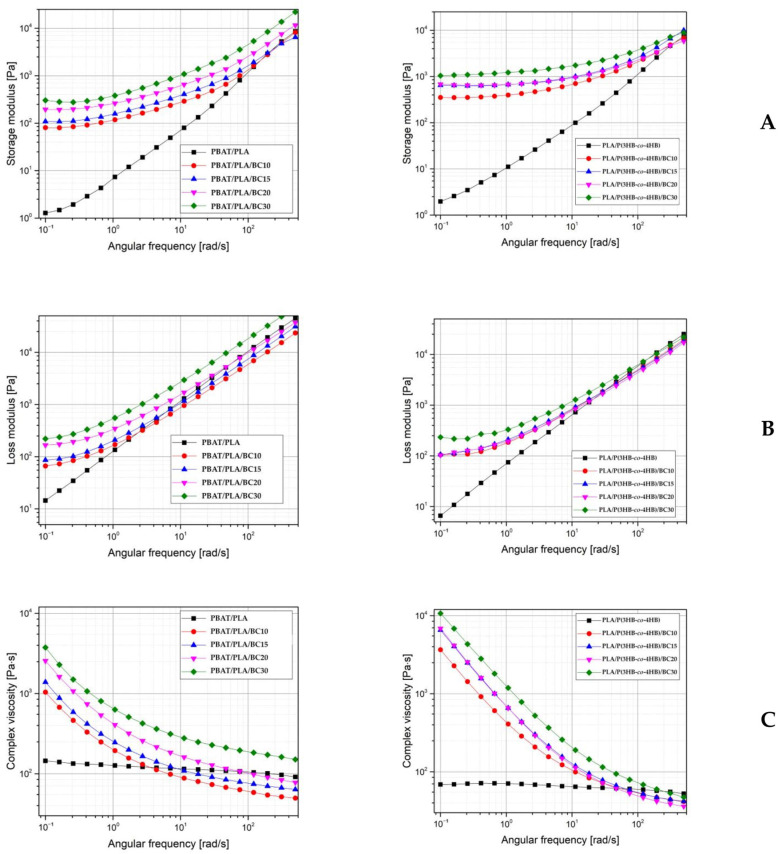
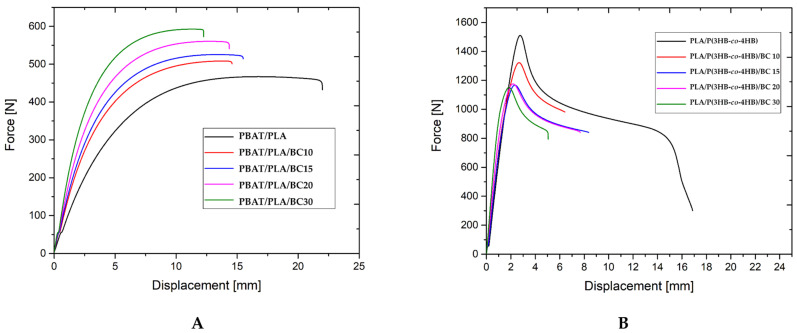
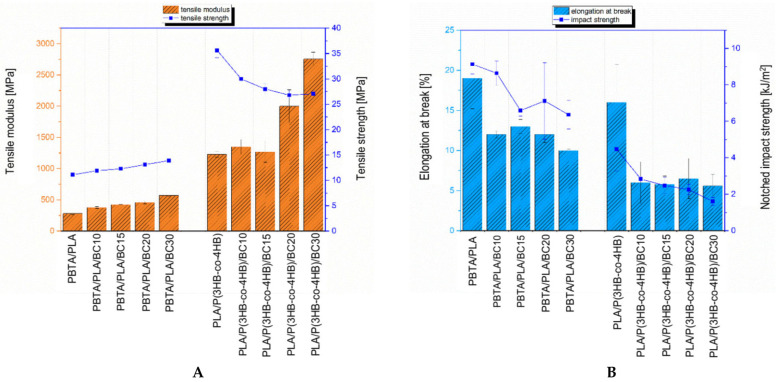
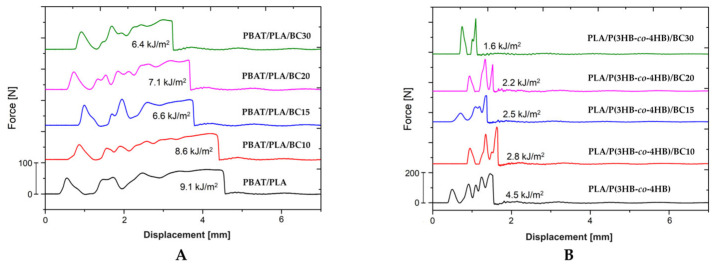
The use of biodegradable polymers as matrices in composites gives a wide range of applications, especially in niche areas. The assessment of the effect of the filler content on the change of mechanical properties makes it possible to optimize the composition for specific needs. Biochar was used as a filler in the studied composites with two different biodegradable blends as a matrix. Poly(1,4-butylene adipate--1,4-butylene terephthalate)/polylactide/biochar (PBAT/PLA/BC) and polylactide/poly[()-3-hydroxybutyrate--4-hydroxybutyrate]/biochar (PLA/P(3HB--4HB)/BC) composites with 0, 10, 15, 20 and 30 wt% of biochar underwent mechanical tests. The test results revealed a change in the properties of the composites related to the filler content. The results of the tensile test showed that increasing the biochar content increased the tensile modulus values by up to 100% for composites with 30 wt% of biochar, compared to unfilled matrices, and decreased the elongation associated with the breaking of PBAT/PLA and PLA/P(3HB--4HB) matrix composites. The elongation values at break of PBAT/PLA and PLA/(3HB--4HB) composites with 30 wt% biochar were reduced by 50% and 65%, respectively, compared to the unfilled matrices. PLA/P(3HB--4HB) matrix composites, in contrast to PBAT/PLA/BC, showed a decrease in tensile strength with the increases in filler content from 35.6 MPa for unfilled matrix to 27.1 MPa for PLA/P(3HB--4HB)/BC30 composites. An increase in filler content increased the brittleness of the composites regardless of the matrix used, as determined under the Charpy impact-test. This phenomenon was observed for all tested PLA/P(3HB--4HB) composites, for which the impact strength decreased from 4.47 kJ/m for the matrix to 1.61 kJ/m for the composite containing 30 wt% biochar. PBAT/PLA-based composites with 10 wt% of biochar showed slightly lower impact strength compared to the unfilled matrix, but composites with 30 wt% biochar showed 30% lower impact strength than PBAT/PLA. The complex viscosity value increased with increased filler content. For all composites tested on both polyester matrices, the viscosity decreased with increasing angular frequency.
使用可生物降解聚合物作为复合材料的基体具有广泛的应用,尤其是在特定领域。评估填料含量对机械性能变化的影响有助于针对特定需求优化复合材料的组成。在本研究中,以两种不同的可生物降解共混物作为基体,生物炭用作填料。对含有0、10、15、20和30 wt%生物炭的聚(己二酸1,4-丁二醇酯-对苯二甲酸1,4-丁二醇酯)/聚乳酸/生物炭(PBAT/PLA/BC)和聚乳酸/聚[(R)-3-羟基丁酸酯-4-羟基丁酸酯]/生物炭(PLA/P(3HB-4HB)/BC)复合材料进行了力学测试。测试结果表明,复合材料的性能随填料含量而变化。拉伸试验结果表明,与未填充的基体相比,对于生物炭含量为30 wt%的复合材料,生物炭含量的增加使拉伸模量值提高了100%,并降低了PBAT/PLA和PLA/P(3HB-4HB)基体复合材料断裂时的伸长率。与未填充的基体相比,生物炭含量为30 wt%的PBAT/PLA和PLA/(3HB-4HB)复合材料的断裂伸长率分别降低了50%和65%。与PBAT/PLA/BC不同,PLA/P(3HB-4HB)基体复合材料的拉伸强度随填料含量的增加而降低,从未填充基体的35.6 MPa降至PLA/P(3HB-4HB)/BC30复合材料的27.1 MPa。根据夏比冲击试验测定,无论使用何种基体,填料含量的增加都会增加复合材料的脆性。在所有测试的PLA/P(3HB-4HB)复合材料中都观察到了这种现象,其冲击强度从未填充基体的4.47 kJ/m²降至生物炭含量为30 wt%的复合材料的1.61 kJ/m²。与未填充的基体相比,生物炭含量为10 wt%的PBAT/PLA基复合材料的冲击强度略低,但生物炭含量为30 wt%的复合材料的冲击强度比PBAT/PLA低30%。复数粘度值随填料含量的增加而增加。对于在两种聚酯基体上测试的所有复合材料,粘度随角频率的增加而降低。