Departments of Critical Care Medicine, the First Affiliated Hospital of Harbin Medical University, Harbin Medical University, Harbin, Heilongjiang, China.
Departments of Critical Care Medicine, Zhongshan Hospital of Xiamen University, Xiamen, Fujian, China.
Virulence. 2024 Dec;15(1):2350775. doi: 10.1080/21505594.2024.2350775. Epub 2024 May 12.
The translocation of intestinal flora has been linked to the colonization of diverse and heavy lower respiratory flora in patients with septic ARDS, and is considered a critical prognostic factor for patients.
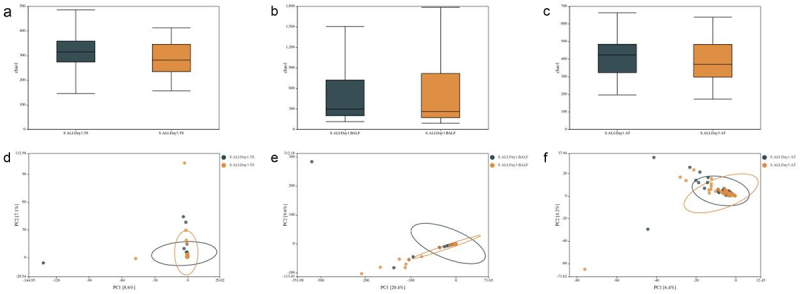
On the first and third days of ICU admission, BALF, throat swab, and anal swab were collected, resulting in a total of 288 samples. These samples were analyzed using 16S rRNA analysis and the traceability analysis of new generation technology.
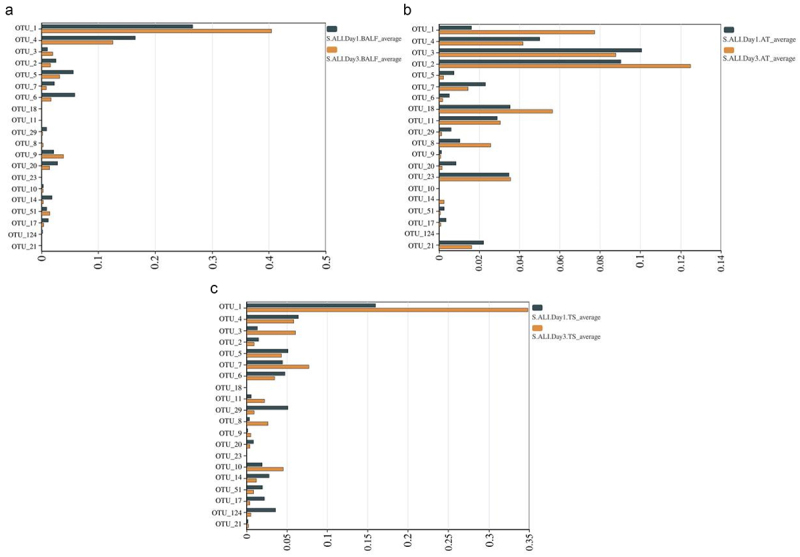
On the first day, among the top five microbiota species in abundance, four species were found to be identical in BALF and throat samples. Similarly, on the third day, three microbiota species were found to be identical in abundance in both BALF and throat samples. On the first day, 85.16% of microorganisms originated from the throat, 5.79% from the intestines, and 9.05% were unknown. On the third day, 83.52% of microorganisms came from the throat, 4.67% from the intestines, and 11.81% were unknown. Additionally, when regrouping the 46 patients, the results revealed a significant predominance of throat microorganisms in BALF on both the first and third day. Furthermore, as the disease progressed, the proportion of intestinal flora in BALF increased in patients with enterogenic ARDS.
In patients with septic ARDS, the main source of lung microbiota is primarily from the throat. Furthermore, the dynamic trend of the microbiota on the first and third day is essentially consistent.It is important to note that the origin of the intestinal flora does not exclude the possibility of its origin from the throat.
肠道菌群的易位与脓毒症性 ARDS 患者下呼吸道定植的多样化和重型菌群有关,被认为是患者的一个关键预后因素。
在 ICU 入院的第 1 天和第 3 天,采集 BALF、咽拭子和肛拭子,共采集了 288 个样本。这些样本使用 16S rRNA 分析和新一代技术的溯源分析进行分析。
第 1 天,在丰度最高的前五个人群中,有 4 个人群在 BALF 和咽拭子样本中是相同的。同样,在第 3 天,在 BALF 和咽拭子样本中也有 3 个人群的丰度是相同的。第 1 天,85.16%的微生物来源于咽喉,5.79%来源于肠道,9.05%来源未知。第 3 天,83.52%的微生物来源于咽喉,4.67%来源于肠道,11.81%来源未知。此外,当对 46 名患者重新分组时,结果显示在第 1 天和第 3 天 BALF 中咽喉微生物明显占主导地位。此外,随着疾病的进展,肠源性 ARDS 患者 BALF 中的肠道菌群比例增加。
在脓毒症性 ARDS 患者中,肺部微生物群的主要来源主要来自咽喉。此外,第 1 天和第 3 天的微生物群动态趋势基本一致。需要注意的是,肠道菌群的来源并不能排除其来源于咽喉的可能性。