AlRawi Halah Z, AlQurashi Alaa, AlDahan Doaa, Alkhudhayri Maha, Alsharidah Amani R, Wani Tariq, AlJaroudi Dania
Research Center, King Fahad Medical City Riyadh Second Health Cluster Riyadh Saudi Arabia.
Clinical Trials Registry Saudi National Institution of Health (SNIH) Riyadh Saudi Arabia.
Health Sci Rep. 2024 May 9;7(5):e1934. doi: 10.1002/hsr2.1934. eCollection 2024 May.
Many women reported experiencing abnormalities in their cycle after being vaccinated with Covid-19 vaccination. To understand this issue further, our study aimed to evaluate the menstrual cycle patterns among women of childbearing age after receiving COVID-19 vaccinations.
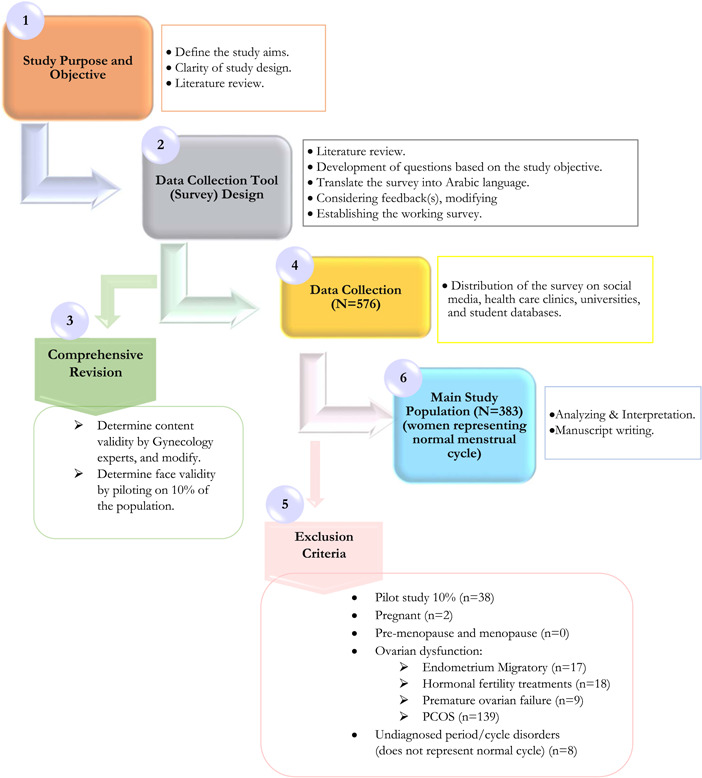
A cross-sectional study was conducted to investigate the impact of COVID-19 vaccine on women aged 18 years and above in Saudi Arabia. A self-administered online questionnaire was distributed among participants who had received at least one dose of COVID-19 vaccine. The questionnaire included questions about the participants' demographic characteristics, medical history, and vaccine-related adverse events.
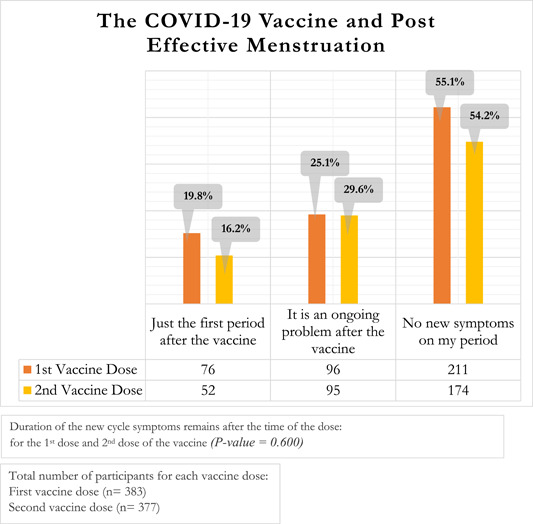
The study included 383 female participants with an average age of 30.8 ± 8.1 years. The majority of participants, 92.7%, were Saudi, and more than half, 51.4%, were single. Of the participants, 78.9% were disease-free, and a majority of 67.9% had no history of Coronavirus Disease 2019 infection. A significant proportion of participants reported postvaccination changes in the menstrual cycle. Specifically, 43.1% reported changes after the first dose, and 38.4% reported changes after the second dose ( = 0.044). The severity of premenstrual symptoms increased from 44 (11.5%) to 113 (29.5%) after the first dose. Reported pain on the (WONG-BAKER) scale was also significantly elevated from 34 (8.9%) to 87 (22.7%) ( < 0.001) after the first dose.
A relatively high prevalence of menstrual cycle irregularities was reported by Saudi vaccinated women, particularly young adults. These findings suggest the need to further research and explore the underlying causes of these irregularities and develop interventions that may help mitigate their impact on women's health. It is also recommended that women who observe long-term changes in their menstrual cycles seek follow-up and consultation with healthcare providers to ensure that any potential health concerns are addressed promptly.
许多女性报告称在接种新冠疫苗后月经周期出现异常。为进一步了解这一问题,我们的研究旨在评估育龄女性接种新冠疫苗后的月经周期模式。
开展了一项横断面研究,以调查新冠疫苗对沙特阿拉伯18岁及以上女性的影响。在至少接种过一剂新冠疫苗的参与者中发放了一份自行填写的在线问卷。问卷包括有关参与者人口统计学特征、病史和疫苗相关不良事件的问题。
该研究纳入了383名女性参与者,平均年龄为30.8±8.1岁。大多数参与者(92.7%)为沙特人,超过一半(51.4%)为单身。在参与者中,78.9%没有疾病,67.9%的大多数人没有2019冠状病毒病感染史。相当一部分参与者报告了接种疫苗后月经周期的变化。具体而言,43.1%的人在接种第一剂后报告有变化,38.4%的人在接种第二剂后报告有变化(P=0.044)。第一剂接种后经前症状的严重程度从44例(11.5%)增加到113例(29.5%)。报告的(面部表情疼痛量表)疼痛程度在第一剂接种后也从34例(8.9%)显著升高到87例(22.7%)(P<0.001)。
沙特接种疫苗的女性中报告月经周期不规律的比例相对较高,尤其是年轻成年人。这些发现表明需要进一步研究和探索这些不规律现象的潜在原因,并制定可能有助于减轻其对女性健康影响的干预措施。还建议观察到月经周期长期变化的女性寻求医疗保健提供者的随访和咨询,以确保及时解决任何潜在的健康问题。