Elmahboub Yasmina S M, Elkordy Amal A
School of Pharmacy and Pharmaceutical Sciences, Faculty of Health Sciences and Wellbeing, University of Sunderland, Sunderland SR1 3SD, UK.
J Taibah Univ Med Sci. 2024 Apr 26;19(3):549-565. doi: 10.1016/j.jtumed.2024.04.004. eCollection 2024 Jun.
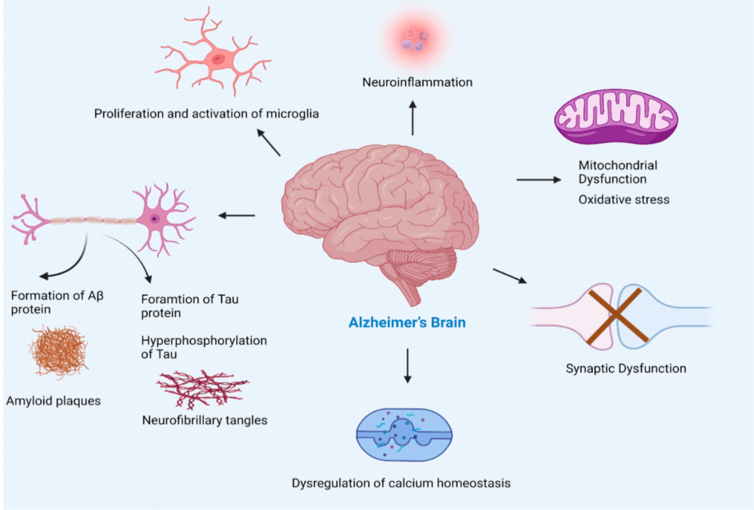
Alzheimer's disease (AD), is characterised by two major hallmarks: the formation of extracellular β-amyloid (Aβ) plaques and the hyperphosphorylation of tau protein, thus leading to the formation of neurofibrillary tangles. These hallmarks cause synaptic loss, neuronal damage, and the development of neuroinflammation and oxidative stress, which promote AD progression. Thus, the goal of treating AD is eliminating these hallmarks, to prevent AD progression and decrease symptoms. However, current available therapies provide symptomatic relief rather than treating the underlying cause of the disease, because the restrictive nature of the blood brain barrier (BBB) impedes the entry of drugs, thereby affecting drug efficacy and bioavailability. Researchers are focusing on developing new therapeutic approaches to bypass the BBB, for achieving site-specific drug delivery with the highest possible bioavailability and the lowest adverse effects. Recently explored therapeutic strategies include use of biologic agents such as monoclonal antibodies. Aducanumab, a strong candidate for treating AD, has been granted accelerated Food and Drug Administration approval; however, safety concerns may hinder its future use. Thus, nanotechnological approaches have led to a new era of AD treatment. Nanoparticles (NPs), because of their small particle size, can cross the BBB, thus enhancing drug pharmacokinetic properties and enabling targeted drug delivery. Polymeric NPs have been extensively studied, because of their simple production, biodegradability, biocompatibility, and unique architecture. These NPs provide a flexible vesicle that can be easily tailored to achieve desired physicochemical features. In this review, various types of polymer-based-NPs are discussed, highlighting the properties of fabricated NPs, which have multiple benefits in AD treatment, including anti-amyloid, antioxidant, and anti-inflammatory effects.
阿尔茨海默病(AD)的特征有两个主要标志:细胞外β淀粉样蛋白(Aβ)斑块的形成以及tau蛋白的过度磷酸化,进而导致神经原纤维缠结的形成。这些标志会导致突触丧失、神经元损伤以及神经炎症和氧化应激的发展,从而促进AD的进展。因此,治疗AD的目标是消除这些标志,以防止AD进展并减轻症状。然而,目前可用的疗法只能缓解症状,而不能治疗疾病的根本原因,因为血脑屏障(BBB)的限制性质阻碍了药物的进入,从而影响药物疗效和生物利用度。研究人员正致力于开发新的治疗方法以绕过血脑屏障,从而实现具有尽可能高的生物利用度和最低副作用的位点特异性药物递送。最近探索的治疗策略包括使用生物制剂,如单克隆抗体。阿杜卡努单抗是治疗AD的有力候选药物,已获得美国食品药品监督管理局的加速批准;然而,安全性问题可能会阻碍其未来的使用。因此,纳米技术方法引领了AD治疗的新时代。纳米颗粒(NPs)由于其粒径小,可以穿过血脑屏障,从而增强药物的药代动力学特性并实现靶向药物递送。聚合物纳米颗粒因其生产简单、可生物降解、生物相容性好和独特的结构而得到广泛研究。这些纳米颗粒提供了一种灵活的囊泡,可以很容易地进行定制以实现所需的物理化学特性。在这篇综述中,讨论了各种类型的基于聚合物的纳米颗粒,强调了所制备纳米颗粒的特性,这些特性在AD治疗中具有多种益处,包括抗淀粉样蛋白、抗氧化和抗炎作用。