Lymphoma Program, Abramson Cancer Center, University of Pennsylvania, Philadelphia, PA.
Department of Internal Medicine, Kalmar County Hospital, Kalmar, Sweden.
Blood Adv. 2024 Jul 9;8(13):3507-3518. doi: 10.1182/bloodadvances.2024012800.
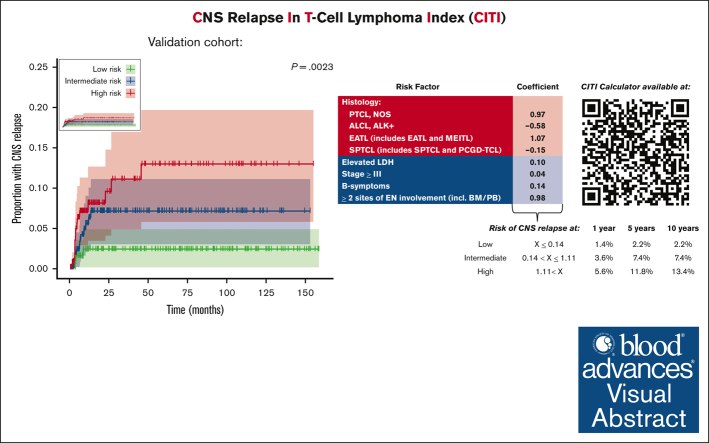
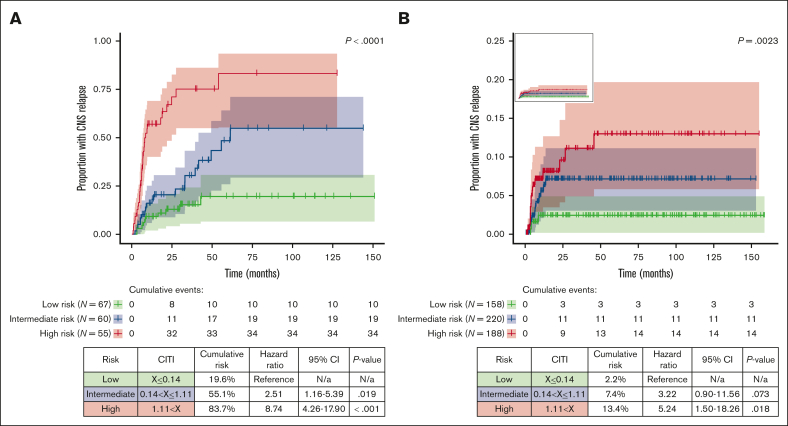
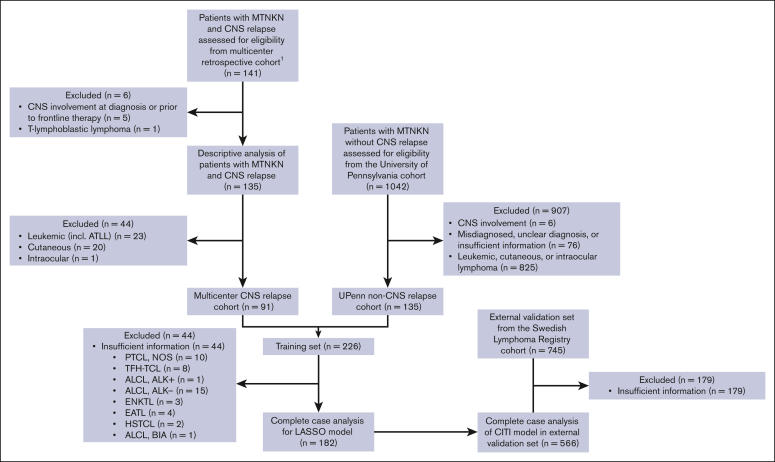
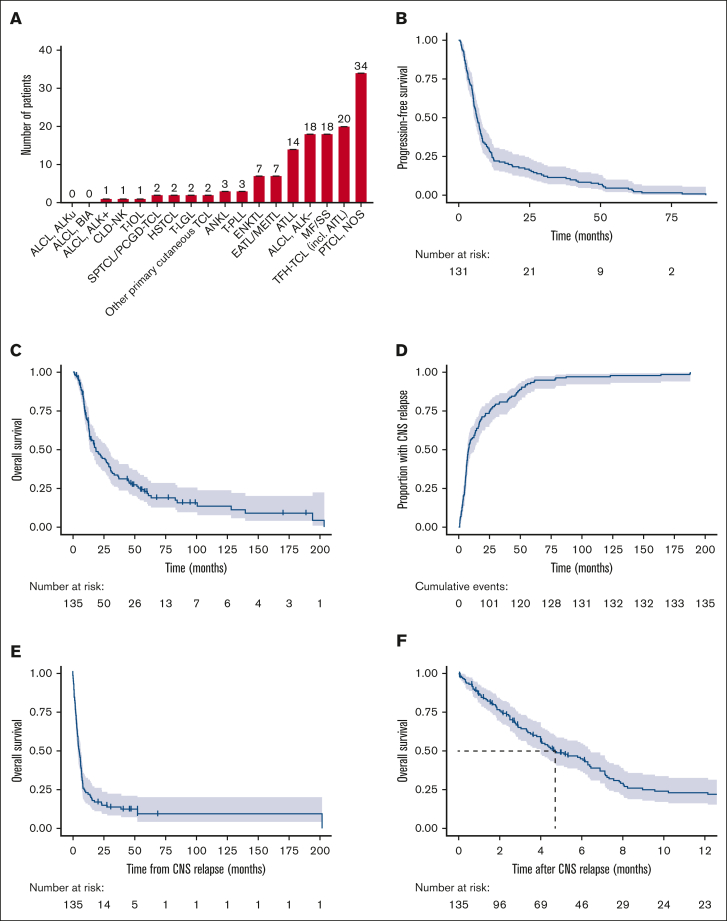
Little is known about risk factors for central nervous system (CNS) relapse in mature T-cell and natural killer cell neoplasms (MTNKNs). We aimed to describe the clinical epidemiology of CNS relapse in patients with MTNKN and developed the CNS relapse In T-cell lymphoma Index (CITI) to predict patients at the highest risk of CNS relapse. We reviewed data from 135 patients with MTNKN and CNS relapse from 19 North American institutions. After exclusion of leukemic and most cutaneous forms of MTNKNs, patients were pooled with non-CNS relapse control patients from a single institution to create a CNS relapse-enriched training set. Using a complete case analysis (n = 182), including 91 with CNS relapse, we applied a least absolute shrinkage and selection operator Cox regression model to select weighted clinicopathologic variables for the CITI score, which we validated in an external cohort from the Swedish Lymphoma Registry (n = 566). CNS relapse was most frequently observed in patients with peripheral T-cell lymphoma, not otherwise specified (25%). Median time to CNS relapse and median overall survival after CNS relapse were 8.0 and 4.7 months, respectively. We calculated unique CITI risk scores for individual training set patients and stratified them into risk terciles. Validation set patients with low-risk (n = 158) and high-risk (n = 188) CITI scores had a 10-year cumulative risk of CNS relapse of 2.2% and 13.4%, respectively (hazard ratio, 5.24; 95% confidence interval, 1.50-18.26; P = .018). We developed an open-access web-based CITI calculator (https://redcap.link/citicalc) to provide an easy tool for clinical practice. The CITI score is a validated model to predict patients with MTNKN at the highest risk of developing CNS relapse.
对于成熟 T 细胞和自然杀伤细胞肿瘤(MTNKN)的中枢神经系统(CNS)复发的危险因素知之甚少。我们旨在描述 MTNKN 患者 CNS 复发的临床流行病学,并制定了 CNS 复发 T 细胞淋巴瘤指数(CITI),以预测 CNS 复发风险最高的患者。我们回顾了来自 19 个北美机构的 135 名 MTNKN 合并 CNS 复发患者的数据。排除白血病和大多数皮肤形式的 MTNKN 后,将患者与来自单一机构的非 CNS 复发对照患者合并,以创建 CNS 复发富集训练集。使用完整病例分析(n=182),包括 91 名 CNS 复发患者,我们应用最小绝对收缩和选择算子 Cox 回归模型选择加权临床病理变量用于 CITI 评分,我们在瑞典淋巴瘤登记处的外部队列(n=566)中进行了验证。CNS 复发最常发生于未特指的外周 T 细胞淋巴瘤患者(25%)。CNS 复发的中位时间和 CNS 复发后的中位总生存期分别为 8.0 个月和 4.7 个月。我们为每个训练集患者计算了独特的 CITI 风险评分,并将其分为风险三分位数。低风险(n=158)和高风险(n=188)CITI 评分的验证集患者 10 年 CNS 复发累积风险分别为 2.2%和 13.4%(危险比,5.24;95%置信区间,1.50-18.26;P=.018)。我们开发了一个基于网络的 CITI 计算器(https://redcap.link/citicalc),为临床实践提供了一个简便的工具。CITI 评分是一种经过验证的模型,可预测 CNS 复发风险最高的 MTNKN 患者。