Division of Evolutionary Biology, Faculty of Biology, LMU Munich, 82152 Planegg-Martinsried, Germany.
Evolutionary Biology & Ecology, Faculty of Biology, University of Freiburg, 79104 Freiburg, Germany.
Mol Biol Evol. 2024 Jun 1;41(6). doi: 10.1093/molbev/msae092.
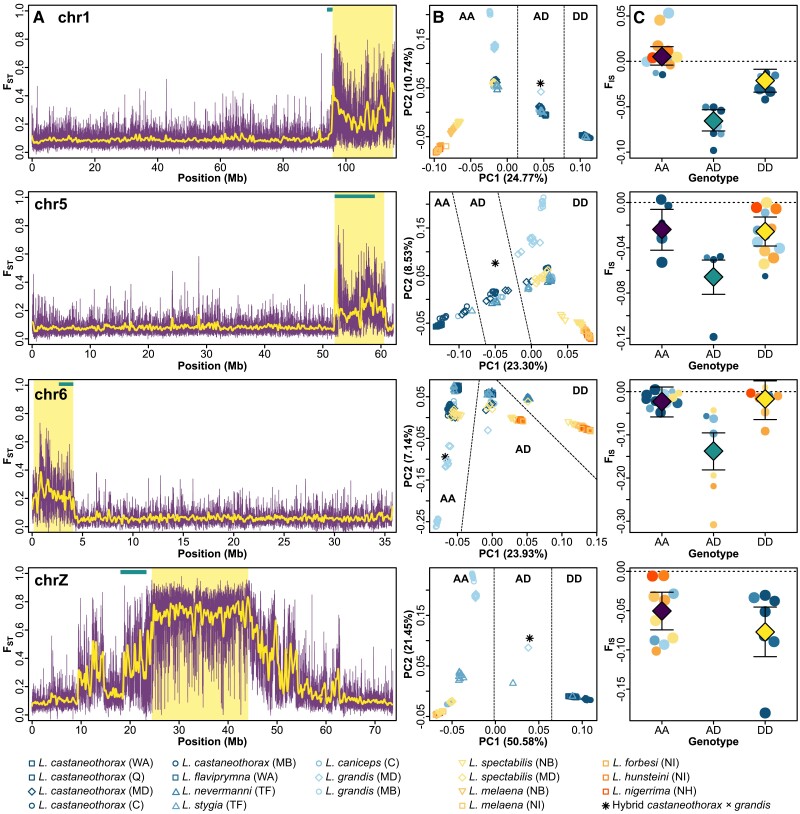
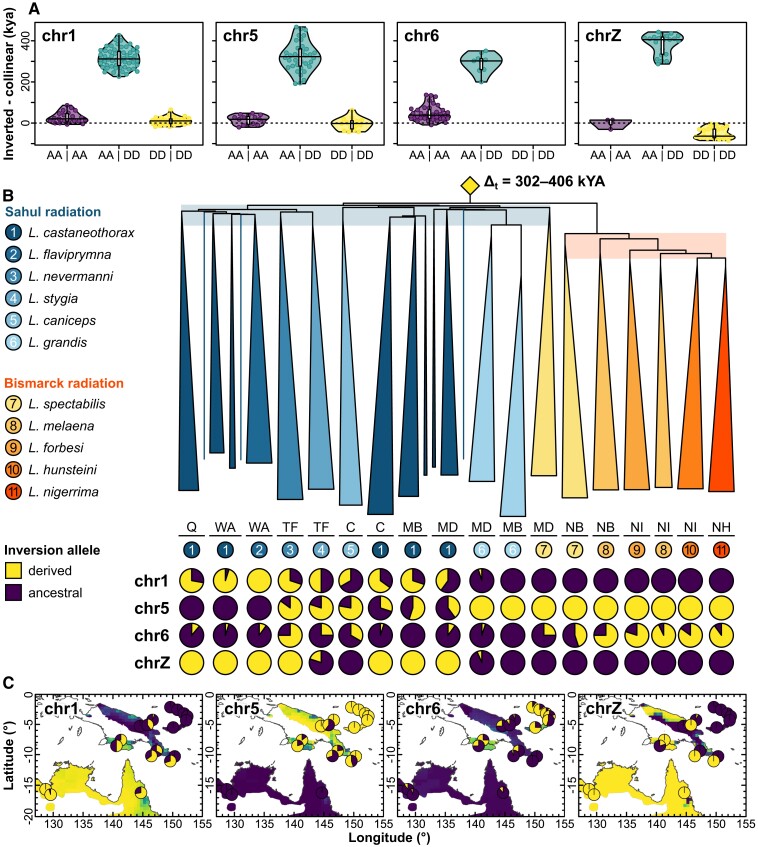
Chromosomal inversions are structural mutations that can play a prominent role in adaptation and speciation. Inversions segregating across species boundaries (trans-species inversions) are often taken as evidence for ancient balancing selection or adaptive introgression, but can also be due to incomplete lineage sorting. Using whole-genome resequencing data from 18 populations of 11 recognized munia species in the genus Lonchura (N = 176 individuals), we identify four large para- and pericentric inversions ranging in size from 4 to 20 Mb. All four inversions cosegregate across multiple species and predate the numerous speciation events associated with the rapid radiation of this clade across the prehistoric Sahul (Australia, New Guinea) and Bismarck Archipelago. Using coalescent theory, we infer that trans-specificity is improbable for neutrally segregating variation despite substantial incomplete lineage sorting characterizing this young radiation. Instead, the maintenance of all three autosomal inversions (chr1, chr5, and chr6) is best explained by selection acting along ecogeographic clines not observed for the collinear parts of the genome. In addition, the sex chromosome inversion largely aligns with species boundaries and shows signatures of repeated positive selection for both alleles. This study provides evidence for trans-species inversion polymorphisms involved in both adaptation and speciation. It further highlights the importance of informing selection inference using a null model of neutral evolution derived from the collinear part of the genome.
染色体倒位是一种结构突变,它在适应和物种形成中起着重要作用。在物种边界上分离的倒位(跨物种倒位)通常被认为是古老的平衡选择或适应性渗入的证据,但也可能是由于不完全谱系分选造成的。利用来自 11 个 Lonchura 属雀形目鸟类 18 个种群的 186 个个体的全基因组重测序数据,我们鉴定出了四个大小在 4 到 20 Mb 之间的大型臂间和近臂中心倒位。这四个倒位都在多个物种中共分离,并早于与这个分支在史前的萨胡尔(澳大利亚、新几内亚)和俾斯麦群岛的快速辐射相关的许多物种形成事件。通过使用合并理论,我们推断,尽管这个年轻的辐射具有大量的不完全谱系分选特征,但中性分离变异的跨物种特异性不太可能。相反,尽管基因组的共线性部分没有观察到生态地理渐变,但三个常染色体倒位(chr1、chr5 和 chr6)的维持可以通过选择来很好地解释,而不是通过选择来很好地解释。此外,性染色体倒位与物种边界基本一致,并显示出两个等位基因的重复正选择的特征。本研究为参与适应和物种形成的跨物种倒位多态性提供了证据。它进一步强调了使用来自基因组共线性部分的中性进化的 null 模型来告知选择推断的重要性。