Division of Pulmonary, Critical Care, Allergy and Sleep Medicine, Department of Medicine, University of California San Francisco, San Francisco, CA, USA.
Inserm CIC 1435, Dupuytren Teaching Hospital, 87000, Limoges, France.
Crit Care. 2024 May 14;28(1):164. doi: 10.1186/s13054-024-04943-x.
Hypoinflammatory and hyperinflammatory phenotypes have been identified in both Acute Respiratory Distress Syndrome (ARDS) and sepsis. Attributable mortality of ARDS in each phenotype of sepsis is yet to be determined. We aimed to estimate the population attributable fraction of death from ARDS (PAF) in hypoinflammatory and hyperinflammatory sepsis, and to determine the primary cause of death within each phenotype.
We studied 1737 patients with sepsis from two prospective cohorts. Patients were previously assigned to the hyperinflammatory or hypoinflammatory phenotype using latent class analysis. The PAF in patients with sepsis was estimated separately in the hypo and hyperinflammatory phenotypes. Organ dysfunction, severe comorbidities, and withdrawal of life support were abstracted from the medical record in a subset of patients from the EARLI cohort who died (n = 130/179). Primary cause of death was defined as the organ system that most directly contributed to death or withdrawal of life support.
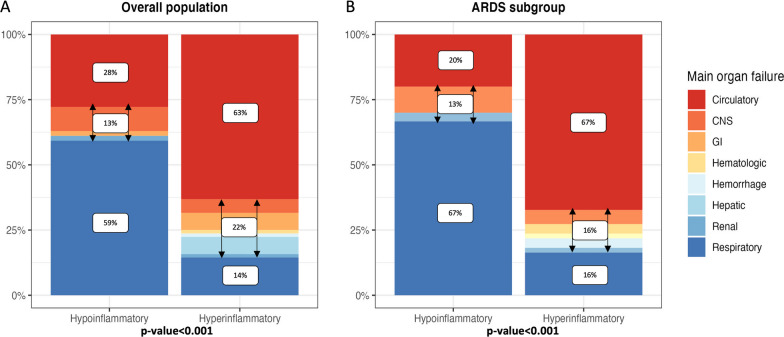
The PAF was 19% (95%CI 10,28%) in hypoinflammatory sepsis and, 14% (95%CI 6,20%) in hyperinflammatory sepsis. Cause of death differed between the two phenotypes (p < 0.001). Respiratory failure was the most common cause of death in hypoinflammatory sepsis, whereas circulatory shock was the most common cause in hyperinflammatory sepsis. Death with severe underlying comorbidities was more frequent in hypoinflammatory sepsis (81% vs. 67%, p = 0.004).
The PAF is modest in both phenotypes whereas primary cause of death among patients with sepsis differed substantially by phenotype. This study identifies challenges in powering future clinical trials to detect changes in mortality outcomes among patients with sepsis and ARDS.
在急性呼吸窘迫综合征(ARDS)和脓毒症中都已经确定了低炎症和高炎症表型。每种脓毒症表型的 ARDS 归因死亡率尚未确定。我们旨在估计低炎症和高炎症性脓毒症中 ARDS 死亡的人群归因分数(PAF),并确定每种表型的主要死亡原因。
我们研究了来自两个前瞻性队列的 1737 例脓毒症患者。使用潜在类别分析先前将患者分配到高炎症或低炎症表型。分别估计脓毒症患者中低炎症和高炎症表型的 PAF。在 EARLI 队列中死亡的患者子集(n=130/179)的病历中提取器官功能障碍、严重合并症和停止生命支持的情况。主要死亡原因定义为最直接导致死亡或停止生命支持的器官系统。
低炎症性脓毒症的 PAF 为 19%(95%CI 10,28%),高炎症性脓毒症的 PAF 为 14%(95%CI 6,20%)。两种表型的死亡原因不同(p<0.001)。呼吸衰竭是低炎症性脓毒症中最常见的死亡原因,而循环衰竭是高炎症性脓毒症中最常见的死亡原因。低炎症性脓毒症中因严重基础合并症死亡的情况更为常见(81%比 67%,p=0.004)。
两种表型的 PAF 都适中,而脓毒症患者的主要死亡原因在表型之间存在显著差异。本研究确定了在为检测脓毒症和 ARDS 患者死亡率变化而进行未来临床试验提供动力方面的挑战。