Universidade Federal da Paraíba - UFPB, Centro de Ciências da Saúde, Programa de Pós Graduação em Odontologia, João Pessoa, PB, Brasil.
Universidade Federal da Paraíba - UFPB, Centro de Ciências Exatas e da Natureza, Departamento de Biologia Molecular, João Pessoa, PB, Brasil.
Braz Oral Res. 2024 May 13;38:e042. doi: 10.1590/1807-3107bor-2024.vol38.0042. eCollection 2024.
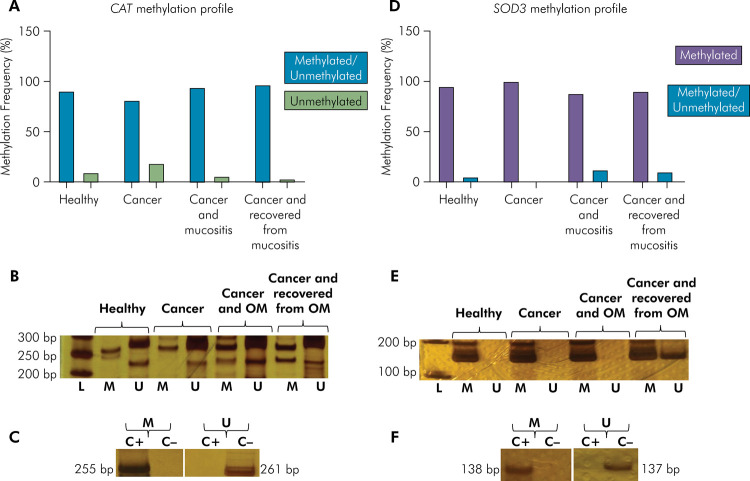
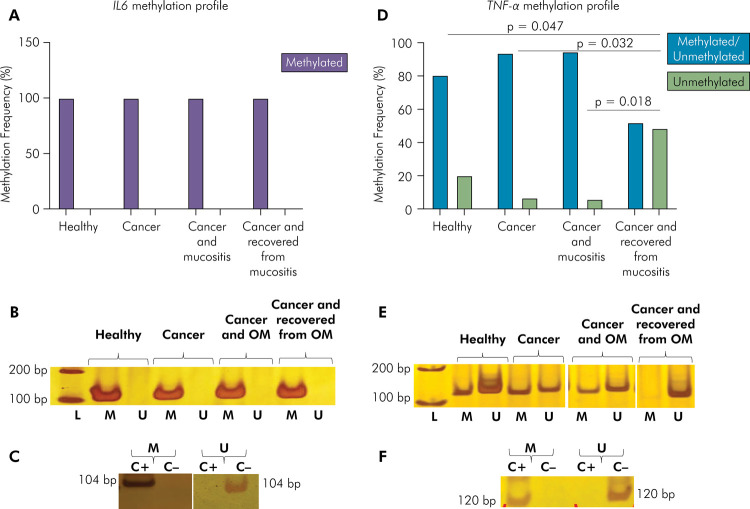
The aim of this study was to investigate the DNA methylation profile in genes encoding catalase (CAT) and superoxide dismutase (SOD3) enzymes, which are involved in oxidative stress mechanisms, and in genes encoding pro-inflammatory cytokines interleukin-6 (IL6) and tumor necrosis factor-alpha (TNF-α) in the oral mucosa of oncopediatric patients treated with methotrexate (MTX®). This was a cross-sectional observational study and the population comprised healthy dental patients (n = 21) and those with hematological malignancies (n = 64) aged between 5 and 19 years. Oral conditions were evaluated using the Oral Assessment Guide and participants were divided into 4 groups: 1- healthy individuals; 2- oncopediatric patients without mucositis; 3- oncopediatric patients with mucositis; 4- oncopediatric patients who had recovered from mucositis. Methylation of DNA from oral mucosal cells was evaluated using the Methylation-Specific PCR technique (MSP). For CAT, the partially methylated profile was the most frequent and for SOD3 and IL6, the hypermethylated profile was the most frequent, with no differences between groups. For TNF-α, the hypomethylated profile was more frequent in the group of patients who had recovered from mucositis. It was concluded that the methylation profiles of CAT, SOD3, and IL6 are common profiles for oral cells of children and adolescents and have no association with oral mucositis or exposure to chemotherapy with MTX®. Hypomethylation of TNF-α is associated with oral mucosal recovery in oncopediatric patients who developed oral mucositis during chemotherapy.
本研究旨在探讨编码过氧化氢酶 (CAT) 和超氧化物歧化酶 (SOD3) 酶的基因的 DNA 甲基化谱,这些基因参与氧化应激机制,以及编码促炎细胞因子白细胞介素-6 (IL6) 和肿瘤坏死因子-α (TNF-α) 的基因在接受甲氨蝶呤 (MTX®) 治疗的肿瘤儿科患者的口腔黏膜中的甲基化谱。这是一项横断面观察性研究,研究人群包括健康牙科患者 (n = 21) 和年龄在 5 至 19 岁之间的血液恶性肿瘤患者 (n = 64)。使用口腔评估指南评估口腔状况,参与者分为 4 组:1-健康个体;2-无黏膜炎的肿瘤儿科患者;3-有黏膜炎的肿瘤儿科患者;4-已从黏膜炎中恢复的肿瘤儿科患者。使用甲基化特异性 PCR 技术 (MSP) 评估口腔黏膜细胞的 DNA 甲基化。对于 CAT,部分甲基化谱最常见,对于 SOD3 和 IL6,高甲基化谱最常见,各组之间无差异。对于 TNF-α,在已从黏膜炎中恢复的患者组中,低甲基化谱更为常见。结论是,CAT、SOD3 和 IL6 的甲基化谱是儿童和青少年口腔细胞的常见谱,与口腔黏膜炎或暴露于 MTX®化疗无关。TNF-α 的低甲基化与接受化疗时发生口腔黏膜炎的肿瘤儿科患者的口腔黏膜恢复有关。