Morshedi Mahbobeh, Zimmermann Simon L, Klaverkamp David, Gilch Peter
Institut für Physikalische Chemie, Heinrich-Heine-Universität Düsseldorf, Universitätsstr. 1, 40225, Düsseldorf, Germany.
J Fluoresc. 2025 May;35(5):3253-3266. doi: 10.1007/s10895-024-03729-2. Epub 2024 May 15.
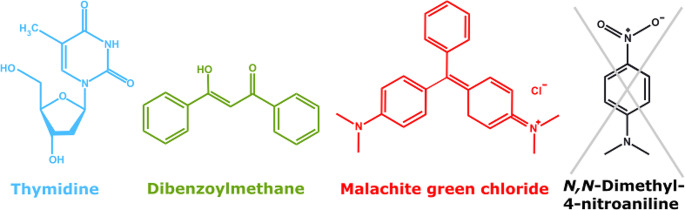
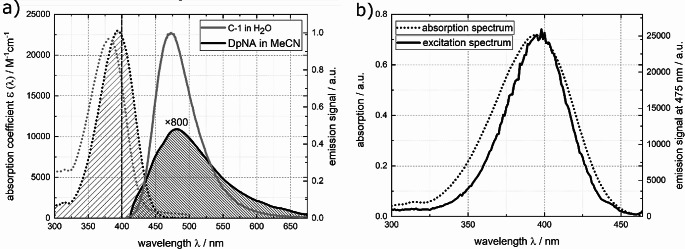
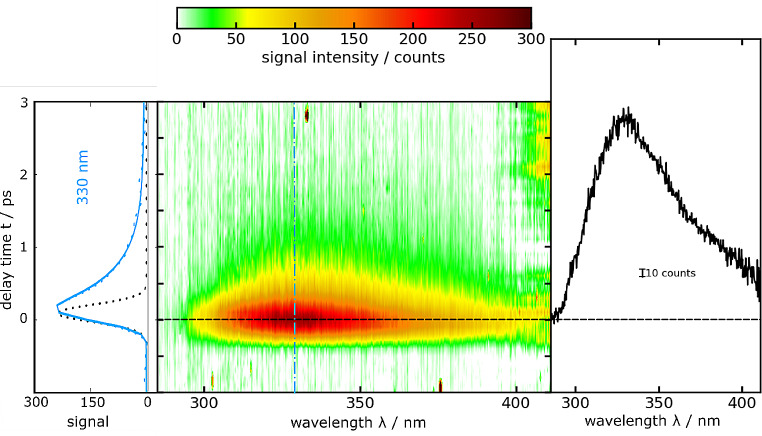
Three compounds with fluorescence quantum yields in the range of 10 to 10 and emission spectra covering the UV/Vis spectral range are suggested as new references for the determination of small fluorescence quantum yields. The compounds are thymidine (dT) in water, dibenzoylmethane (DBM) in ethanol, and malachite green chloride (MG) in water, representing the blue, green, and red regions of the spectrum, respectively. All compounds are easily handled, photostable, and commercially available. Furthermore, these compounds exhibit a mirror-image symmetry between their absorption and fluorescence spectra. This symmetry, along with closely aligned fluorescence excitation and absorption spectra, confirms that the observed emissions originate from the compounds themselves. The fluorescence quantum yields were determined via a relative approach as well as Strickler-Berg analysis in conjunction with time resolved fluorescence spectroscopy. Within the respective error margins, the two approaches yielded identical results.
三种荧光量子产率在10至10范围内且发射光谱覆盖紫外/可见光谱范围的化合物被提议作为测定小荧光量子产率的新参考物。这些化合物分别是水中的胸腺嘧啶核苷(dT)、乙醇中的二苯甲酰甲烷(DBM)和水中的孔雀石绿氯化物(MG),分别代表光谱的蓝色、绿色和红色区域。所有化合物易于处理、光稳定且可商购。此外,这些化合物在吸收光谱和荧光光谱之间呈现镜像对称。这种对称性,连同紧密对齐的荧光激发光谱和吸收光谱,证实观察到的发射源自化合物本身。荧光量子产率通过相对方法以及结合时间分辨荧光光谱的斯特里克勒 - 伯格分析来测定。在各自的误差范围内,两种方法得出相同的结果。