Department of Anesthesiology and Critical Care Medicine, Children's Hospital of Philadelphia and University of Pennsylvania, Philadelphia.
Center for Clinical Epidemiology and Biostatistics, Perelman School of Medicine, University of Pennsylvania, Philadelphia.
JAMA Netw Open. 2024 May 1;7(5):e2411375. doi: 10.1001/jamanetworkopen.2024.11375.
While disparities in consent rates for research have been reported in multiple adult and pediatric settings, limited data informing enrollment in pediatric intensive care unit (PICU) research are available. Acute care settings such as the PICU present unique challenges for study enrollment, given the highly stressful and emotional environment for caregivers and the time-sensitive nature of the studies.
To determine whether race and ethnicity, language, religion, and Social Deprivation Index (SDI) were associated with disparate approach and consent rates in PICU research.
DESIGN, SETTING, AND PARTICIPANTS: This retrospective cohort study was performed at the Children's Hospital of Philadelphia PICU between July 1, 2011, and December 31, 2021. Participants included patients eligible for studies requiring prospective consent. Data were analyzed from February 2 to July 26, 2022.
Exposures included race and ethnicity (Black, Hispanic, White, and other), language (Arabic, English, Spanish, and other), religion (Christian, Jewish, Muslim, none, and other), and SDI (composite of multiple socioeconomic indicators).
Multivariable regressions separately tested associations between the 4 exposures (race and ethnicity, language, religion, and SDI) and 3 outcomes (rates of approach among eligible patients, consent among eligible patients, and consent among those approached). The degree to which reduced rates of approach mediated the association between lower consent in Black children was also assessed.
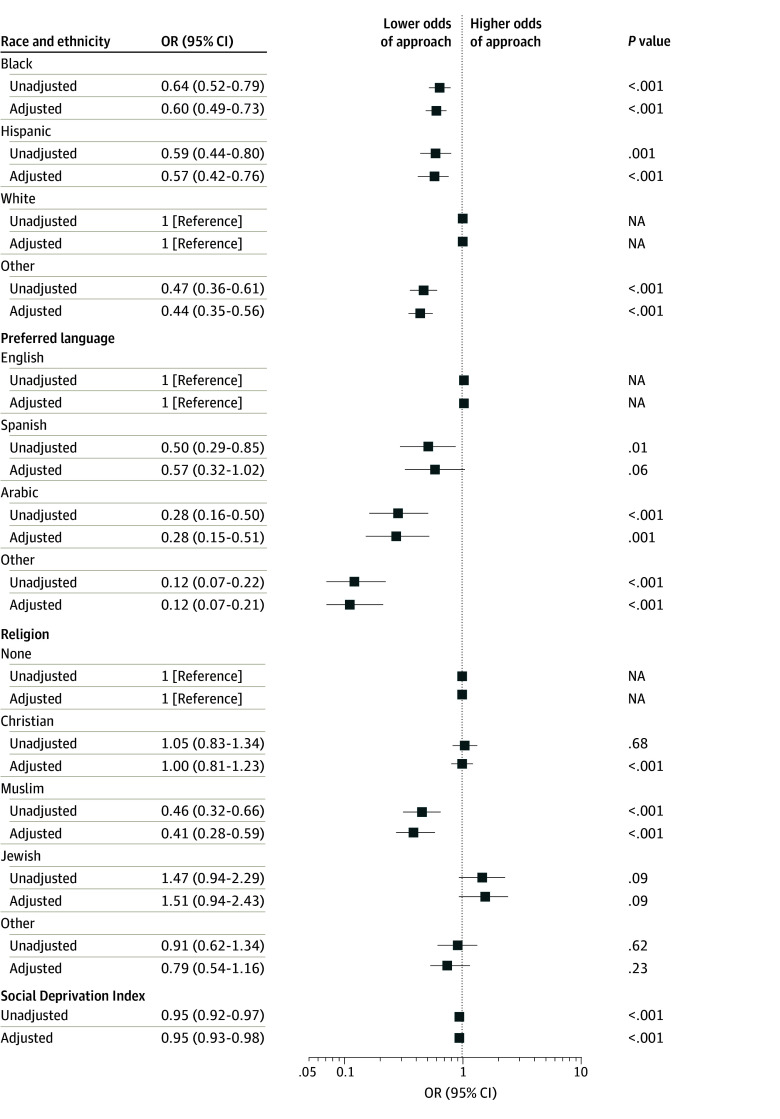
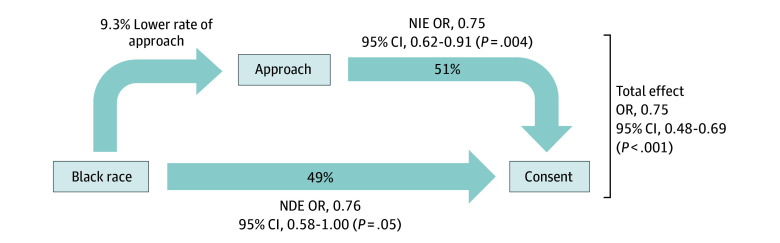
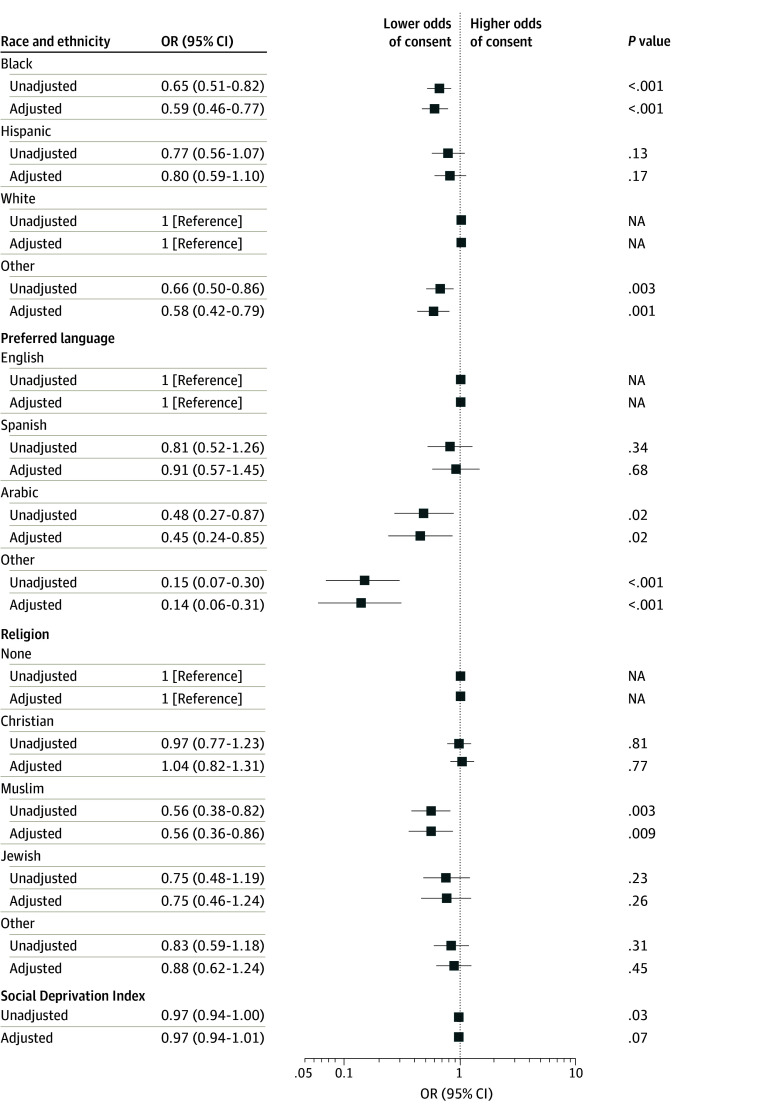
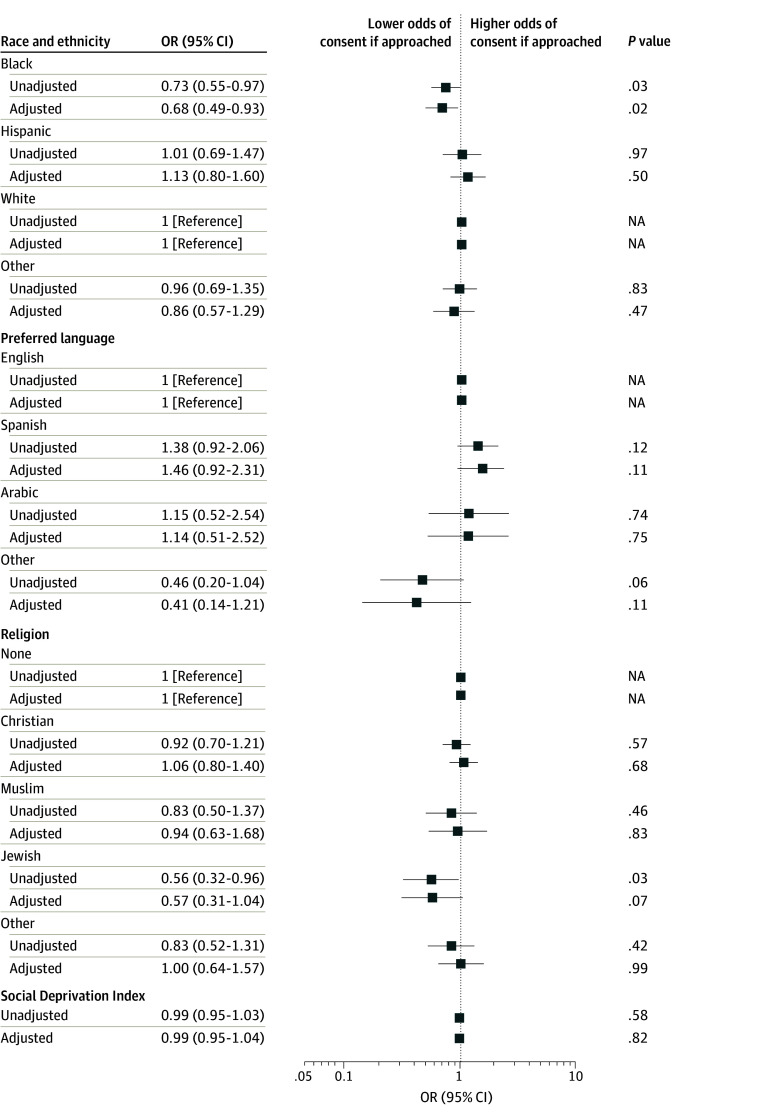
Of 3154 children included in the study (median age, 6 [IQR, 1.9-12.5] years; 1691 [53.6%] male), rates of approach and consent were lower for Black and Hispanic families and those of other races, speakers of Arabic and other languages, Muslim families, and those with worse SDI. Among children approached for research, lower consent odds persisted for those of Black race (unadjusted odds ratio [OR], 0.73 [95% CI, 0.55-0.97]; adjusted OR, 0.68 [95% CI, 0.49-0.93]) relative to White race. Mediation analysis revealed that 51.0% (95% CI, 11.8%-90.2%) of the reduced odds of consent for Black individuals was mediated by lower probability of approach.
In this cohort study of consent rates for PICU research, multiple sociodemographic factors were associated with lower rates of consent, partly attributable to disparate rates of approach. These findings suggest opportunities for reducing disparities in PICU research participation.
尽管在多个成人和儿科环境中已经报告了研究同意率的差异,但可供参考的儿科重症监护病房 (PICU) 研究入组数据有限。由于照顾者的环境高度紧张和情绪化,以及研究的时间敏感性,像 PICU 这样的急性护理环境对研究入组提出了独特的挑战。
确定种族和民族、语言、宗教和社会剥夺指数 (SDI) 是否与 PICU 研究中的不同接触和同意率相关。
设计、设置和参与者:这是一项回顾性队列研究,在费城儿童医院 PICU 进行,时间为 2011 年 7 月 1 日至 2021 年 12 月 31 日。参与者包括符合需要前瞻性同意的研究标准的患者。数据分析于 2022 年 2 月 2 日至 7 月 26 日进行。
暴露因素包括种族和民族(黑人、西班牙裔、白人及其他)、语言(阿拉伯语、英语、西班牙语及其他)、宗教(基督教、犹太教、伊斯兰教、无宗教信仰及其他)和 SDI(多种社会经济指标的综合)。
多元回归分别检验了 4 个暴露因素(种族和民族、语言、宗教和 SDI)与 3 个结果(合格患者中的接触率、合格患者中的同意率和已接触患者中的同意率)之间的关联。还评估了降低接触率的程度在多大程度上减轻了黑人儿童同意率较低的关联。
在这项研究中,共有 3154 名儿童(中位数年龄为 6 岁[IQR,1.9-12.5];1691 名男性[53.6%]),黑人及西班牙裔家庭和其他种族、讲阿拉伯语和其他语言、穆斯林家庭以及 SDI 较差的家庭,其接触和同意的比例较低。在接受研究接触的儿童中,黑人种族的儿童的同意率仍然较低(未经调整的优势比[OR],0.73[95%CI,0.55-0.97];调整后的 OR,0.68[95%CI,0.49-0.93]),而白人种族的儿童则较低。中介分析显示,黑人个体同意率降低的 51.0%(95%CI,11.8%-90.2%)可归因于接触率较低。
在这项关于 PICU 研究同意率的队列研究中,多个社会人口因素与较低的同意率相关,部分原因是接触率存在差异。这些发现表明,有机会减少 PICU 研究参与方面的差异。