
一种基于密度图的麦穗计数方法。
A density map-based method for counting wheat ears.
作者信息
Zhang Guangwei, Wang Zhichao, Liu Bo, Gu Limin, Zhen Wenchao, Yao Wei
机构信息
College of Information Science and Technology, Hebei Agricultural University, Baoding, China.
Hebei Key Laboratory of Agricultural Big Data, Hebei Agricultural University, Baoding, China.
出版信息
Front Plant Sci. 2024 May 1;15:1354428. doi: 10.3389/fpls.2024.1354428. eCollection 2024.
INTRODUCTION
Field wheat ear counting is an important step in wheat yield estimation, and how to solve the problem of rapid and effective wheat ear counting in a field environment to ensure the stability of food supply and provide more reliable data support for agricultural management and policy making is a key concern in the current agricultural field.
METHODS
There are still some bottlenecks and challenges in solving the dense wheat counting problem with the currently available methods. To address these issues, we propose a new method based on the YOLACT framework that aims to improve the accuracy and efficiency of dense wheat counting. Replacing the pooling layer in the CBAM module with a GeM pooling layer, and then introducing the density map into the FPN, these improvements together make our method better able to cope with the challenges in dense scenarios.
RESULTS
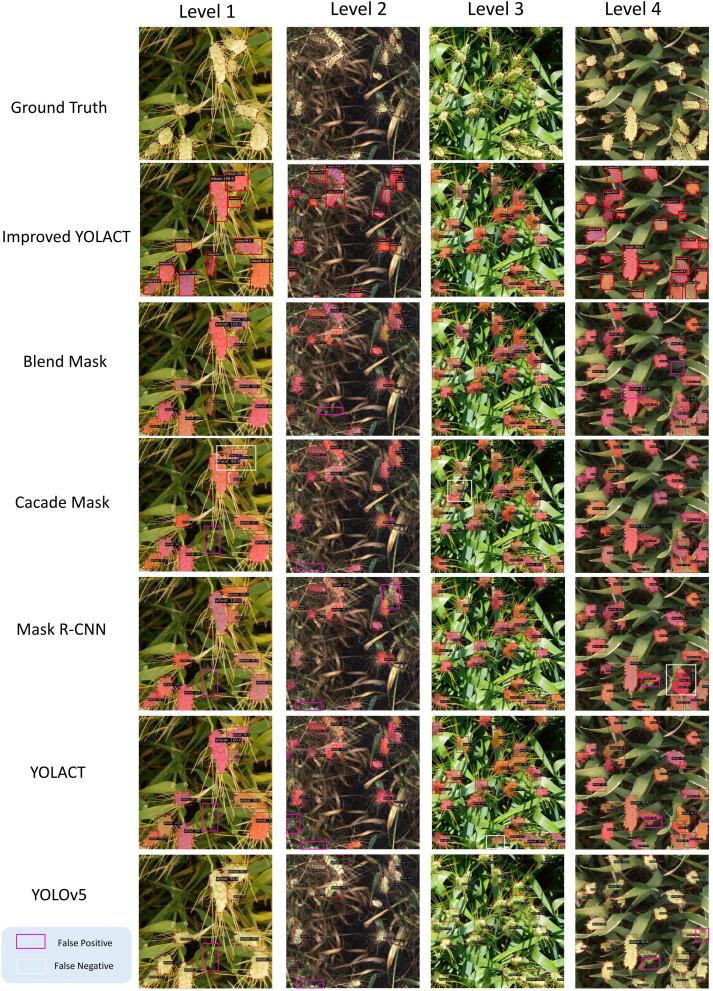
Experiments show our model improves wheat ear counting performance in complex backgrounds. The improved attention mechanism reduces the RMSE from 1.75 to 1.57. Based on the improved CBAM, the R2 increases from 0.9615 to 0.9798 through pixel-level density estimation, the density map mechanism accurately discerns overlapping count targets, which can provide more granular information.
DISCUSSION
The findings demonstrate the practical potential of our framework for intelligent agriculture applications.
引言
田间麦穗计数是小麦产量估算的重要环节,如何在田间环境中解决快速有效的麦穗计数问题,以保障粮食供应稳定,并为农业管理和政策制定提供更可靠的数据支持,是当前农业领域的关键关注点。
方法
利用现有方法解决密集小麦计数问题仍存在一些瓶颈和挑战。为解决这些问题,我们提出一种基于YOLACT框架的新方法,旨在提高密集小麦计数的准确性和效率。用广义均值池化层(GeM pooling layer)替换CBAM模块中的池化层,然后将密度图引入特征金字塔网络(FPN)中,这些改进共同使我们的方法更能应对密集场景中的挑战。
结果
实验表明我们提出的模型在复杂背景下提高了麦穗计数性能。改进后的注意力机制将均方根误差从1.75降至1.57。基于改进后的CBAM模块,并通过像素级密度估计,R2从0.9615提高到0.9798,密度图机制能够准确识别重叠计数目标,可提供更精细的信息。
讨论
研究结果证明了我们提出的框架在智能农业应用中的实际潜力


 Zotero 插件